
Technology·News & analysis
AMD's 256-core Zen 6 server chip ships, and early tests show big gains
AMD's EPYC 9006 'Venice' server processors are on sale from today. Independent tests of the 256-core flagship show up to 93% more throughput than the last generation.

Tide
Ripple
Sci-fi
5/10
Reality
Shipping
A thousand tiny workers sharing one very large desk.How we rate
AMD's 6th-generation EPYC 9006 'Venice' server processors, the first built on the Zen 6 design, went on sale on 10 November, topped by a 256-core chip priced at $14,904.
In independent tests, a two-chip server with that flagship scored 93% higher than the previous generation's best. AMD says it also beats Nvidia's Vera chip per core. Cheaper eight-channel versions follow in the first half of 2027.
What to know
- AMD's EPYC 9006 'Venice' server processors, the first chips built on the Zen 6 design, went on sale on 10 November with systems shipping from partners.
- The flagship EPYC 9996 has 256 cores and costs $14,904; a two-chip server delivers 1,024 threads and scored 93% higher than the previous 192-core flagship in one industry test.
- AMD claims 1.2 times the per-core speed of an Nvidia Vera-based system, and says the 96-core 9686F is its closest rival to Vera.
- AMD's own numbers come from its testing; independent results so far come from reviewers AMD supplied with hardware.
AMD's new Zen 6 server chips are on sale today, and the biggest one has 256 cores. That's the news. Now the fun part: what does anyone do with a thousand threads?
The chips are the EPYC 9006 series, code-named "Venice". They are the first processors to use AMD's Zen 6 design. Servers built around them started shipping from partners on 10 November, after AMD showed the range in July.
What is Venice, exactly?
Venice is a family of processors for data centers. These are the chips inside the big computers that run websites, databases and AI services.
A processor core is one worker that follows instructions. A thread is a lane of work that a core can juggle. More cores and threads mean more jobs at once.
AMD sells two flavors of the Zen 6 core:
- Zen 6: the full-speed version, up to 96 cores per chip, boosting up to 5 GHz.
- Zen 6c: a smaller version that runs slower but packs in far more cores, up to 256 per chip.
Both use the same core design. The "c" version is just trimmed to take up less space and use less power.
How big is the flagship?
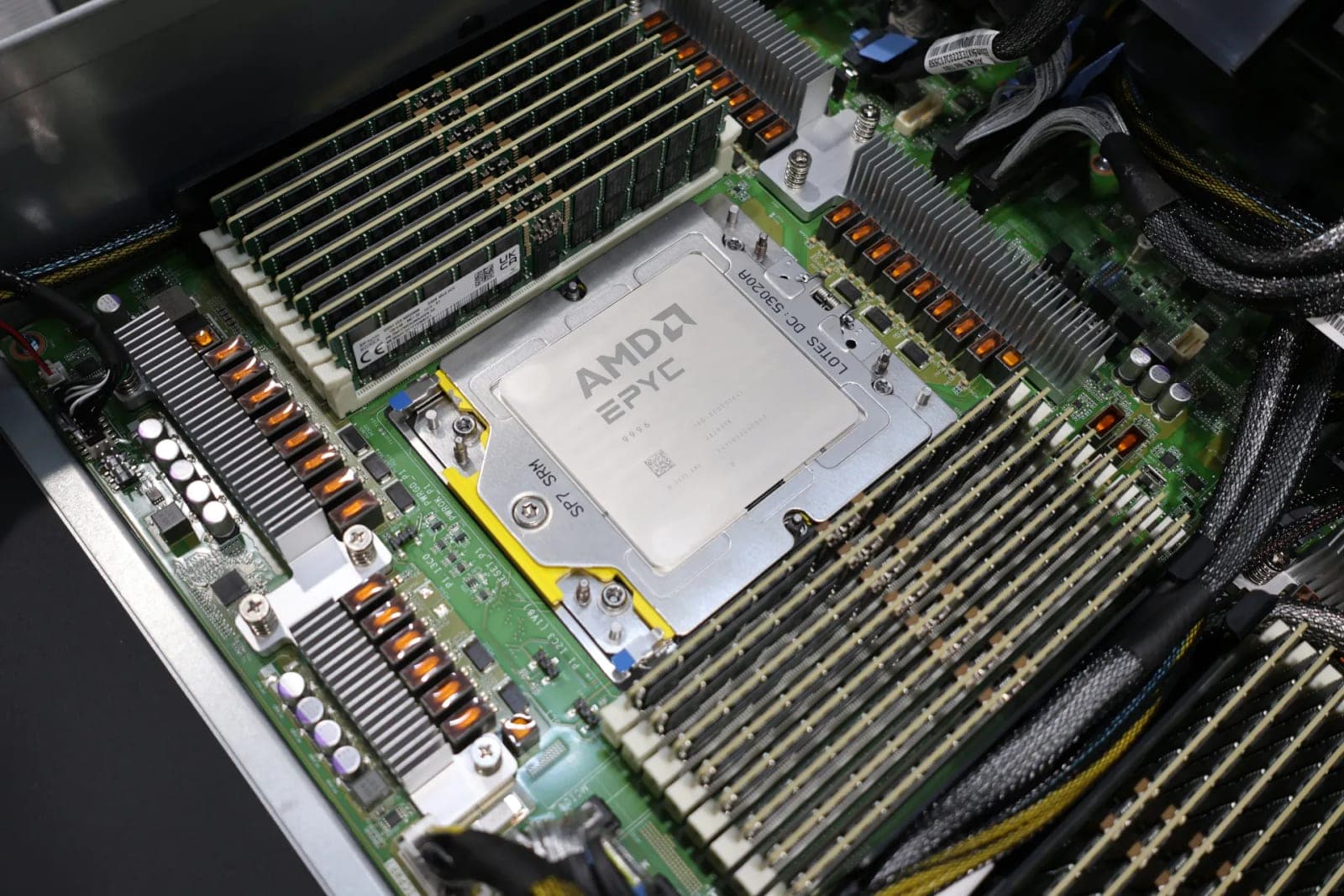
The top chip is the EPYC 9996. It has 256 Zen 6c cores, a 2.55 GHz base speed and a 4.1 GHz boost speed. It also carries 1,024 MB of cache, a small pool of very fast memory right on the chip.
Its default power rating is 600 watts, and it can be set as low as 400 watts. AMD lists the price at $14,904 per chip when bought in batches of 1,000.
Servers can hold two chips. A two-chip machine tested by reviewers had 512 cores and 1,024 threads in total.
In real life Picture a restaurant kitchen. Older chips were a kitchen with 192 cooks. The 9996 is the same kitchen with 256 cooks, a bigger pantry and faster doors between the rooms.
What changed inside?
Zen 6 is built on TSMC's N2P process, the manufacturer's newest widely used way of making chips. At this scale, parts are only a few billionths of a meter wide. The process promises 18% more speed at the same power, or 36% less power at the same speed, compared with the one used for Zen 5's cores.
AMD says the design gets about 27% more work per tick of the clock than Zen 5, in enterprise, cloud and AI jobs. That number is not a promise for every program, and AMD measured it against a 16-core Zen 6c setup.
Other upgrades:
- Bigger building blocks: one block of cores can now hold 12 full cores or 32 smaller ones, up from 8 and 16.
- More cache: each small-core block carries 128 MB, four times the older design.
- Two I/O chips: the part that talks to memory and add-on cards is now split in two, which allows 16 memory channels per socket.
- Faster memory: up to 12,800 MT/s with special memory modules, and up to 1.6 TB per second of bandwidth per socket, AMD says.
- PCIe 6.0: the newest generation of the connection used by graphics cards and fast storage, at up to 64 Gbps per lane.
The catch: the extra memory channels come with a trade. The SP7 socket gets 96 PCIe 6.0 lanes, while the smaller SP8 socket offers 128.
Is it really 93% faster?
Reviewers who got early hardware from AMD have now published results. In one industry test of throughput, a two-chip EPYC 9996 server scored 93% higher than a two-chip server with the previous 192-core flagship, the EPYC 9965.
Throughput means how much total work a machine finishes in a given time. It is the number that matters when a server handles thousands of requests at once.
AMD adds its own claims from its testing:
- Versus the last generation: about 2 times the integer compute, 2.4 times the floating-point compute and 2.7 times the memory bandwidth.
- Versus Intel: the 9996 delivers 1.8 to 3.13 times the speed of Intel's 128-core Xeon 6980P on molecular dynamics, materials modeling and weather forecasting.
- Web and databases: gains of 2.4 to 3.7 times across server-side Java, OpenSSL, MongoDB, Redis, NGINX and transaction processing.
AMD says the flagship delivers 2.24 times the platform-level performance of a Nvidia Vera system and 1.2 times its per-core performance.
Vendor claims deserve a grain of salt. Testers noted that Venice often leads, though Intel's next chip, Diamond Rapids, is due next year and should tighten the race.
What about Nvidia's Vera?
Nvidia's Vera is a different kind of chip: an Arm-based processor with 88 cores, built for AI servers. AMD's closer rival to it is the EPYC 9686F, a 96-core Zen 6 part tuned for high clock speeds, up to 5 GHz.
Reviewers found the 9686F beats Vera in many tests, and shines in scientific computing. Vera still holds its own in a few spots, so the answer depends on the job.
AMD pitches Venice as a chip for agentic AI. An AI agent is a program that plans a task, calls tools and checks its work, instead of just answering one question. Each step runs code, searches data and moves files, and that work lands on regular processors, not graphics chips.
Which tricks do the new chips add?
AMD added three features to make big server fleets easier to run:
- UPP (Unified Power Provisioning): shares the power budget across the whole machine. AMD says a rack that held 16 servers can hold 18 in the same power limit.
- UBPS (Utilization Based Power Scaling): adjusts power as the workload rises and falls.
- FAST (Frequency Adaptive Spectrum Technology): lets one chip run two speed tiers. In AMD's example, 32 cores of a 96-core chip run as a "premium" group up to 5 GHz, while the other 64 run as a slower "batch" group at about 2 GHz.
There is also MEXT, which AMD acquired this year. It lets a server use flash storage as extra memory, by moving rarely used pages out and guessing which ones come back. AMD says an app kept 95% of its speed with only 50% of the usual memory, and 80% with 25%. That claim is AMD's own, from internal use on 145 servers.
What's next for the range?
The SP7 chips are the first wave. The 31-chip lineup runs from about $700 to $14,904. Nine parts use the SP7 socket and 22 use the smaller SP8 socket.
SP8 machines, with 8 memory channels and more PCIe lanes per slot, arrive in the first half of 2027. A cache-heavy EPYC 9006X and a low-power Verano line follow in the second half of 2027. AMD's consumer Zen 6 chips, code-named Olympic Ridge, are also expected next year.
If you follow AMD, this lands after its purchase of World Labs, covered in our earlier story, and its push into local AI hardware, like the Gorgon Halo mini-PC.
What it means for you
- You can't buy it: Venice is for data centers. Your PC doesn't change.
- Cloud services could benefit: AMD says more servers fit in the same power budget, which is the kind of saving data centers look for.
- AI services get roomier: the busywork around chatbots runs on chips like these.
- Watch the independent tests: AMD's biggest numbers are its own. More reviews are coming.
The bottom line
AMD's Zen 6 server chips are real, shipping and fast in early independent tests. The flagship packs 256 cores and costs $14,904.
Whether it beats Nvidia's Vera depends on the job. The next test is how Intel answers next year.
Key facts
- Flagship
- EPYC 9996: 256 Zen 6c cores, 512 threads
- Price (flagship)
- $14,904 per chip
- Memory
- 16 channels, up to 8 TB per socket
- Connectivity
- Up to 96 PCIe 6.0 lanes (SP7)
- Availability
- SP7 now; SP8 in H1 2027
Got questions?
Quick answers, plain wordsWhat is AMD EPYC Venice?
Venice is the code name for AMD's 6th-generation EPYC 9006 server processors, the first chips built on the Zen 6 design. They are made for data centers, not for home computers.
How many cores does the biggest Venice chip have?
The EPYC 9996 has 256 cores and 512 threads. A server with two of them has 512 cores and 1,024 threads.
How much does the EPYC 9996 cost?
AMD lists it at $14,904 per chip when bought in batches of 1,000. The whole range has 31 chips, from about $700 up to $14,904.
Can I buy a Venice chip for my gaming PC?
No. Venice is a server chip. AMD's consumer Zen 6 chips, code-named Olympic Ridge, are expected next year.
Is Venice faster than Nvidia's Vera?
AMD says its 256-core chip delivers 1.2 times the per-core performance of a Vera-based system in one integer test, and 2.24 times at the platform level. Those are AMD's own numbers, and the two chips are built very differently.
What is the difference between Zen 6 and Zen 6c?
They use the same core design. Zen 6c is a smaller version that runs at lower speeds, so AMD can fit many more of them on one chip.
What is the SP7 socket?
SP7 is the physical slot the chip sits in. It supports 16 memory channels and 96 PCIe 6.0 lanes. A smaller SP8 version has 8 memory channels and arrives in the first half of 2027.
What is MEXT?
MEXT is a technology AMD bought this year that uses flash storage to stretch a server's memory. AMD says an app kept 95% of its speed with only half the usual memory.
When is the next Venice version coming?
AMD says a version with extra cache and a low-power version called Verano are due in the second half of 2027.
SourcesAMD
Go deeper
Related stories
AMD confirms a Radeon driver bug that keeps writing to your SSD
A small background service in AMD's Radeon software can write to your system drive nonstop, even when the PC is idle. AMD says a fix is coming in Adrenalin 26.11.1.
NVIDIA lets Korean AI chips plug into its systems with Rebellions and SK Telecom
Rebellions will connect its Rebel R200 chips to NVIDIA's platform, and SK Telecom plans to run the racks in its Korean data center.
Samsung will build Nvidia's custom memory base dies at TSMC, report says
Nvidia asked all three of its memory suppliers to make the bottom layer of its new NVHBM chips on TSMC's 3nm process, and Samsung said yes.
More in brief
- FAA lifts a nationwide ground stop after a communications outageNov 14
- Tesla opens Cybercab orders at $29,990, plus $299 a month to drive itNov 14
- Apple Sports adds UFC with live stats for every fight on the cardNov 13
- LangChain raises $300 million at a $3 billion valuation for AI agentsNov 13
- SignDrop, a new Windows zero-day, gives attackers full System rightsNov 13
- Microsoft's AI Frontiers research group is over, says co-founder John LangfordNov 13