
Technology·News & analysis
NVIDIA lets Korean AI chips plug into its systems with Rebellions and SK Telecom
Rebellions will connect its Rebel R200 chips to NVIDIA's platform, and SK Telecom plans to run the racks in its Korean data center.

Tide
Ripple
Sci-fi
5/10
Reality
Demo
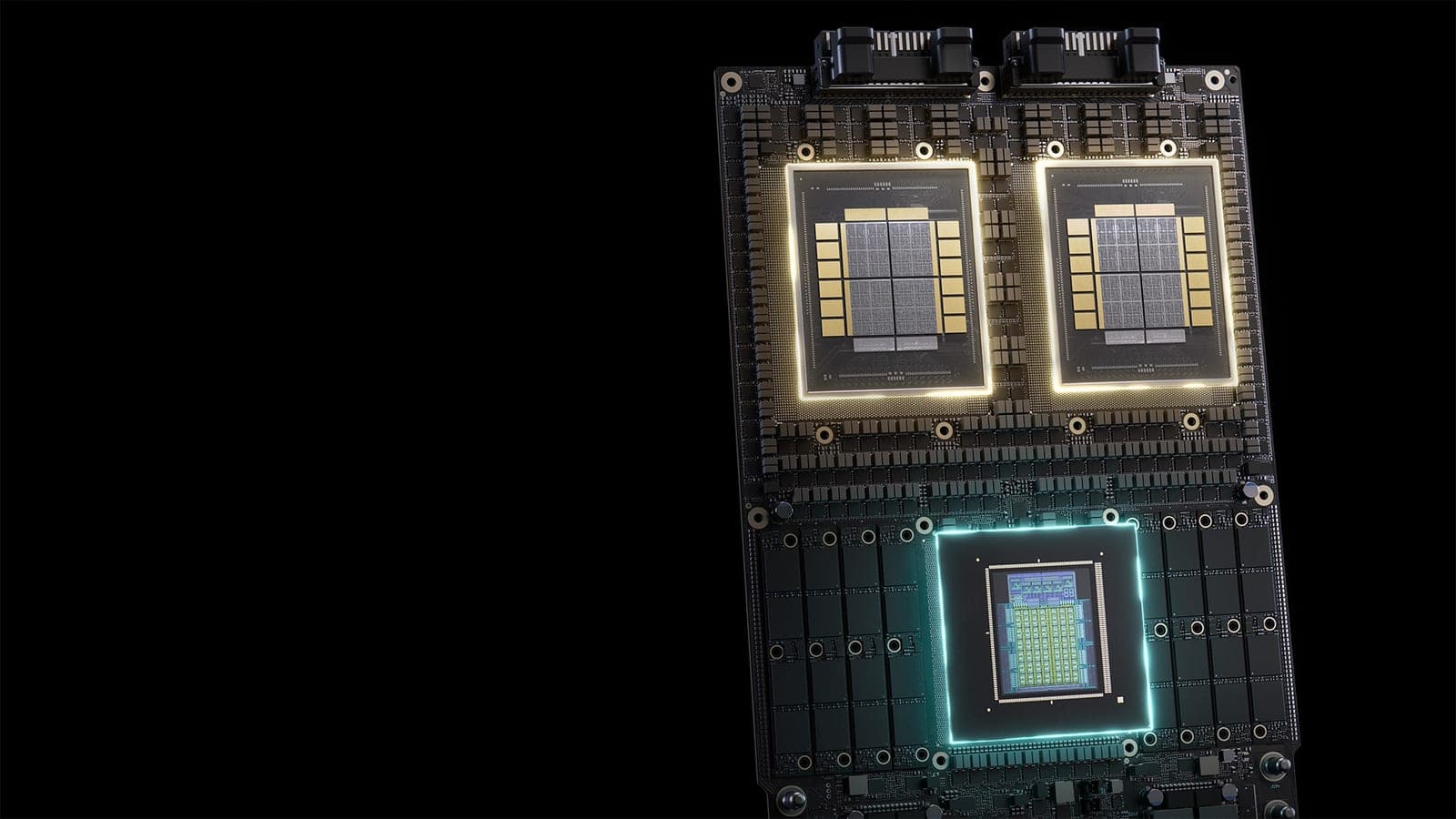
Two chip families sharing one very fast hallway.How we rate
NVIDIA, Rebellions and SK Telecom announced that Rebellions will connect its Rebel R200 AI chips to NVIDIA's platform through NVLink Fusion, with SK Telecom planning to deploy the racks in its Korean data center.
NVIDIA GPUs would handle the first stage of an AI answer, and Rebellions chips the second. Korea's science ministry backs the plan. No launch date or chip count was given.
What to know
- Rebellions will use NVIDIA NVLink Fusion to connect its Rebel R200 neural processing units (NPUs) to NVIDIA's platform.
- SK Telecom plans to deploy the resulting racks in its AI data center, including for Korea's "AI for All" project.
- The companies plan to use NVIDIA GPUs for the first stage of an AI answer and Rebellions chips for the second.
- Korea's Ministry of Science and ICT backs the work, and says it will start with Rebellions and SK Telecom.
NVIDIA announced on Monday that Korean chip startup Rebellions will connect its next AI chip to NVIDIA's platform. SK Telecom plans to run the result in its own data center.
That is the news. Now the fun question: why would the biggest AI chip company invite a smaller chipmaker into its house?
Who is involved?
Three companies signed on, and the Korean government is behind them.
- NVIDIA: the US company whose graphics chips (GPUs) power most of the world's AI.
- Rebellions: a South Korean company that designs AI chips. It was founded in 2020.
- SK Telecom: one of Korea's biggest phone and network companies. It also runs AI data centers and builds its own AI models.
- Korea's Ministry of Science and ICT (MSIT): the government body that supports the work.
The government says it will start by backing NVIDIA's work with Korean chip companies through Rebellions and SK Telecom. The plan lays the groundwork for other Korean chip firms to explore joining NVIDIA's network later.
What is NVLink Fusion?
Think of a data center as a very busy office building. The chips are the workers, and they constantly pass notes to each other. NVLink is NVIDIA's own high-speed hallway for those notes.
NVLink Fusion opens that hallway to chips NVIDIA did not make. A company can design its own chip, then plug it into NVIDIA's networking and rack designs.
NVIDIA also offers a rack blueprint called MGX. It standardizes things like the size of the rack, how power reaches the chips and how they are cooled. Rebellions will use it to build its systems, which gives it access to an established chain of parts suppliers.
In real life It is like a phone maker using the standard USB-C port. The maker does not have to invent a new plug, and your cable still fits.
What will Rebellions build?
Rebellions will connect its Rebel R200 to the NVIDIA platform. The R200 is a neural processing unit, or NPU. An NPU is a chip built specifically for AI math.
The company designs it for inference. Inference means running an AI model to get an answer, like when a chatbot replies to you. It is different from training, which is the long process of teaching the model.
Rebellions says the R200 is built for low-latency (fast to respond) and energy-efficient inference. It is aimed at very large models, including multitrillion-parameter mixture-of-experts models. A mixture-of-experts model splits its work among many smaller specialist parts, so it does not use the whole model for every word.
By the numbers: Rebellions closed a $400 million round in March 2026 at a valuation of about $2.34 billion. Its total funding is about $850 million, and it was the first investment of the Korea National Growth Fund, a government-backed fund.
What is SK Telecom's role?
SK Telecom brings the building and the customers. It plans to deploy the systems in its AI data center, drawing on its experience running such sites. It also has its own AI models, including one called A.X K2.
The company says it wants "full-stack sovereign AI". Full-stack means every layer, from the chips up to the services people use. Sovereign AI means a country builds and runs its own AI, so it depends less on other nations.
The systems are also meant to serve the government's "AI for All" project. NVIDIA says that project involves three selected consortia (groups of companies) and four leading Korean builders of foundation models, which are the big general-purpose AI models other products are built on.
SK Telecom and NVIDIA already work together. In June 2026 SK Telecom said it plans a gigawatt-scale AI cloud in Korea on NVIDIA's DSX platform, with the first AI factory due in 2027.
How will the two kinds of chips split the work?
This is the most interesting technical detail. The companies plan to use what is called disaggregated inference. That means splitting one AI answer into stages and giving each stage to the chip best suited for it.
- Prefill: the first stage, where the AI reads your question. NVIDIA GPUs would do this.
- Decode: the second stage, where the AI writes the answer a piece at a time. Rebellions NPUs would do this.
The aim is better throughput (more answers per second) and better power efficiency. It is a plan, so there are no test results yet.
The catch: the announcement gives no launch date, no number of chips and no price. Words like "plans" and "aims" appear throughout.
Is Rebellions only betting on NVIDIA?
No, and that is part of the story. In April 2026, Rebellions, SK Telecom and Arm signed an agreement to build servers outside the NVIDIA ecosystem. That system pairs an Arm processor with Rebellions' RebelCard, which is built around the Rebel100 chip. SK Telecom planned to test it with its A.X K1 model.
So SK Telecom is working both sides. It is building with NVIDIA, and it is helping a homegrown alternative. For a company buying AI infrastructure, having a second option is a form of insurance.
For NVIDIA, the deal has its own logic. If Korea's chip makers are going to build custom chips anyway, NVLink Fusion lets those chips live inside NVIDIA's systems. NVIDIA stays at the center of the rack even when the chip in it is not its own.
What did the leaders say?
Jensen Huang, NVIDIA's founder and CEO, said Korea has "the talent, technology and industrial ambition to become a world leader in AI." He said NVLink Fusion lets Korea's chipmakers connect their custom chips to NVIDIA's AI factory platform.
Sunghyun Park, Rebellions' cofounder and CEO, called it "a turning point". He said Rebellions aims to establish Korean technology as a core pillar powering AI worldwide.
Jung Jai-hun, SK Telecom's president and CEO, said the deal validates next-generation sovereign AI infrastructure that combines global technology with Korean AI chips.
Bae Kyung-hoon, Korea's Deputy Prime Minister and science minister, said it lets Korean-developed NPUs enter the computing infrastructure market alongside NVIDIA.
What else did NVIDIA announce for Korea?
The chip deal is one part of a bigger set of announcements the same day. NVIDIA says it is expanding its collaboration with the science ministry in several areas.
- Skills: training and certification programs, hackathons and technical seminars to help Korean teams get more out of GPUs.
- Open models: NVIDIA released deployment recipes for Korean open models, including SK Telecom's A.X K2 and LG AI Research's K-EXAONE 2.0. Open models are ones developers can download and run themselves. NVIDIA says the recipes deliver up to 2x performance on its B200 GPUs.
- Security: Hyundai Motor Group is exploring NVIDIA's OpenShell, a secure runtime that keeps AI agents (programs that act on their own to finish tasks) inside a sandbox with rules about what data they can touch.
- Industry: Samsung, Kakao Mobility and LG Electronics each announced physical AI work with NVIDIA. Physical AI, which means AI that controls machines in the real world, shows up as chip design simulation and a level 4 self-driving system in Seoul.
What it means for you
- Not a product yet: nothing here can be bought today. It is a plan between companies and a government.
- More choice later: if the plan works, AI services in Korea could run on more varied and possibly more efficient hardware.
- Watch the power bill: AI data centers use huge amounts of electricity, so chips that answer questions with less power matter to everyone.
- Chip makers beyond NVIDIA: the idea that rival chips can live inside NVIDIA's systems could spread to other countries.
The bottom line
NVIDIA, Rebellions and SK Telecom want a Korean AI chip to work inside NVIDIA's systems, with the Korean government cheering them on. NVIDIA keeps its platform at the center, and Korea gets a way to put its own chips into a real data center.
It is still a plan, with no date, no chip count and no test results. The next thing to watch is the first rack that actually runs a Korean model on both kinds of chips.
Key facts
- Companies
- NVIDIA, Rebellions, SK Telecom
- Technology
- NVIDIA NVLink Fusion and MGX racks
- Chip
- Rebellions Rebel R200 NPU
- Backed by
- Korea's Ministry of Science and ICT
- Timeline
- Not announced
Got questions?
Quick answers, plain wordsWhat did NVIDIA, Rebellions and SK Telecom announce?
They announced a collaboration to build sovereign AI infrastructure for Korea. Rebellions will connect its Rebel R200 chips to NVIDIA's platform with NVLink Fusion, and SK Telecom plans to deploy the systems in its AI data center.
What is NVLink Fusion?
NVLink Fusion is a way for other companies' custom chips to connect to NVIDIA's high-speed networking and rack systems. It lets a chipmaker pair its own processor with NVIDIA hardware instead of building the whole system alone.
What is Rebellions?
Rebellions is a South Korean company that designs AI chips built for inference, which means running AI models to get answers. It was founded in 2020 and raised a $400 million pre-IPO round in March 2026.
What is an NPU?
An NPU, or neural processing unit, is a chip built for AI work. It does the math AI models need, and it is usually designed to use less power than a general-purpose chip.
What is sovereign AI?
Sovereign AI means a country builds and runs its own AI, including the chips, data centers and models, so it depends less on other countries. Korea says it wants AI tuned to its own language and industries.
What does prefill and decode mean?
Prefill is the first stage, where the AI reads your question. Decode is the second, where it writes the answer one piece at a time. The companies plan to use NVIDIA GPUs for prefill and Rebellions chips for decode.
Is this available to buy now?
No. The companies describe a plan. They gave no launch date, no chip count and no price.
What is the AI for All project?
It is a Korean government initiative that NVIDIA says involves three selected consortia and four leading Korean foundation model builders. The aim is public-facing AI services built on Korean models.
Why would NVIDIA open its platform to a rival chip?
NVIDIA says NVLink Fusion extends its platform to custom chips. Chipmakers get NVIDIA's networking and rack designs, and NVIDIA keeps its systems at the center of the data center.
Does this change anything for regular users?
Not directly or soon. If the plan works, Korean AI services could run on cheaper or more power-efficient hardware, but the announcement makes no promise about prices or products.
SourcesNVIDIA
Topics and tagsNVIDIA, AI chips, Data centers, nvidia
Go deeper
- ExplainerWhat is a semiconductor chip?A semiconductor is a material, usually silicon, that can either conduct or block electricity. Chips pack billions of...
- ExplainerWhat is an AI data center?An AI data center is a huge building full of specialized computers, mostly GPUs, that train AI models and answer...
Related stories
Samsung will build Nvidia's custom memory base dies at TSMC, report says
Nvidia asked all three of its memory suppliers to make the bottom layer of its new NVHBM chips on TSMC's 3nm process, and Samsung said yes.
Microsoft's Surface Laptop Ultra opens for preorder at $2,599, built to run AI on the laptop itself
Microsoft and NVIDIA opened preorders for the Surface Laptop Ultra and a $5,999 Surface RTX Spark Dev Box, two Windows machines built around local AI.

Nvidia ends the base Shield TV and raises the Shield TV Pro to $299
Nvidia has stopped making the standard Shield TV and raised the Pro's price by $100, blaming industry-wide increases in the cost of memory and other parts.
More in brief
- YouTube is going back on the Billboard charts in 2027Nov 9
- Apple starts selling $50 packs for extra Apple Intelligence useNov 9
- Windows 11 tests a way to switch off the Sticky Keys popup for goodNov 9
- US regulators question whether Waymo's school bus fix workedNov 9
- NVIDIA unveils GR00T 2 and Isaac Lab 3.0 to teach robots delicate workNov 9
- Tesla launches its robotaxi service in San Antonio, its eighth cityNov 9