
Technology·News & analysis
AMD's 192GB 'Gorgon Halo' chip powers a $7,099 mini-PC for local AI
The Ryzen AI Max+ Pro 495 packs 192GB of unified memory into a mini-PC, enough in theory to run models with hundreds of billions of parameters, at a price that has doubled from a year ago.
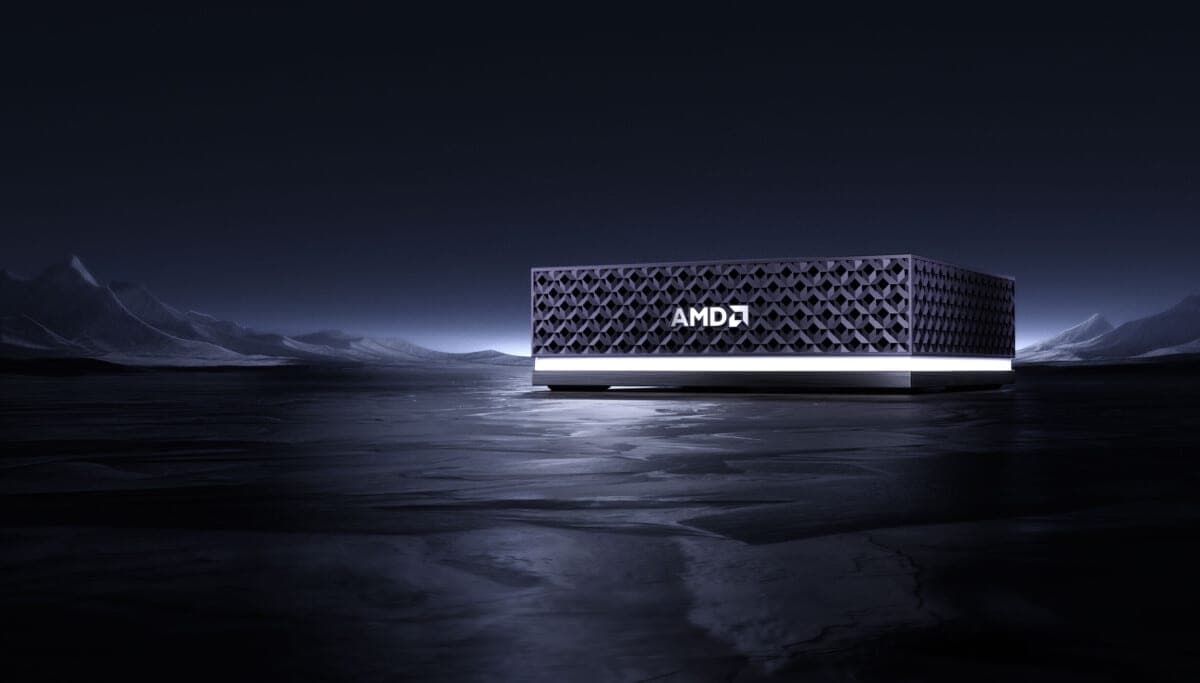
AMD's Ryzen AI Max+ Pro 495 chip, code-named Gorgon Halo, is now shipping inside the GMKtec Evo-X5 mini-PC with 192GB of unified memory.
It starts at $7,099, with an early-bird deal knocking $425 off. That's enough memory to theoretically run AI models with hundreds of billions of parameters locally, without cloud access. But it's also a roughly 64% jump from what comparable 128GB machines cost as recently as this summer, driven by a global memory shortage that's pushing up prices across the entire AI hardware market.
What to know
- AMD's Ryzen AI Max+ Pro 495 chip, code-named Gorgon Halo, powers the GMKtec Evo-X5, a mini-PC with 192GB of unified memory built to run large AI models locally.
- The Evo-X5 starts at $7,099, with an early-bird discount cutting $425 off that price.
- At 4-bit precision, the system can theoretically run models with up to 345 billion parameters on Linux, putting models like DeepSeek V4 Flash within reach.
- Comparable 128GB Strix Halo mini-PCs cost $2,000 to $3,000 a year ago and around $4,000 by summer 2026, meaning the 192GB model represents roughly a 64% price jump amid a broader memory shortage.
A mini-PC small enough to fit on a shelf can now theoretically run AI models with hundreds of billions of parameters, entirely on its own, no cloud connection required. The price for that privilege has more than doubled in about a year.
AMD's Ryzen AI Max+ Pro 495, code-named Gorgon Halo, is shipping inside the GMKtec Evo-X5, a mini-PC built around 192GB of unified memory. It starts at $7,099, with an early-bird discount cutting $425 off that price.
What Gorgon Halo actually is
Why it matters: according to The Register, Gorgon Halo is essentially a factory-overclocked version of AMD's existing Strix Halo APU, with meaningfully more memory and a modest clock speed bump.
The chip specs break down as follows:
- CPU: up to 16 Zen 5 cores.
- GPU: a 40-compute-unit integrated graphics unit.
- NPU: an XDNA 2-based neural processing unit for AI acceleration.
- Memory: 192GB of unified LPDDR5x running at 8,533 MT/s, versus Strix Halo's 128GB at 8,000 MT/s.
- Clock speed: roughly 100 MHz higher than Strix Halo.
- Memory bandwidth: 273 GB/s, about 6.5% faster than Strix Halo's 256 GB/s.
Unified memory means the CPU, GPU, and NPU all share the same pool of RAM rather than each needing its own dedicated memory, which is part of what makes running very large AI models on a compact system possible in the first place.
Why 192GB matters for AI
The big picture: at 4-bit precision, a common way of compressing AI models to use less memory, the Evo-X5 can theoretically run models with up to 345 billion parameters on Linux, or 320 billion on Windows.
That range puts genuinely large open models within reach of a single desktop machine. The Register specifically points to DeepSeek V4 Flash, a 284-billion-parameter model, as one that fits comfortably inside that ceiling. For businesses or individuals who want to run a frontier-scale model without sending data to a third-party cloud API, that's a meaningful capability shift.
In real life a small business handling sensitive client data could run a large language model entirely on-premises on a machine like this, instead of routing every query through an external AI provider's servers.
The catch: The Register cautions that LLM inference is "predominantly memory bound," meaning the speed at which memory can move data matters at least as much as how much of it is available. Extra capacity without matching bandwidth gains doesn't automatically translate into proportionally faster performance.
How we got here
Background: Strix Halo, the platform Gorgon Halo builds on, isn't new. AMD revealed the silicon in 2024 and released it across a wide range of laptops through 2025, marketed as Ryzen AI Max. AMD's own developer-focused mini-PC built around the chip, the Ryzen AI Halo, launched at $3,999.99 with 128GB of memory, aimed squarely at local AI development work.
That price point kicked off a wave of copycat hardware. "Every mini PC vendor on the planet is now slapping 'Ryzen AI MAX+ 395' on something," as one review put it. The GMKtec EVO-X2, an earlier 128GB model from the same maker behind the new Evo-X5, ranged from $2,349 for 96GB up to $3,299 for the full 128GB configuration, well under AMD's own reference price.
That earlier 128GB generation was already capable of real local AI work. A 128GB Strix Halo system could handle 70-billion-parameter models comfortably, along with select larger mixture-of-experts models and even a constrained, low-bit route to running DeepSeek V4 Flash. The jump to 192GB with Gorgon Halo extends that ceiling further, rather than opening up an entirely new category of capability.
The price problem
By the numbers: a year ago, 128GB Strix Halo systems, the previous generation, cost between $2,000 and $3,000. By summer 2026, those same class of machines had climbed to around $4,000. The new 192GB Gorgon Halo systems starting near $7,000 represent roughly a 64% increase over where the market sat just months ago.
That's not an AMD-specific problem. LPDDR5x memory remains in short supply industry-wide, squeezed by surging demand from AI data center infrastructure. Samsung has warned that memory supply constraints are likely to persist through 2028, according to reporting cited by The Register.
Nvidia isn't escaping the same pressure. The company's comparable GB10-based workstations have also roughly doubled in price over the past year, now landing in the same $6,000 to $8,000 range as the Evo-X5.
How it stacks up against Apple's approach
The rivals: AMD isn't the only company betting on unified memory for local AI. Apple's 2026 Mac Studio takes the same basic approach with its M5 series chips, and the comparison is instructive.
The M5 Max Mac Studio starts at $2,499 with up to 128GB of unified memory and 614 GB/s of bandwidth, well ahead of Gorgon Halo's 273 GB/s. The M5 Ultra configuration goes further still, supporting up to 512GB of unified memory at 1.2TB/s of bandwidth, enough to comfortably run 400-billion-parameter class models and even some 600-billion-parameter models at reduced precision.
That top configuration starts at $5,499, though reaching the full 512GB requires pairing it with the more expensive 80-core GPU option.
The catch: Apple's memory bandwidth advantage is substantial, more than double what Gorgon Halo offers at the high end. For memory-bandwidth-bound AI inference, that gap likely translates into meaningfully faster real-world performance per token generated, even before accounting for the memory capacity difference. AMD's platform still has the advantage of running Windows and Linux natively, which matters for developers whose tooling isn't built around macOS.
Is it worth it
What's next: The Register's own analysis lands on a fairly blunt note of skepticism, that it's "awfully hard to cross shop when you can't afford either option." At this price point, the comparison isn't really Gorgon Halo versus a cheaper alternative. It's whether a buyer can justify a five-figure hardware purchase at all for local AI work that a cloud subscription might otherwise handle for a fraction of the upfront cost.
For a narrow set of buyers, researchers, businesses with strict data privacy requirements, or hobbyists serious about running frontier-scale open models at home, that math might still work out. For most people, hardware in this bracket remains firmly outside typical PC-buying territory, and this generation's pricing hasn't made that any easier, even as the underlying capability keeps genuinely improving.
Who's affected: the real audience for a machine like this is narrower than the marketing around "run AI at home" implies. Developers building and testing applications against large open-weight models, small businesses with data residency or privacy requirements that rule out cloud APIs, and researchers who need to experiment with model internals directly are the practical buyers.
Casual users experimenting with a local chatbot have far cheaper options, including smaller models that run fine on ordinary consumer hardware.
The bottom line
Gorgon Halo delivers a genuine technical leap for running large AI models on a single compact machine sitting quietly on a desk, with 192GB of fast unified memory that puts hundreds-of-billions-of-parameter models within theoretical reach of ordinary hardware.
But the sticker price has climbed in step with a global memory shortage that's squeezing the entire industry, AMD and Nvidia alike, leaving this generation of local-AI hardware priced well outside what most buyers, even serious enthusiast ones, are realistically likely to spend.
Key facts
- Chip
- AMD Ryzen AI Max+ Pro 495 ("Gorgon Halo")
- Memory
- 192GB unified LPDDR5x at 8,533 MT/s
- Starting price
- $7,099 (early bird: $6,674)
- Max model size (4-bit, theoretical)
- 345 billion parameters on Linux
Got questions?
Quick answers, plain wordsWhat is AMD Gorgon Halo?
Gorgon Halo is the code name for AMD's Ryzen AI Max+ Pro 495 chip, described as a factory-overclocked version of the existing Strix Halo APU, with more and faster memory.
What mini-PC uses the Gorgon Halo chip?
The GMKtec Evo-X5, which starts at $7,099 with a $425 early-bird discount bringing it to $6,674.
How much memory does it have?
192GB of unified LPDDR5x memory running at 8,533 MT/s, up from the 128GB at 8,000 MT/s found in the earlier Strix Halo chip.
Can this mini-PC run large AI models locally?
Theoretically yes. At 4-bit precision, it can handle models up to about 345 billion parameters on Linux or 320 billion on Windows, covering models like DeepSeek V4 Flash.
Why did the price go up so much?
A global shortage of LPDDR5x memory, driven by AI infrastructure demand, has pushed prices up across the market. Comparable 128GB machines cost $2,000 to $3,000 a year ago and reached about $4,000 by summer 2026.
How does this compare to Nvidia's alternatives?
Nvidia's comparable GB10-based workstations have also roughly doubled in price over the past year, now ranging from $6,000 to $8,000, according to The Register.
Is more memory always better for running AI models?
Not exactly. The Register notes that LLM inference is predominantly memory-bandwidth bound, meaning how fast the memory moves data matters as much as how much of it there is.
What are the chip's other specs?
Up to 16 Zen 5 CPU cores, a 40-compute-unit integrated GPU, and an XDNA 2-based NPU, with a memory bandwidth of 273 GB/s, about 6.5% faster than Strix Halo's 256 GB/s.
SourcesThe Register
Related stories

Amazon redesigned the entire Kindle lineup and built a $35 remote so you never have to touch the screen
Amazon introduced a completely redesigned Kindle family with flush-front displays across every model, plus Kindle Click, a $35 Bluetooth remote for turning pages without touching the screen.
Micron's CEO says the memory chip shortage squeezing your next laptop won't end until at least 2028
Micron's CEO said memory shortages will persist through 2027 and 2028, with customers paying much higher prices, as AI data centers keep pulling DRAM production away from everyday devices.

The AI boom turned Singapore into a chipmaking powerhouse, and a risk
Singapore's economy is riding the AI chip boom to record growth, but high costs, scarce land, and its role as neutral ground between the US and China all threaten how long that lasts.
More in brief
- arXiv limits researchers to two papers a month as AI drives submissions to a recordOct 2
- California will fine robotaxi companies that block first responders for over 30 minutesOct 2
- Microsoft launches real-time transcription and new voice models for AI voice agentsOct 1
- Apple's smart home hub reportedly launches October 13, with a camera that never records videoOct 1
- Cloudflare releases Clef, open-weight AI models that make yes-or-no decisions fastOct 1
- GrayKey maker reportedly found a way around the iPhone's Inactivity RebootOct 1