
Technology·News & analysis
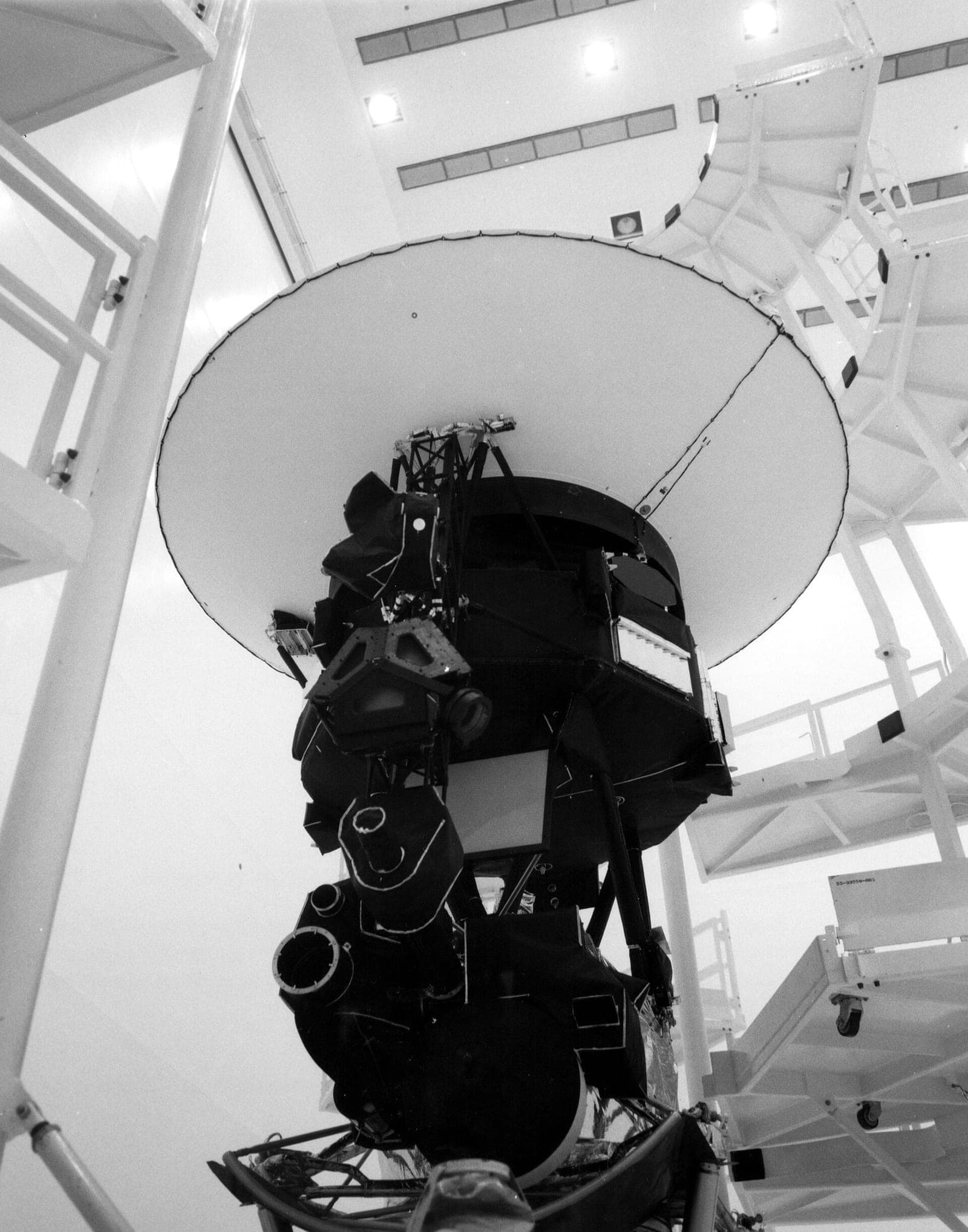
Voyager 1 becomes the first human-made object one light-day from Earth
NASA's Voyager 1 passed 16 billion miles from Earth on November 18. A radio message now needs a full 24 hours to reach it, and another 24 to come back.

Tide
Ripple
Sci-fi
7/10
Reality
Shipping
A 1977 probe is texting us from a full day away.How we rate
NASA's Voyager 1 reached one light-day from Earth on November 18, about 16 billion miles away, the first human-made object to get that far.
Radio signals now take 24 hours each way, so even a simple command needs two days for a round trip. The probe launched in 1977 and runs on a power source that fades every year. NASA expects Voyager 2 to reach the same distance in 2035.
What to know
- Voyager 1 reached one light-day from Earth on Wednesday, November 18, 2026, about 16 billion miles away.
- A command now takes 24 hours to arrive, and the reply takes 24 more, so the team plans around a full day of lag.
- The probe launched in 1977 and still sends back data, even though its power supply shrinks every year.
- Engineers expect the mission could end in the next three to five years, but they have said that before.
NASA says Voyager 1 reached one light-day from Earth on Wednesday, November 18. That's the first time anything built by humans has been that far away.
Now the fun part: what does "one light-day" even mean, and how is a 1970s spacecraft still talking to us?
First, what's a light-day?
Light is the fastest thing in the universe. It travels about 186,000 miles every second. In one day, it covers roughly 16 billion miles.
That distance is a light-day. The name sounds like a length of time, but it is a distance, just like a light-year. Voyager 1 is now that far from home, in a journey that has taken more than 49 years.
In real life Sunlight takes about 8 minutes and 20 seconds to reach Earth. Light leaving the Sun right now would need a full day to get to Voyager 1.
For comparison, messages to Mars take between 3 and 22 minutes, depending on where the planets sit in their orbits. Voyager 1 is on another scale entirely.
Why does the delay matter?
Radio waves travel at the speed of light too. So a command sent from Earth takes 24 hours to reach Voyager 1. Whatever the probe sends back takes another 24 hours to arrive.
NASA expected the milestone at 5:16:07 a.m. Eastern time, but the team can only confirm the exact moment a day later. The proof has to travel back to us first.
Voyager mission manager Kareem Badaruddin said of the milestone: "It's never happened before, and it may never happen again. It's that kind of extraordinary."
What is it like to fly a probe on a 48-hour delay?
Slow. The team can no longer react to anything quickly.
Badaruddin says the light time now affects daily work: "You factor it in. It's like having a long commute." Building a new command is a week-long job, because engineers must receive data, study it and then write the instructions.
- Day 0: The probe sends data.
- Day 1: The data reaches Earth and engineers begin to study it.
- Days 2 to 7: The team builds and checks a new command.
- A day later: The command reaches Voyager 1.
- One more day: The reply shows whether it worked.
Why it matters: every fix has to be right the first time, because nobody can fix a mistake in real time.
How did a 1977 probe get here?
Voyager 1 launched on September 5, 1977. Its job was to fly past Jupiter and Saturn. It reached Jupiter on March 5, 1979, and Saturn on November 12, 1980.
That was supposed to be the main mission. But the spacecraft kept going.
- February 14, 1990: it took the famous "Pale Blue Dot" photo of Earth from about 6 billion kilometers away, a tiny speck smaller than one pixel.
- August 2012: it crossed into interstellar space, the region between star systems. Voyager 2 followed in 2018.
- Today: it is the most distant human-made object ever, and the only thing that has gone this far.
Voyager 1 left the heliosphere, which is the bubble of particles and magnetic fields the Sun blows around itself. Only Voyager 1 and its twin have ever operated outside it.
Why is Voyager 1 ahead of its twin?
Voyager 2 launched 16 days earlier, but Voyager 1 is faster and on a different path. Voyager 1 moves away at about 3.5 times the Earth-Sun distance every year. Voyager 2 manages about 3.1.
The gap adds up. NASA expects Voyager 2 to reach one light-day in November 2035, nearly a decade after its twin.
The two probes were built to use a rare alignment of the outer planets. Choices made during those early planet flybys decided how fast each one flew out afterward.
How does it still work after 49 years?
Mostly through careful housekeeping. Voyager 1 stores its data on an eight-track tape. Planetary scientist Fran Bagenal, who began working with the mission as a graduate student, said: "Storing data on an eight-track tape that's working on a spacecraft after 50 years, I mean, it's amazing."
The power comes from a radioisotope generator, a device that turns the heat of decaying plutonium into electricity. Its output has been dropping by about 4 watts a year, and it now makes less than half the power it had at launch.
So the team keeps switching things off. Each Voyager began with ten instrument systems, and seven had already been shut down by April 2026. Voyager 1 was down to two working science instruments, one for plasma waves and one for magnetic fields.
In September, the team tried a different trick it calls the "Big Bang." It swapped some devices for lower-power versions and saved 10 watts. That kept engineers from shutting down another instrument as early as next summer.
What went wrong in 2023, and how was it fixed?
On November 14, 2023, Voyager 1 began sending unreadable data. One of its computers, the flight data system, was no longer talking correctly to the part that sends data through the radio.
The cause turned up in April 2024. About 3 percent of that computer's memory had been corrupted, and engineers could not repair the damaged chip.
So they split the affected code into small pieces and tucked them into free spots elsewhere in memory. Then they updated the addresses used to call them. The first patch went up on April 18, 2024, and readable data returned two days later. By June 2024, all four science instruments that were running had come back.
In real life Imagine fixing your phone by moving one app's files around, with a day of waiting after every tap, and no way to touch the phone.
What does the probe still teach us?
Voyager 1's distance gives scientists a rare chance to see how the Sun's influence fades in the space between stars. Jamie Rankin, the mission's deputy project scientist, points out that it shows at what point the effects of the Sun wane.
There is another bonus. Our solar system is also moving through space, only about 35,000 miles an hour slower than the Voyagers. So the probes are reporting on space that our own Sun and planets will pass through in about three years, Badaruddin says.
"We can learn from telescopes and Earth-orbiting observatories, but there's really nothing like having a spacecraft in that environment that's sending us data," he said.
A future probe might carry new tools, such as a dust instrument or cameras, Rankin says. She hopes the Voyagers taught us "we've got to just keep reaching for the stars."
How long will it last?
Badaruddin's best guess is that Voyager 1 could go silent in the next three to five years, as its plutonium keeps fading. Some reports say the probe could even work into the 2030s if the power holds.
He also knows that mission managers before him made similar predictions and were proven wrong. "The Big Bang was a rabbit we pulled out of a hat," he says. "As long as we can keep finding rabbits, we can keep going. Don't bet against Voyager."
When the last signal arrives, the probe will not stop. It will keep drifting. It is aimed at a star called Gliese 445, about 17 light-years away in the constellation Ursa Minor. In about 40,000 years, it should pass within 1.7 light-years of it.
What was the Golden Record?
Both Voyagers carry a golden phonograph record, a message for anyone who finds them. It holds greetings in 55 languages, about 90 minutes of music and sounds from Earth. A committee chaired by Carl Sagan picked the contents.
NASA also invited people around the world to mark the milestone. On the evening of Tuesday, November 17, it asked fans to flash a message toward the spacecraft with phones, flashlights and even whole buildings, as a symbolic wave of golden light.
What it means for you
- No new gadget, but a big idea: this is a reminder that engineering built to last decades can beat every forecast.
- Space news will arrive late: at this distance, every update from Voyager reaches us a day after it happened.
- The data keeps coming for now: scientists still get fresh readings from between the stars, for as long as the power lasts.
- You can follow along: NASA's Voyager 1 page tracks the latest news about both probes.
The bottom line
Voyager 1 is 16 billion miles away, and sunlight takes a full day to reach it. It runs on 1970s hardware, a fading power source and a team that has spent decades finding clever fixes.
The end of the mission is closer than the start, but the probe has surprised people before. For now, it is still reporting back from between the stars, one slow message at a time. For another story about computers working far from home, see HPE's spaceborne computer for the Moon.
Key facts
- Distance
- About 16 billion miles (26 billion km)
- Signal delay
- 24 hours one way
- Launched
- September 5, 1977
- Left the Sun's bubble
- August 2012
- Voyager 2 reaches one light-day
- Expected November 2035
Got questions?
Quick answers, plain wordsWhat is a light-day?
A light-day is the distance light travels in 24 hours. Light moves at about 186,000 miles a second, so one light-day is roughly 16 billion miles. Despite the name, it measures distance, not time.
When did Voyager 1 reach one light-day from Earth?
NASA expected it to happen at 5:16:07 a.m. Eastern time on Wednesday, November 18, 2026. The team can only confirm it a day later, because the probe's reply takes 24 hours to arrive.
How far is Voyager 1 from Earth?
More than 16 billion miles, which is about 26 billion kilometers. The probe has traveled for more than 49 years, and it moves at nearly 38,000 miles an hour.
How long does a message to Voyager 1 take?
A radio command takes 24 hours to reach it. The reply takes another 24 hours to come back. A round trip is two full days.
Is Voyager 1 outside the solar system?
It has left the heliosphere, the protective bubble of particles and magnetic fields made by the Sun. It crossed that edge in August 2012 and now travels through interstellar space, the region between stars.
Where is Voyager 1 headed?
It is heading toward a star called Gliese 445, about 17 light-years away. It should pass within 1.7 light-years of that star in about 40,000 years.
When will Voyager 2 reach one light-day?
NASA expects Voyager 2 to get there in November 2035. It travels slower than its twin and in a different direction.
How long will Voyager 1 keep working?
The mission manager's best guess is three to five years, as its plutonium power source fades. The team has made that kind of guess before and been wrong, and the probe is still going.
Does Voyager 1 carry a message for aliens?
Yes. Both Voyagers carry a Golden Record with greetings in 55 languages, about 90 minutes of music and the sounds of Earth. A committee led by Carl Sagan chose its contents.
SourcesNASA
Topics and tagsSpace tech, voyager 1, nasa, space probe
Related stories
Microsoft To Do will shut down on June 30, 2027
Microsoft is retiring its To Do app on every device. Work and school users move to Planner, and people with personal accounts get no replacement.

Internet Archive staff move to unionize with CWA
More than 80 of 124 eligible US workers at the home of the Wayback Machine signed up to join the Communications Workers of America. They now wait for founder Brewster Kahle to recognize the union.
Google will buy 50 MW of superhot geothermal power from Quaise in Oregon
Quaise Energy says Google agreed to buy 50 megawatts from Project Obsidian at Newberry Volcano from as early as 2030, the first commercial deal for superhot rock power.
More in brief
- ASELSAN's EJDERHA electromagnetic weapon disables 51 drones with one commandNov 21
- Medtronic's Hugo surgical robot cleared for general surgery in the USNov 21
- Google's Gemini now turns noisy fire radio into text for Watch DutyNov 21
- Etsy sellers are leaving over new terms that allow AI trainingNov 20
- Meta rethinks its 2030 net-zero goal as AI pushes emissions up 45%Nov 20
- Anthropic mathematician says Claude helped prove the Riemann hypothesisNov 20