
Robots·News & analysis
Medtronic's Hugo surgical robot cleared for general surgery in the US
The FDA cleared Medtronic's Hugo robot for gallbladder, hernia, gastric bypass and other abdominal operations. Until now it could only be used for urology in the US.

Tide
Wave
Sci-fi
5/10
Reality
Shipping
A robot with four arms helps remove your gallbladder.How we rate
The FDA cleared Medtronic's Hugo robotic surgery system for general surgery, covering upper abdominal operations such as gallbladder removal, gastric bypass and hernia repair, plus groin hernia and appendix surgery.
Medtronic says these operations total about 3.5 million US surgeries a year. Hugo was cleared only for urology in December 2025. A gynecology clearance is still pending, and Medtronic plans to add AI features.
What to know
- The FDA cleared Medtronic's Hugo robotic-assisted surgery system for general surgery on November 17, 2026, after clearing it for urology in December 2025.
- The clearance covers upper abdominal operations, such as gallbladder removal, gastric bypass, ventral hernia repair and small bowel resection, plus groin hernia repair and appendix removal.
- Medtronic says these operations add up to about 3.5 million US surgeries a year, more than half of all soft-tissue procedures in the country.
- Hugo is on track for more than 50,000 procedures worldwide by the end of Medtronic's fiscal year, and a gynecology clearance is still pending.
Medtronic announced on November 17, 2026 that the US Food and Drug Administration (FDA) has cleared its Hugo robotic-assisted surgery system for general surgery. Until now, US hospitals could use Hugo only for urology.
That is a big step for a robot that only reached American operating rooms about a year ago.
What did the FDA clear?
The clearance is wide. It covers all upper abdominal general surgical procedures. Medtronic names these examples:
- Cholecystectomy: removing the gallbladder.
- Roux-en-Y gastric bypass: a weight-loss operation that reroutes part of the digestive system.
- Ventral hernia repair: fixing a hernia in the front wall of the belly.
- Small bowel resection: removing a damaged piece of the small intestine.
The words "including but not limited to" in the announcement mean the list is a sample, not a limit. Two lower abdominal operations were cleared as well: inguinal hernia repair (a hernia in the groin) and appendectomy (removing the appendix).
The type of clearance is a 510(k). In plain words, it is the FDA path for a device that is shown to be as safe and effective as one already on the market.
Why does the number matter?
By the numbers: Medtronic says these procedures add up to about 3.5 million surgeries a year in the US. That is more than half of all soft-tissue operations done in the country each year.
Soft-tissue surgery means operations on organs and tissue, not on bones. It is where most robotic systems earn their keep, and general surgery is described in the announcement as one of the fastest-growing areas of robotic surgery in the US.
For a hospital that already bought a Hugo for urology, this is a bigger menu. The same machine can now be used by more surgical teams for more kinds of patients.
What is the Hugo system?
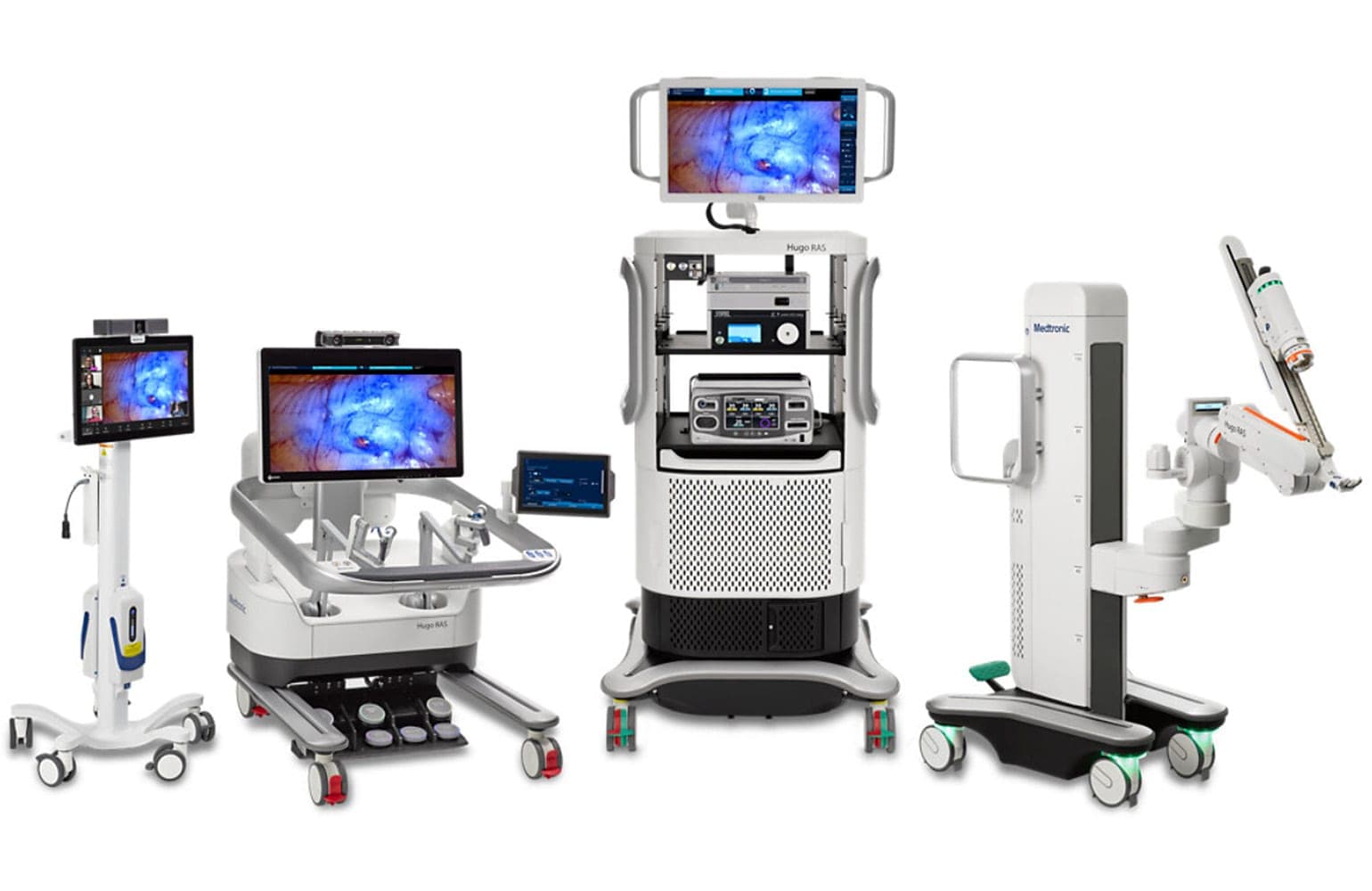
Hugo is a robot that helps a surgeon, not a robot that operates alone. According to Medtronic's own description of the system, it has four robotic arms that copy the movements of human hands. Each arm can hold a tiny instrument or a camera, and the arms can be placed anywhere around the operating table to suit each patient.
The surgeon wears 3D glasses and sits at an open workstation with a 33-inch display. From there, the surgeon moves the arms with controls at the console.
Dr. James Porter, a urologic surgeon and a Medtronic chief medical officer, described it this way in an earlier Medtronic story: "It's definitely video-based, but it's not a video game." He said it takes coordination between hands, feet and eyes.
The design is modular. Surgical teams can use only the robotic arms they need for a given operation, and position them for the surgeon's technique and the patient's body. The console is open, so the surgeon stays connected with the rest of the operating room team and the patient.
In real life Think of a gallbladder removal. The surgeon sits at the console and sees a magnified 3D view of the belly. The small arms hold the camera and tools, while nurses and assistants stand right there in the room.
Why is general surgery a good fit?
Rajit Kamal, who leads robotic surgical technologies at Medtronic, told The Robot Report that general surgery is already Hugo's fastest-growing procedure mix outside the US. Medtronic says it now passes urology and gynecology in those markets.
He pointed to the shape of the operations. "Many of [the surgeries] are multi-quadrant procedures where Hugo's modularity provides better coverage, flexibility in port placement, and ability to reach the surgical sites," Kamal said.
A quadrant is one of four rough areas of the belly. A port is the small opening where an instrument goes in. Operations that reach into several areas are easier when the arms can be placed flexibly.
Medtronic also says it can bring trusted tools to the robot. One is the LigaSure RAS Maryland instrument, which carries vessel-sealing technology, a way to seal blood vessels with heat and pressure. The company says that technology has been used in more than 45 million open and laparoscopic procedures.
How did Hugo get to this point?
The road to the US took years, and the steps are public.
- 2022: Hugo received its CE mark (the European approval) for general surgery. That produced real-world data that Medtronic later used in its US file.
- February 2025: Medtronic started its US journey with the system, according to Kamal.
- September 2025: Medtronic announced that a US clinical study of Hugo for hernia repair met its safety and effectiveness goals. It also gained an investigational device exemption (IDE), the FDA permission to run a US trial for general surgery.
- December 2025: the FDA cleared Hugo for urologic procedures, such as prostate removal.
- June 3, 2026: Medtronic submitted 510(k) filings for general surgery and for gynecologic surgery.
- November 17, 2026: the general surgery clearance arrived.
Kamal said the company took two paths to the FDA. One was a US clinical trial run with the agency. The other was using data from outside the US. "I think it was a creative way of approaching this, and we were able to get a broader set of general surgery indications," he said.
Medtronic also has a long history in this field. It says its open and laparoscopic tools have been used with general surgeons for more than half a century, and it wants to bring "that same commitment to robotic surgery for U.S. customers."
What's next for Hugo?
What's next: gynecology is the next US target. Medtronic filed for a gynecologic indication in June, and its Embrace IDE study finished enrolling patients. The study looks at Hugo's safety and effectiveness in radical, modified radical and total hysterectomies, including those done to treat cancer.
The company also talks about AI. Kamal described three stages of care where it could help:
- Before surgery: planning a procedure with imaging, to personalize it.
- During surgery: spotting anatomy and critical structures, and giving guidance.
- After surgery: improving the recovery plan.
"Our intent is to bring AI features onto our Hugo platform and continue being that partner with the surgeons," Kamal said. Medtronic already won FDA approval in June 2026 for Touch Surgery Aide, a computer platform for the operating room that uses computer vision to analyze surgical video and give real-time information to the team. Hugo is not said to run it yet.
The company is also placing bets beyond its own robot. In September 2026 it invested $700 million in Cornerstone Robotics, and gained rights to distribute the Sentire surgical system in select markets outside the US where it is approved.
On the global scale, Medtronic says Hugo's procedure growth is running at more than two times the robotic surgery market. It is on track to pass 50,000 procedures by the end of the Medtronic fiscal year.
What does it change for surgeons and hospitals?
Kamal argued that the biggest effect may land on surgeons themselves. Conventional laparoscopic surgery, where tools go through small cuts, can be physically demanding because surgeons stand for long periods.
With a robot, he said, a surgeon gets "a magnified 3D image, so you have clear depth perception," and sits "comfortably in a chair." He added that any laparoscopic surgeon who is doing robotics "will tell you that they don't want to go back."
He also sees a benefit for newer surgeons. Robotic views show the surgical field clearly and the instruments are precise, which can help them build skills.
For hospitals, the hard part is access. Kamal said that making robotic surgery more widely available in the US comes down to three things: cost, training and support. Medtronic says it is open to working with hospitals on a financial case for adopting the system.
Medtronic's own message is about choice and capacity. Matt Anderson, who leads the company's Surgical business, said Hugo "expands choice with a practical option to help hospitals address capacity and access challenges."
Dr. Francesco Bianco, a surgeon at UI Health in Chicago, said that expanding robotic capabilities with Hugo lets his academic health system "offer additional treatment options" and train the next generation of surgeons.
What it means for you
- If you need one of these operations: a Hugo robot may be an option at some hospitals now. Whether it is used depends on your surgeon, your hospital and your condition.
- Ask your surgeon: how many robotic operations they have done, and why a robotic or a traditional approach fits your case.
- If you work in health care: expect more hospitals to weigh robotic systems for hernia, gallbladder and similar operations, with cost, training and support as the main questions.
- If you follow robotics: this is a move in the surgical robot market, where Medtronic is stepping into soft-tissue surgery with a second US specialty.
The bottom line
The FDA's clearance turns Hugo from a urology robot into a general surgery robot in the US. Medtronic says the cleared operations make up about 3.5 million surgeries a year.
Gynecology and AI features are still ahead, and Medtronic has not given dates for either. For patients, the practical step is simple: ask your surgeon what tools they use and why.
Key facts
- Cleared
- November 17, 2026 (FDA 510(k))
- Covers
- Upper abdominal procedures, inguinal hernia, appendectomy
- US operations a year
- About 3.5 million
- Earlier US clearance
- Urology, December 2025
Got questions?
Quick answers, plain wordsWhat did the FDA clear?
The FDA cleared Medtronic's Hugo robotic-assisted surgery system for general surgery procedures. It covers all upper abdominal general surgery, plus inguinal hernia repair and appendix removal.
What is the Hugo robot?
Hugo is a robotic-assisted surgery system from Medtronic. A surgeon sits at an open console and controls robotic arms that hold a camera and small instruments, while the surgical team stays in the room.
Does the robot operate by itself?
No. The surgeon controls the arms from the console. Medtronic calls the system robotic-assisted, and the arms copy the surgeon's hand movements.
Which operations are included?
Examples are gallbladder removal (cholecystectomy), Roux-en-Y gastric bypass, ventral hernia repair and small bowel resection. Inguinal hernia repair and appendectomy were cleared too.
How many surgeries does this open up?
Medtronic says the cleared procedures account for about 3.5 million surgeries a year in the US. That is more than half of all soft-tissue procedures done in the country each year.
Was Hugo already approved in the US?
Yes, for urology. The FDA cleared it for urologic procedures such as prostate removal in December 2025. General surgery is the second area.
Is Hugo used outside the US?
Yes. Medtronic says it has nearly five years of commercial use across more than 35 countries. Hugo received its European CE mark for general surgery in 2022.
What about gynecology?
Medtronic filed for a gynecologic indication in June 2026, and a US clinical study of Hugo for hysterectomies is running. A US clearance for gynecology has not been announced yet.
Will AI be added to Hugo?
Medtronic says it intends to bring AI features to Hugo. Rajit Kamal, who runs its robotic surgical technologies, described uses before, during and after an operation. No date was given.
What does this mean for patients?
More hospitals that own Hugo can now use it for these operations. Whether you get a robotic operation still depends on your surgeon, your hospital and your condition, so ask your care team.
SourcesMedtronic
Topics and tagsmedtronic, hugo, surgical robots, fda
Related stories

ASELSAN's EJDERHA electromagnetic weapon disables 51 drones with one command
Turkish defense company ASELSAN says its EJDERHA system knocked out a swarm of 51 drones in seconds, with no missile and no ammunition.

Rockwell Automation to buy AGILOX and double its warehouse robot business
Rockwell signed a deal to acquire Austrian robot maker AGILOX, pairing its forklift-style robots with Rockwell's OTTO flatbed robots. Terms were not disclosed.

Disney built three Star Wars aliens that think with AWS AI
Disney Imagineering and Amazon Web Services made three talking Anzellan figures that read the room and react without a human puppeteer. They debut at AWS re:Invent on November 30.
More in brief
- Microsoft To Do will shut down on June 30, 2027Nov 21
- Google's Gemini now turns noisy fire radio into text for Watch DutyNov 21
- Internet Archive staff move to unionize with CWANov 20
- Etsy sellers are leaving over new terms that allow AI trainingNov 20
- Meta rethinks its 2030 net-zero goal as AI pushes emissions up 45%Nov 20
- Google will buy 50 MW of superhot geothermal power from Quaise in OregonNov 20