
AI·News & analysis
HPE is sending an AI computer to the Moon on Astrolab's FLIP rover
HPE's Spaceborne Computer-4 is a hand-sized, fanless module that will run AI and the first supercomputing benchmarks on the lunar surface, riding on Astrolab's FLIP rover.
Tide
Ripple
Sci-fi
8/10
Reality
Demo
A small computer thinks for itself at the edge of the edge.How we rate
HPE announced that its Spaceborne Computer-4, a fanless module the size of a hardcover book, will run AI workloads and the first high performance computing benchmarks on the Moon.
It will ride on Astrolab's FLIP rover, which Voyager Technologies' Griffin-1 lander will deliver near the south pole. The mission is set to launch in late 2026 and run for about a year. NASA and Deloitte will run their own experiments on it.
What to know
- HPE announced on October 20, 2026 that its Spaceborne Computer-4 will fly on Astrolab's FLIP rover to the Moon's south pole, launching in late 2026 on Voyager Technologies' Griffin-1 lander.
- The module is fanless, about 249 by 132 by 26 millimeters, and uses a low-power CPU and GPU with a pair of mirrored Kioxia SSDs totaling 1 TB.
- It will run LLM retrieval, vision inference, LiDAR processing and HPC benchmarks that HPE says will be the first on the lunar surface.
- NASA and Deloitte are adding their own AI experiments to the mission.
HPE announced that AI is going to the Moon. Its Spaceborne Computer-4 will ride on Astrolab's FLIP rover and run AI and supercomputing tests on the lunar surface.
That is the news. The fun part: how do you build a computer for a place with no air, no fans and a 14-day night?
What is Spaceborne Computer-4?
It is HPE's fourth-generation compute module for space. HPE has been flying computers on the International Space Station for years, and this one goes farther.
HPE says the module is lightweight, self-contained and fanless, with a low-power CPU and a GPU. StorageReview puts the whole system in an aluminum chassis of about 249 by 132 by 26 millimeters. The Register says it measures around 5 by 10 inches and about an inch thick.
ServeTheHome notes that mass is critical when sending payloads to the Moon. The idea is a small system that can make decisions locally rather than wait for Earth.
Where is it going?
The mission is intended to launch in late 2026, according to HPE. It is part of NASA's Commercial Lunar Payload Services program, which buys rides to the Moon from commercial companies.
- Lander: Voyager Technologies' Griffin-1.
- Rover: Astrolab's FLIP, short for Flex Lunar Innovation Platform.
- Destination: Near the Moon's south pole.
- Length: The Register says the rover's mission lasts about a year.
StorageReview explains why the south pole matters. Craters there sit in perpetual darkness and may contain large amounts of water ice, a valuable resource for a future Moon base.
What will it actually do?
HPE says Spaceborne Computer-4 will run several AI workloads once it is deployed:
- Language models: retrieval-augmented generation, which lets an LLM search documents.
- Vision: inference on camera images.
- Mapping: LiDAR processing for mapping and navigation.
- Services: an AI services container, meant to show that scalable AI apps can be deployed reliably at the lunar edge.
It will also run HPC benchmarks. StorageReview names High-Performance LINPACK and High-Performance Conjugate Gradient. HPE says these will be the first HPC benchmarks on the lunar surface.
By the numbers: The Register says that would make HPE and Astrolab the first to make a Top500 submission from a celestial body. Then it adds that being the top computer on the Moon "is not a particularly high bar."
In real life Think of the rover as a camera crew with a tiny newsroom on board. Instead of mailing home every raw photo, the computer sorts out what matters and sends a short summary.
Why put the computer on the Moon?
Because the connection is slow. The Register says the delay between Earth and the Moon is about 2.5 seconds, far better than Mars, but still awkward for steering a rover live.
Bandwidth is the bigger problem. The Register notes that when Artemis 2 flew around the Moon earlier this year, astronauts could not send high-resolution photos in real time. They sent full-resolution images only on the way back.
Astrolab CEO Jaret Matthews says it is important to ship back insight rather than all the raw data, so local processing saves bandwidth. HPE's Mark Fernandez calls it operating "at the edge of the edge," according to The Register.
How does it survive the Moon?
The Moon has no air to carry heat away. So the module drops fans and uses a space radiator. ServeTheHome says the housing has an intricate lattice structure.
Then there is radiation. The Moon lacks Earth's thick atmosphere and magnetic field, so cosmic rays and solar radiation hit hard.
The surprise is how ordinary the parts are. The Register says the system is largely built from off-the-shelf components, including standard Kioxia BG6 M.2 SSDs. The main protection is software RAID 1, two drives mirrored.
Fernandez says that after nine years of using drives on the Space Station, HPE does not need anything special for space. He told The Register early SSD failures on past missions came from bad capacitors, not radiation, and that he has had zero SSD failures since 2019.
What is "hardware hardening in software"?
Fernandez uses that phrase for HPE's approach. The computer uses spare processor cycles to watch its own hardware and compare readings against a table of limits.
If something goes out of range, it protects itself in steps. Fernandez describes the goal this way, according to The Register:
- First choice: run at full speed.
- If it cannot: run slower.
- If that fails: stay booted but idle, so the system can recover.
- Worst case: power down rather than get destroyed.
Who else is on the mission?
HPE says NASA and Deloitte are adding experiments. NASA will run FLUID, short for Federated Learning for Unbounded and Intelligent Decentralization. It coordinates three separate AI models trained on data from Earth, the Moon and the International Space Station.
NASA will also run a tuned LLM test that searches and interprets onboard documents. Deloitte's Silent Shield system will provide near real-time predictive cyber-analytics and anomaly detection.
On Earth, HPE will support Astrolab's mission control in Hawthorne, California, using HPE Private Cloud and HPE CloudOps Software to manage and automate workloads. Kioxia supplies the storage. It has been proving commercial NAND on the ISS for years, ServeTheHome says.
What is the FLIP rover for?
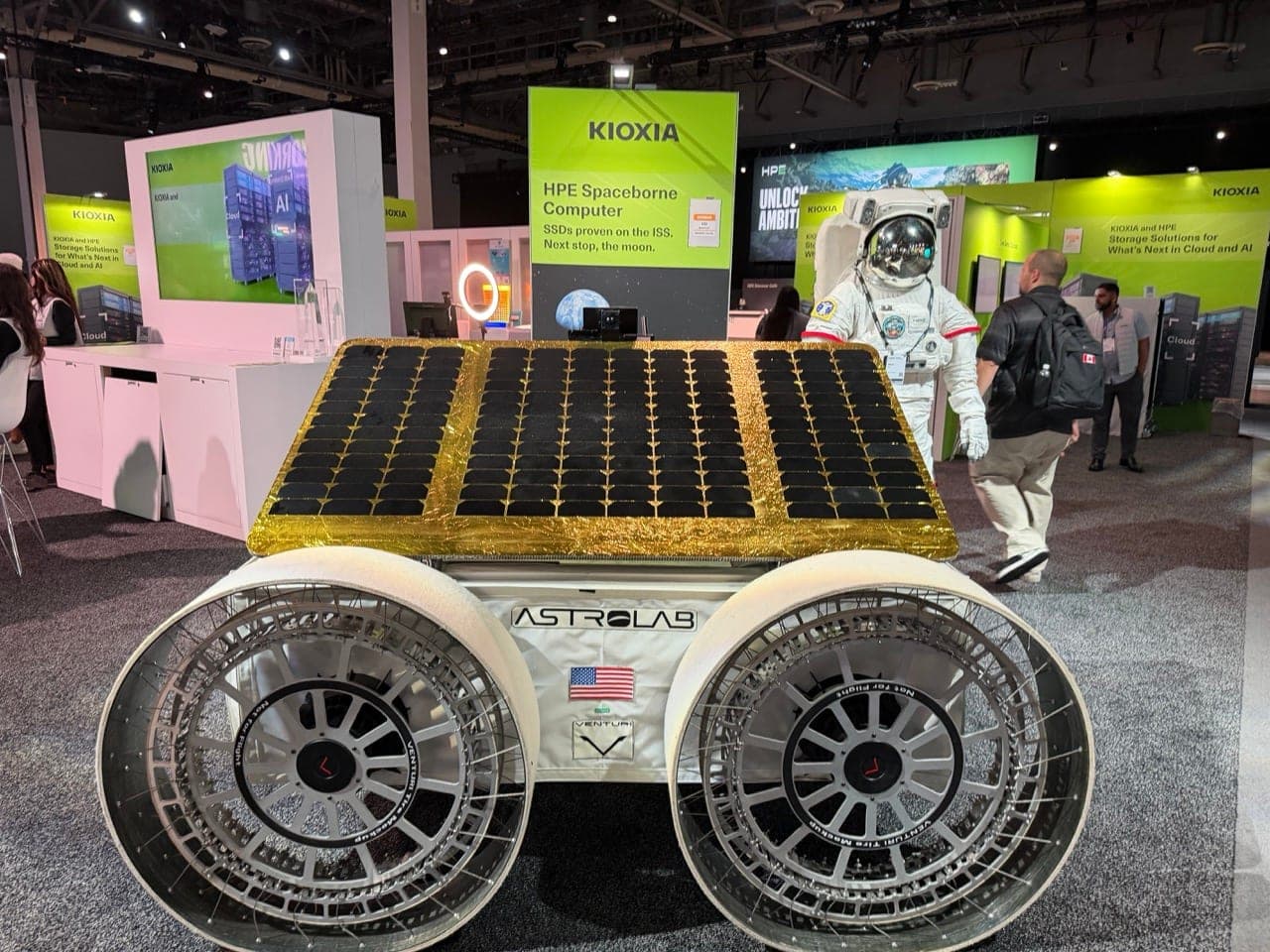
FLIP is mainly a proof-of-concept vehicle. StorageReview says it is meant to evaluate and mature parts for Astrolab's future rover, FLEX: full-sized batteries, tires, avionics, sensors and software.
The rover's most obvious feature is its large wheels, designed by Venturi to cope with loose lunar soil. StorageReview also notes that the solar panel deploys upright, because at the south pole the Sun stays on the horizon during the lunar day.
The Register says the rover will face roughly 14-day nights over the course of its mission, so keeping it from icing over is a real concern.
Is this the same as space data centers?
No. The Register points out that Google, Amazon and SpaceX are all touting orbital data centers powered by the Sun. This is a much smaller bet: one small module, one rover, one test.
The Register also quotes Nvidia CEO Jensen Huang from an earnings call earlier this year. He said imaging is one of the best uses of GPUs in space, because sending petabytes of imaging data to Earth is harder than processing it out there.
What is still unknown?
The silicon. HPE has not named the chips. The Register says the secrecy comes down to the risk of the mission: if the hardware fails, HPE's compute partner does not want its name attached.
HPE says more details will follow once the system is up and running. Until then, it is unclear how large a language model the little module can handle.
The catch: none of this counts until the lander touches down. The Register's own phrasing is "assuming a safe landing on the surface."
What it means for you
- Not an AI product: You will not use this computer. It is a test of whether ordinary parts can work on the Moon.
- Edge computing grows up: The idea of processing data where it is collected, not in a far-off data center, is the same one behind many phones and cameras.
- Cheaper space tech: If off-the-shelf parts hold up, future lunar missions may not need custom space-grade chips.
- Watch late 2026: The launch window is the moment to see whether this goes beyond a nice announcement.
The bottom line
HPE is putting a small, fanless computer on a rover and asking it to think for itself on the Moon. The goal is simple: send home answers, not mountains of raw data.
It is a test bed, not a product. If it works, the Moon gets its first benchmark score and engineers get proof that everyday hardware can handle the trip.
Key facts
- Announced
- October 20, 2026
- Launch
- Late 2026, on Griffin-1
- Size
- About 249 x 132 x 26 mm
- Storage
- Two mirrored Kioxia SSDs, 1 TB total
- Mission length
- About a year on the lunar south pole
Got questions?
Quick answers, plain wordsWhat is HPE Spaceborne Computer-4?
It is HPE's fourth-generation compute module for space. It is lightweight, self-contained and fanless, with a low-power CPU and GPU, and it is built to run AI and high performance computing on the Moon.
When will it launch?
HPE says the mission is intended to launch in late 2026 on Voyager Technologies' Griffin-1 lander, as part of NASA's Commercial Lunar Payload Services program.
Where will it land?
Near the Moon's south pole. Astrolab's FLIP rover carries the computer, and the Griffin-1 lander delivers the rover to the surface.
What will it run?
Large language model retrieval-augmented generation, vision inference, LiDAR processing for mapping and navigation, and an AI services container. It will also run HPL and HPCG benchmarks.
Why not send the data to Earth instead?
Bandwidth is limited and a signal takes about 2.5 seconds each way. Astrolab's CEO Jaret Matthews says it is better to ship back insight rather than raw data, so the rover processes data locally.
Is it built from special space-grade parts?
Mostly not. The Register reports it uses largely off-the-shelf components, including Kioxia BG6 SSDs protected by software RAID 1. HPE adds software that monitors the hardware and slows or powers down to protect it.
What are NASA and Deloitte doing on the mission?
NASA will run its FLUID experiment, which coordinates three AI models trained on data from Earth, the Moon and the ISS, plus a tuned LLM test. Deloitte's Silent Shield system will provide cyber-analytics and anomaly detection.
What chips are inside?
HPE has not said. The Register reports the silicon is a mystery because HPE's compute partner does not want its name tied to the mission if the hardware fails. HPE says more details will come once it is running.
SourcesHPE
Topics and tagsSpace tech, hpe, moon, space computing
Go deeper
- ExplainerWhat is a GPU, and why does AI need them?A GPU (graphics processing unit) is a chip that does huge numbers of simple calculations at the same time. Built to...
- ExplainerWhat is a large language model (LLM)?A large language model is an AI system trained on huge amounts of text to predict the next word. That simple skill,...
Related stories
Perplexity Computer can now run fully on your Mac, even offline
Perplexity's new local-first mode puts the whole Computer agent, model and orchestrator included, on an Apple silicon Mac with at least 36GB of memory.
Yelp's new AI agent will phone restaurants to check the wait for you
Yelp's Check for Me calls a restaurant, asks about the wait and texts you the answer. It arrives with OpenTable booking, My Lists and a $30 tool for service pros.

DHS orders federal agencies to remove DeepSeek and stop buying it
A Homeland Security order pulls DeepSeek's AI out of civilian agency computers and bars agencies from buying it, including other companies' tools built on its models.
More in brief
- Antigravity halves the A1 drone's entry price with watch and ring controlsOct 20
- Slate opens its first showroom for its $24,950 electric truckOct 20
- TP-Link plans US router assembly at a Mississippi line after the import banOct 19
- MIT left Claude alone on a virtual island for 30 hours, and it started to playOct 19
- Four Gemini 4 Argon agents beat Minecraft with no human helpOct 19
- World launches a World ID suite for banks to fight deepfake fraudOct 19