
AI·News & analysis
Google will switch off AI and Search for school accounts until schools opt in
Google says Gemini and Search will be off for K-12 student accounts until administrators turn them on, and a school that wants no AI loses Search too.
Tide
Wave
Sci-fi
3/10
Reality
Shipping
A search box that coaches you like a patient tutor.How we rate
Google announced that Gemini, Gemini Notebook, Gemini in Classroom and Google Search will be off for K-12 student accounts until school administrators explicitly turn them on.
Schools cannot disable the AI features and keep Search, because Google says the two are deeply integrated. Google Classroom has more than 150 million teachers and students. Google will share more specifics in the coming months, and a Guided Learning pilot in Search starts this month.
What to know
- Google announced that Gemini, Gemini Notebook, Gemini in Classroom and Google Search will be entirely off for K-12 student accounts until school administrators explicitly turn them on.
- Schools cannot switch off Google's AI features and keep Search, because Google says the two are deeply integrated.
- Guided Learning, a study mode that coaches students with questions instead of answers, is available in Google Classroom worldwide today.
- A Guided Learning pilot in Search starts in select US schools later this month, and Google will share more details with schools in the coming months.
Google announced that its AI tools and Google Search will be switched off for K-12 student accounts until schools turn them on. The catch: a school that wants no AI at all will lose Search too. So what does a school actually get to choose?
What did Google announce?
On November 3, Chris Phillips, Google's vice president and general manager of education, laid out a new approach to school controls. K-12 means kindergarten through 12th grade, so this covers students from about age 5 to 18.
Four products are affected. Gemini is Google's AI assistant. Gemini Notebook is its AI note-taking and study tool. Gemini in Classroom is the assistant built into Google Classroom, the app where teachers hand out and collect schoolwork. The fourth is Google Search.
"Access to these products will be entirely off for K-12 student accounts until school administrators explicitly turn them on."
Administrators are the people who run a school's Google accounts, usually the IT staff. Today they manage what each student account can use. Under the new plan, doing nothing means students get none of these four products.
Why can't schools keep Search and drop the AI?
This is the part that surprised people. Google did not give schools a separate switch for its AI features inside Search. Phillips said Search and AI are deeply integrated. A school that turns off Google's AI features will not have access to Search at all.
Students on those accounts will see a message from their school saying Search is not available.
The catch: AI Overviews are the short AI-written answers that appear at the top of many search results. They are now part of the main Search experience. Schools that want students to keep Search have to accept those features along with it.
That puts some schools in an awkward spot. A teacher may not want students copying an AI answer into an essay, but the same teacher probably still wants them to find sources and learning materials with a search engine.
When does this happen?
Google says it will share more specifics with schools in the coming months, ahead of the changes rolling out, so schools have time to prepare. Reports of the plan point to early 2027 for the switch.
Google's stated goal is simple: give school leaders the control and confidence to use AI products in classrooms as they see fit.
In real life Imagine a district with 20,000 students. Today the students might already be using Gemini or Search on their school laptops. After the change, the district's IT team has to decide, product by product, what to turn on before the new default switches everything off.
What is Guided Learning?
Google paired the news with a new feature. Guided Learning is a study mode that works like a coach. Instead of giving a final answer, it asks open-ended questions and breaks a problem into steps.
Google calls the idea "productive struggle": students should be challenged without getting so overwhelmed that they give up. It started inside Gemini, and Google says its research shows measurable learning gains.
Now it is spreading to two more places.
- Google Classroom: Guided Learning is available worldwide starting today. A student starts an activity their teacher assigned, and it acts like a one-on-one study tool tied to the class material.
- Teacher view: teachers get real-time insights that show where the class might need extra help.
- Google Search: a pilot starts in select US schools later this month, then expands to other districts in the coming months.
How will Guided Learning work in Search?
When Google's systems understand that a student is looking for certain kinds of homework help, Search will walk them through the topic step by step instead of jumping to the answer.
Google gives two examples. If a student pastes a hard physics problem into Search, they will see prompts that help them think through the concepts. If a student asks for help writing a book report, the same thing happens: questions first, not a finished report.
The pilot is meant to gather feedback from teachers before the feature reaches more schools. Google says it tested Guided Learning in Classroom with schools and educators before launching it.
Why is this happening now?
Google says the new approach follows conversations with schools, teachers, leading researchers and policymakers. The wider backdrop is a year of pressure over AI in classrooms.
Google turned on its Gemini assistant by default inside Google Classroom only months ago. Classroom is used by more than 150 million teachers and students around the world. Questions followed about whether AI helps or hurts learning, and about students using AI for shortcuts instead of working problems out themselves. Last month, lawmakers pressed Google on the potential harms of putting its AI products in schools.
Some big school systems have also moved on their own. New York City has restricted student AI use through eighth grade.
Google is no longer turning AI features on by default for students. The new rule is the reverse: off first, on only when a school says yes.
Why does Google have so much say here?
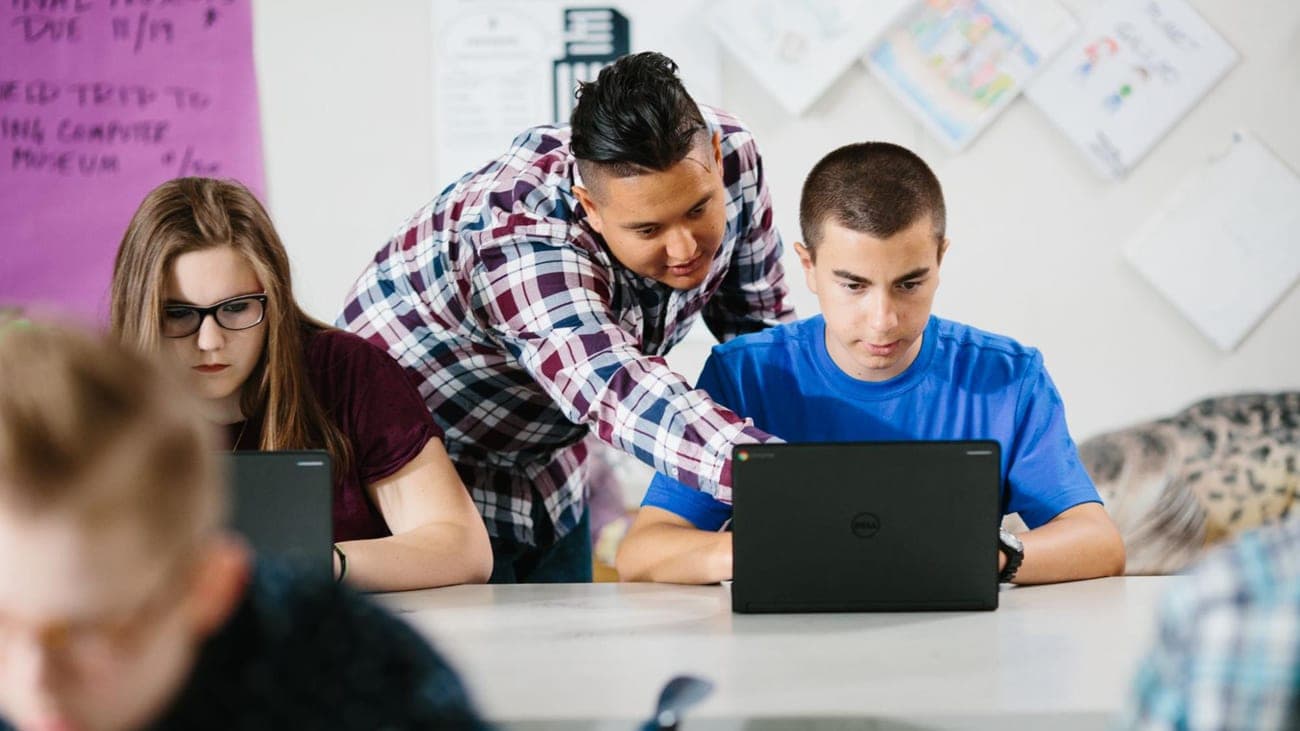
Google's tools are everywhere in schools. Many classrooms run on Chromebooks, the low-cost laptops built around Google's software, and on Google accounts for email, documents and classwork. We looked at that reach in our story on ChromeOS support ending in 2034.
That reach is why a bundled setting matters. When one company supplies the laptops, the accounts and the search engine, how it packages its AI decides what many schools can choose. The new design gives schools a clear off switch for the assistants. It gives them no separate one for the AI inside Search.
Why it matters: for a school, "no AI" now has a price, and the price is Search on student accounts.
What is still unknown?
Google's announcement leaves several questions open, and it says more specifics are coming.
- The exact date: Google has not given a day for the switch. It says only that schools will hear more in the coming months.
- Which schools join the Search pilot: Google says "select U.S. schools" and has not listed them.
- How Guided Learning is triggered: Google says Search will offer it when its systems understand a student wants certain kinds of homework help. It has not said how that is decided.
- Finer controls: Google has not said whether schools will ever get a separate switch for AI inside Search.
Until those answers arrive, the safest reading is the plain one. Everything is off by default, and the school chooses.
What it means for you
- If you are a parent: ask your child's school what it plans to turn on. The default will be off, so the school makes the call.
- If you are a teacher: Guided Learning is in Google Classroom now, and you can assign it like any other activity.
- If you run school IT: expect more details from Google in the coming months, and plan your choices before the new default arrives.
- If you are a student: your school decides what you can use, and a school that blocks AI will see Search blocked too.
The bottom line
Google is moving from AI on by default to AI off until a school says yes. That gives schools more control over the assistants. The tradeoff is that the AI inside Search comes bundled with Search, so saying no to one means saying no to both.
Guided Learning is Google's answer to the worry about shortcuts. It is live in Classroom today, and the first test in Search comes later this month.
Key facts
- Products turned off by default
- Gemini, Gemini Notebook, Gemini in Classroom, Search
- Who it covers
- K-12 student accounts
- Guided Learning in Classroom
- Global, available now
- Guided Learning in Search
- US school pilot, later this month
- Google Classroom users
- More than 150 million
Got questions?
Quick answers, plain wordsWhat exactly did Google announce?
Google said access to Gemini, Gemini Notebook, Gemini in Classroom and Google Search will be entirely off for K-12 student accounts until school administrators explicitly turn them on.
When does the change start?
Google has said it will share more specifics with schools in the coming months so they can prepare. Reports of the plan point to early 2027 for the switch.
Can a school turn off Google's AI and keep Search?
No. Google's education chief Chris Phillips said Search and AI are deeply integrated, so a school that turns off Google's AI features will not have access to Search.
What will students see if their school blocks AI?
Phillips said students will see a message from their school saying Search is not available.
What is Guided Learning?
It is a study mode that coaches students with open-ended questions and step-by-step prompts instead of handing over a final answer. It started in Gemini and is now spreading to Classroom and Search.
Is Guided Learning available now?
In Google Classroom, yes: it is available worldwide starting today. In Search, a pilot starts in select US schools later this month, before expanding to other districts in the coming months.
Who decides whether students get these tools?
School administrators, the staff who manage a school's Google accounts. Nothing is on for student accounts until they choose to turn a product on.
Does this affect adults or teachers?
The announcement is about K-12 student accounts. It does not describe changes for teachers, other adults or people using Search at home.
Why is Google doing this now?
Google says it listened to schools, teachers, researchers and policymakers. The change follows concerns about AI in classrooms, including questions from lawmakers last month.
How many people use Google Classroom?
More than 150 million teachers and students use it worldwide.
SourcesGoogle
Topics and tagsGoogle, google, gemini, education
Related guide
Guide, 8 minHow to use Gemini: Live camera help, Skills and Android scam protectionUse Gemini Live with your camera, prepare for Gems turning into Skills, and switch on the opt-in scam protection in Google Messages.Related stories

Four Gemini 4 Argon agents beat Minecraft with no human help
Google DeepMind researchers gave four AI agents one goal, defeat the Ender Dragon, and no game tools. Twenty-seven hours and 605 deaths later, the dragon fell.
Google's Gemini 4 Argon reaches the Gemini app, Search and developers
Two weeks after a defenders-only debut, Google is rolling out Gemini 4 Argon to AI Pro and Ultra subscribers and to developers, with a robotics showcase on the side.
Google launches Nano Banana 2.1, a better image model at half the price
Google's new Flash image model improves text, editing and character consistency, and cuts the developer price per 1K image from 6.7 to 3.36 cents.
More in brief
- Peak Design, the backpack maker, now sells a $100 wireless charger and $25 cablesNov 3
- Apple says the $400 extra for the new MacBook Pro screen buys a pro monitorNov 3
- Tutor Intelligence raises $75M to rent out warehouse robots by the hourNov 3
- Apple Watch can now replay what someone just said, in betaNov 3
- Robots race up Mount Tai's 3,100 stone steps in China's first mountain contestNov 3
- Apple posts record $114.5 billion quarter, then warns of slower growthNov 3