
Robots·News & analysis
Tutor Intelligence raises $75M to rent out warehouse robots by the hour
The MIT spinoff closed a $75 million Series B led by Andreessen Horowitz. Its robots work in factories and warehouses, and customers pay by the hour or by the pick.
 Techlantis
Tide
Ripple
Sci-fi
7/10
Reality
Shipping
Robot interns, trained by teachers who work from far away.How we rate
Tutor Intelligence, an MIT spinoff that rents warehouse robots by the hour or by the pick, raised a $75 million Series B led by Andreessen Horowitz.
Its total funding is now $117 million. The company says it has twice as many robots in almost four times as many facilities as a year ago. It expects more than 1,000 robots under contract by the end of 2027.
What to know
- Tutor Intelligence raised $75 million in a Series B round led by Andreessen Horowitz, bringing its total funding to $117 million.
- Customers pay by the hour or by the pick, with no upfront purchase and no long-term contract.
- The company says it has twice as many robots working in almost four times as many facilities as a year ago.
- It expects more than 1,000 robots under contract by the end of 2027, all built and deployed from the US.
Tutor Intelligence just raised $75 million to put more robots to work in warehouses and factories. The twist is that you do not buy them. You rent them by the hour, like a worker.
What did Tutor Intelligence announce?
The company closed a $75 million Series B. That is a funding round for a young company that already has customers and wants to grow faster.
Andreessen Horowitz, a big venture capital firm, led the round. Union Square Ventures and Neo also joined. They led the company's Series A and seed rounds, which are the earlier, smaller rounds.
Total funding is now $117 million. A Series A of $34 million came in December 2025.
Tutor says the money will pay for three things: training its robot AI model, building robots, and sending them to customers.
Who is Tutor Intelligence?
It is a robotics company based in Watertown, Massachusetts. Josh Gruenstein and Alon Kosowsky-Sachs started it in 2021 at MIT's computer science and AI lab. Gruenstein is the CEO, and Kosowsky-Sachs is the chief technology officer.
The company builds both the software and the robot bodies. It does not sell you a robot and wave goodbye. It runs the whole system.
Why do customers pay by the hour?
Most robot companies sell a machine or lease it for years. Tutor does something different.
- Pricing: customers pay by the hour or by the pick. A pick is one item grabbed and moved.
- Upfront cost: none. There is no purchase.
- Contract: no long-term deal.
- Service: Tutor handles setup, repairs and software upgrades.
That is the same way a company pays for manual labor. The idea is simple. A small warehouse may never spend millions on a custom machine, but it can rent a worker.
In real life Think of a ride-share app. You do not buy the car. You pay for the time you use it, and someone else fixes the engine.
Who are the "tutors"?
The name is not just branding. Tutor's robots work in real customer sites with help from remote operators called tutors. When a robot gets stuck, a person can guide it from a screen.
Remote operation like this is called teleoperation, which means a human steers a robot from far away. Tutor says its operators work from places such as Mexico and the Philippines.
There is a second job for the tutors. Every time one helps, the robot learns something. Gruenstein has said that intelligence is "almost a byproduct" of running the business. The company runs, the robots get better, and the better robots can do more jobs for less money.
Why it matters: robots have no giant library to learn from. AI chatbots read the internet. A robot that learns to pick up a bag of snacks needs real examples of someone doing it.
What are Sonny and Cassie?
Tutor has two robot models.
- Sonny: a two-armed, semi-humanoid robot for picking items. It is named after the robot in the movie I, Robot.
- Cassie: a mobile robot with one arm. It handles case picking and palletizing, which means grabbing boxes and stacking them on a pallet, the flat wooden platform that goes on a forklift.
Earlier this year, the company said the latest Cassie can be set up in two days. It can lift boxes up to 50 pounds, about 22.6 kilograms, and move up to 14 cases a minute.
The robots handle breakfast cereal, snacks, candy, cosmetics, home goods and toys. They work in some of the largest manufacturing and logistics networks in the country.
How is the robot AI trained?
Tutor runs a training site it calls DF1, short for Data Factory 1. It is a room of 100 Sonny robots at its headquarters in an old mill in Watertown. The company says it is the largest robot data factory in the US.
Think of it as a kindergarten for robots. At first they were clumsy with sponges and bags of snacks. Teams of tutors and on-site staff taught them.
The setup has one big advantage. Tutor can test the same robot behavior on all 100 robots at once. The company says that lets it find and fix mistakes about 100 times faster. A problem that takes eight hours of one robot's work to notice shows up in five minutes.
The model it trains is called Ti0. It is a vision-language-action model, or VLA. That means an AI that looks at the world through cameras, understands instructions in words, and decides what the robot's arms should do.
Tutor also trains in real life more than in simulation. Simulation means practicing in a computer-made world.
Are the robots catching on?
Tutor says yes. It reports that twice as many robots work for customers than a year ago, in almost four times as many facilities.
Nearly a third of the organizations that received Tutor robots in the past 12 months were existing customers buying more. Gruenstein says the company "can hardly build robots fast enough."
The company expects more than 1,000 robots under contract by the end of 2027. It says all of them will be built in the US.
Tutor says the growth shows a shift in how companies see physical AI, which means AI that works in the real world, not only on screens. Firms are moving from small tests to expecting a clear return on the money they spend.
Why not just buy one big machine?
Gruenstein says about 90% of factories still have no robots at all. In his talks with supply chain chiefs, he hears a common worry: advanced robots need a babysitter.
The old way to automate was a specialized machine that costs around $2 million. It sits in the middle of a line and does one narrow job for one product. Gruenstein says customers now think differently when they see Sonny.
A rented robot that can switch tasks is easier to justify than a single-purpose machine.
What about safety and help from big tech?
Cassie uses cameras to see and can connect to outside sensors. Its safety features include zones watched by lidar, a laser sensor that measures distance. It also follows ISO/TS 15066, an international standard for robots that work near people.
The company has also worked with Amazon Web Services for cloud computing and with NVIDIA for AI modeling. It joined the first group of the Physical AI Fellowship, a program with support from AWS, NVIDIA and MassRobotics.
Another detail shows how careful the training is. Different operators move at different speeds. Tutor uses a method it calls velocity normalization to even out those speeds before the AI learns from them.
What is the catch?
Tutor's numbers come from the company itself. These are claims, not independent measurements.
Also, the robots are not fully independent. They rely on human operators for hard cases. That is by design, and Gruenstein has said that pretending hard cases do not exist pushes the problem onto the customer.
The company says its robots are not trying to look like people. The point is to be useful, not to be a humanoid.
What it means for you
- If you work in a warehouse: you may see more robots on the floor over the next few years, with remote helpers behind them.
- If you run a small business: renting a robot by the hour is a new option that needs no big purchase.
- If you buy things online: more automation in packing and moving goods could, in time, help keep costs down.
- If you follow AI: this is a sign that investors are betting on robots learning from real work, not just from computers.
The bottom line
Tutor Intelligence wants robots to be as easy to hire as a temp worker. A $75 million round gives it room to build more of them and teach them more jobs. The proof will be whether those 1,000 robots show up by the end of 2027.
Key facts
- Round
- $75 million Series B
- Lead investor
- Andreessen Horowitz
- Total raised
- $117 million
- Pricing
- By the hour or by the pick
- Target
- 1,000+ robots under contract by end of 2027
Got questions?
Quick answers, plain wordsWhat is Tutor Intelligence?
It is a robotics company based in Watertown, Massachusetts. It spun out of MIT's computer science lab in 2021 and builds robots that pick, lift and stack items in factories and warehouses.
How much did Tutor Intelligence raise?
It raised $75 million in a Series B round, a funding round for a company that already has customers and wants to grow faster. Total funding is now $117 million.
Who led the funding round?
Andreessen Horowitz led the round. Union Square Ventures and Neo, which led the earlier Series A and seed rounds, also took part.
How do customers pay for the robots?
They pay by the hour or by the pick, the same way they would pay for human labor. They buy nothing upfront and sign no long-term contract, and Tutor handles setup, repairs and software upgrades.
What are Sonny and Cassie?
Sonny is a two-armed, semi-humanoid robot for picking items. Cassie is a mobile robot with one arm, built for picking cases and stacking them on pallets.
What are the human 'tutors'?
They are remote operators who step in when a robot gets stuck. Their help also becomes training data, so the robots get better over time. Tutor says its operators work from places such as Mexico and the Philippines.
How many robots does Tutor Intelligence plan to have?
The company says it is on track to have more than 1,000 robots under contract by the end of 2027. It says all of them will be built in the US.
What will the new money be spent on?
Tutor says it will fund training of its robot foundation model, plus manufacturing and deployment of Sonny and Cassie.
Are these robots replacing people?
The story does not say. Tutor says its robots take on tasks that are hard for older robots, and that its customers are companies trying to keep basic goods affordable. The robots still rely on human operators for hard cases.
Can I buy a Tutor robot for my home?
No. The robots work in factories, warehouses and logistics networks, handling goods like cereal, snacks, cosmetics and toys.
SourcesThe Robot Report
Topics and tagsIndustrial robots, Funding & deals, tutor intelligence, warehouse robots
Go deeper
Related stories
Percepto launches Axion, AI that reads inspection data from any drone
Percepto, the drone-in-a-box maker, is selling its inspection AI as software that works with other companies' drones and sensors.
Teradyne Robotics and Sereact team up to put AI-driven robot arms in warehouses
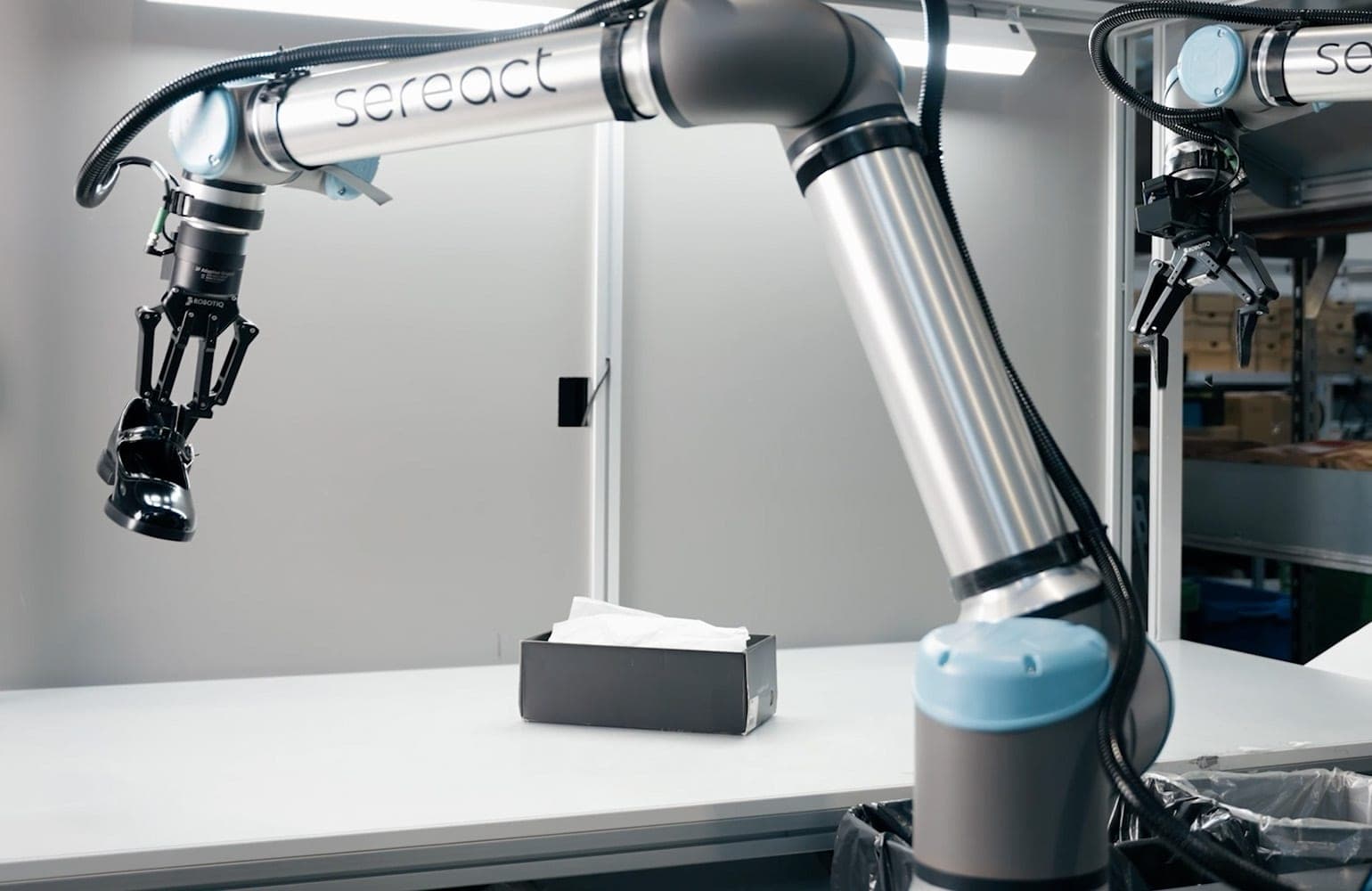
Sereact's Cortex AI will run on Universal Robots arms, and hundreds of dual-arm systems already sort returned fashion at Zalando sites in Germany and Poland.
Eka Robotics raises $150M for robot hands that feel what they grip
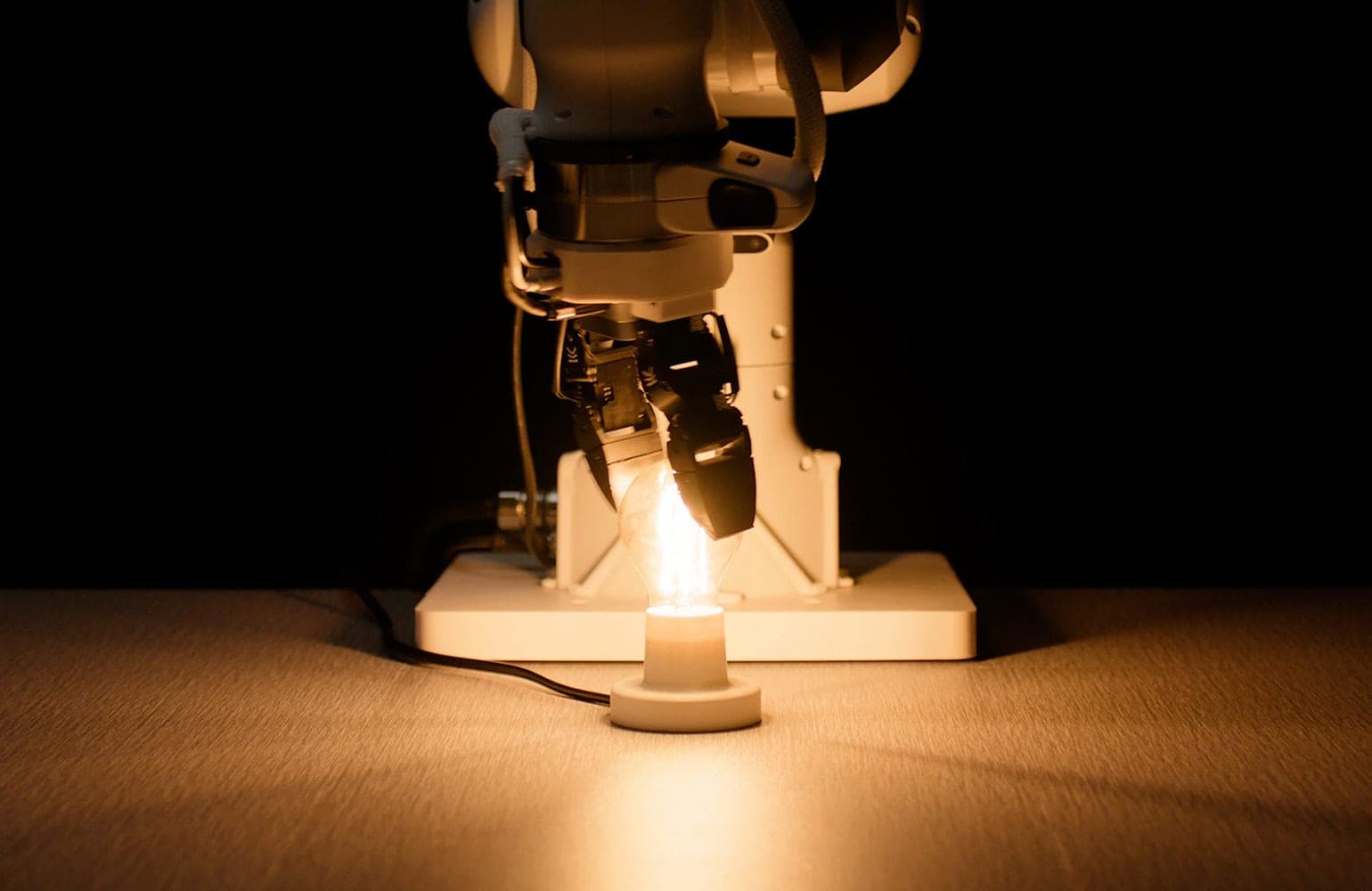
The Cambridge startup says its vision-force-action model picks about 1,500 objects an hour. A $150 million Series A at a $1.45 billion valuation will fund the push into real factories.
More in brief
- Apple Watch can now replay what someone just said, in betaNov 3
- Robots race up Mount Tai's 3,100 stone steps in China's first mountain contestNov 3
- Apple posts record $114.5 billion quarter, then warns of slower growthNov 3
- Agility Robotics clears its SPAC vote and heads to Nasdaq this weekNov 3
- Marvell to buy Lumentum in a $115 billion all-stock deal for AI opticsNov 2
- Google cuts off a botnet of 1.3 million Android TV boxes built in at the factoryNov 2