
Technology·News & analysis
California legalizes plug-in balcony solar, but compliant kits aren't here yet
A new state law lets renters and homeowners plug small solar panels into a wall outlet starting in 2027, making California the 10th state to allow so-called balcony solar.
Tide
Wave
Sci-fi
2/10
Reality
In your hands
Your balcony becomes a tiny power plant. Just plug it in.How we rate
California has legalized plug-in balcony solar under SB 868, letting renters and homeowners plug up to 1,200 watts of solar into a wall outlet from January 1, 2027.
Kits must be safety certified and shut off during outages. California is the 10th state to allow it, roughly doubling the US market. Compliant kits are expected next spring.
What to know
- California has legalized plug-in solar panels, often called balcony solar, under SB 868, the Plug and Play Solar Act.
- The law takes effect on January 1, 2027, and allows up to 1,200 watts of plug-in solar per home.
- Kits must be certified by UL or an equivalent lab and shut off automatically during a grid outage.
- CNET reports no kit on the market yet meets California's rules, with compliant models expected next spring.
Californians who can't put solar panels on a roof will soon be able to hang them on a balcony and plug them into the wall. Gov. Gavin Newsom has signed SB 868, the Plug and Play Solar Act, legalizing plug-in solar devices across the state, pv magazine USA reports.
What does the new law allow?
SB 868 was introduced in January by state Sen. Scott Wiener, who represents San Francisco and part of northern San Mateo County. Newsom signed it on September 30, the last day to act on bills from the 2026 session.
The key rules, according to pv magazine USA:
- Start date: the law takes effect on January 1, 2027.
- What's covered: "portable solar generation devices," meaning solar panels that connect to a building's wiring through a regular outlet and offset the electricity used on site.
- The limit: a single home can have devices with a total output of no more than 1,200 watts.
- Utilities: the devices are exempt from utility interconnection requirements, and utilities can't charge fees or require customers to get permission to use them.
CNET adds that the law covers apartments, condos and single-family homes, and notes that 1,200 watts is about enough to power a window air conditioner.
"These small, easy-to-use solar panels will give everyone, including renters, the relief they desperately need on our outrageous energy bills," Wiener said in a statement, as reported by pv magazine USA.
What are the safety rules?
Plug-in solar isn't a free-for-all. The law requires:
- Certification: kits must be certified by UL or an equivalent testing laboratory, pv magazine USA reports.
- Outage protection: systems must not feed power back into the grid during a power outage. CNET says that may require a separate smart power management meter.
The catch: CNET also reports that systems will need to be registered, much like a rooftop solar system. That sits a little awkwardly next to the law's exemption from utility interconnection, and the exact process is something buyers will want to check once kits arrive.
Why does it matter?
The big picture: until laws like this, installing solar that could send power back to the grid required an interconnection agreement with the utility.
In California, that process cost $100 to $800 upfront and took about an hour to complete, with approval typically taking three days, CNET reports, citing PG&E. Plug-in solar skips the expensive wiring and installation of rooftop panels, so it can go on a balcony, in a backyard or on a roof wherever there's open space and a standard outlet.
That makes it one of the few ways renters and apartment dwellers can generate some of their own solar power.
"This new law will deliver cleaner power, greater energy independence and real savings for consumers," said Bernadette Del Chiaro, senior vice president for California at the nonprofit Environmental Working Group, one of the groups that pushed for the bill, according to pv magazine USA.
In real life Picture a renter in a sunny Los Angeles apartment hanging two panels on the balcony railing and plugging them into an outdoor outlet. The power they make gets used in the apartment first, trimming the electric bill a little every sunny day.
How does California compare?
California is the 10th state to legalize balcony solar, and the Environmental Working Group says it effectively doubles the size of the US market, according to CNET.
- Utah was first, in 2025, with HB 340, pv magazine USA reports.
- New Jersey is among the more recent states. CNET says its law stops landlords and local governments from blocking residents from installing systems up to 1,200 watts.
- New York passed its SUNNY Act in June, but it still awaits Gov. Kathy Hochul's signature, according to pv magazine USA.
- The trend: 35 states considered plug-in solar laws in 2026, pv magazine USA reports.
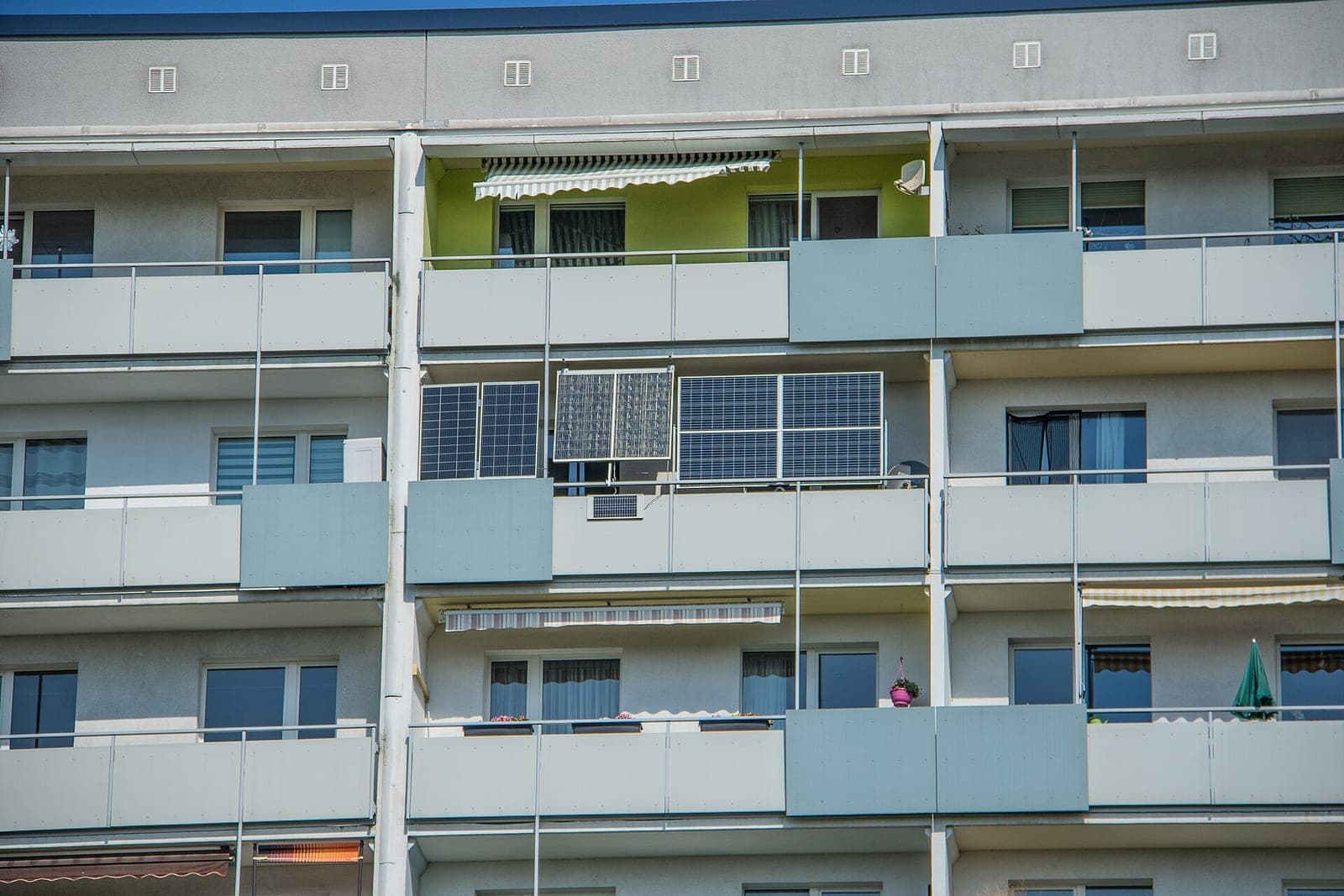
The technology is already big in Europe. Germany alone has 4 million systems installed, CNET reports. The photo above shows balcony panels on an apartment block in Leipzig.
Is there a deadline built in?
Yes, and it matters. pv magazine USA reports that utilities got a 2030 sunset added to the bill.
The sunset would repeal the rules that exempt plug-in solar from interconnection requirements and stop utilities from requiring permission. It was a last-minute addition by the Assembly Appropriations Committee in August, before the bill's final vote.
Kevin Chou, a co-founder of the nonprofit Bright Saver, is betting on demand to keep the rules in place. "The way we beat it is to put plug-in solar on so many California balconies by then that no legislator will vote to take it away," he told pv magazine USA.
Bright Saver has been selling plug-in solar kits to Californians for more than a year, most recently at cost, operating in something of a legal gray area to show the technology is safe and useful while it pushed for rules, pv magazine USA reports.
Chou said a policy expert once told him a California law would take three to five years. "Plug-in solar is so easy to understand that it only took one legislative session," he said.
Can you buy a kit now?
Not yet, says CNET. It reports that none of the units currently on the market meet California's requirements. Groups that sponsored the bill expect compliant models to arrive in the spring, and noncompliant systems will become illegal in the state in 2030.
Manufacturers are watching closely. At the IFA tech show in Berlin in September, CNET saw balcony solar systems from Jackery, EcoFlow, Bluetti and others. A Bluetti representative said the company was waiting for US regulations to settle before releasing its systems here. pv magazine USA notes that EcoFlow's STREAM series has been popular in Utah.
"This is a huge win for California renters, condo owners and anyone who wants an affordable, simple path to more energy independence," EcoFlow's head of communications, Ryan Oliver, told pv magazine USA.
Other supporters of SB 868 included the California Solar and Storage Association, the Sierra Club and Bright Saver, according to pv magazine USA. "These new tools will make energy more affordable for everybody by getting more usage out of the infrastructure that Californians have already paid for," said Brad Heavner, the solar association's executive director.
For more on energy costs and tech, see our story on Amazon's $1 billion pledge to data center towns, which also deals with power bills.
What it means for you
- If you rent in California: you'll be able to use plug-in solar starting January 1, 2027, without needing utility permission, according to pv magazine USA.
- Wait to buy: CNET says no current kit meets the rules, so hold off until certified, California-compliant models arrive, expected next spring.
- Check the details: look for UL certification, the 1,200-watt limit and automatic shut-off during outages, and check any registration steps.
- Outside California: check your state, since 10 now allow plug-in solar and more are considering it.
The bottom line
California has legalized plug-in balcony solar, opening the door for renters and apartment dwellers to make some of their own power from 2027. The rules are set, but compliant kits aren't on shelves yet. If you're in California, the best move for now is to wait until spring.
Key facts
- Law
- SB 868, the Plug and Play Solar Act
- Signed
- September 30, 2026
- Takes effect
- January 1, 2027
- Limit
- 1,200 watts of plug-in solar per home
- Rank
- 10th US state to legalize plug-in solar
Got questions?
Quick answers, plain wordsWhat is balcony solar?
It's a small solar panel kit that plugs into a regular wall outlet instead of being wired into your home's electrical system. They're often used on balconies, which is where the name comes from, but they can go anywhere with open space and an outlet.
Is balcony solar legal in California?
Yes. SB 868, the Plug and Play Solar Act, was signed on September 30, 2026, and takes effect on January 1, 2027.
How much solar can I plug in?
A single home can have plug-in solar devices with a total output of no more than 1,200 watts, according to pv magazine USA. CNET says that's about enough to power a window AC unit.
Can renters use balcony solar?
Yes. The law covers apartments, condos and single-family homes, and supporters say it's aimed largely at renters who can't install rooftop solar.
Do I need my utility's permission?
According to pv magazine USA, the law exempts these devices from utility interconnection requirements and bars utilities from charging fees or requiring customers to get permission. CNET reports that systems will still need to be registered.
What safety rules apply?
Kits must be certified by UL or an equivalent testing lab and must not feed power into the grid during an outage, to protect line workers.
Can I buy a kit now?
CNET advises waiting. It reports that none of the units currently on the market meet California's requirements, and compliant models are expected in the spring.
Which other states allow balcony solar?
California is the 10th state. Utah was the first, in 2025, and New Jersey is among the more recent, CNET and pv magazine USA report.
How popular is balcony solar elsewhere?
It's common in Europe, especially Germany, where 4 million systems have been installed, according to CNET.
Sourcespv magazine USA
Topics and tagsAI policy, solar, energy, california
Related stories
Amazon pledges $1B+ to the towns that host its data centers
AWS's new Built Together program promises free community college, home energy upgrades and local grants over five years, as more than 100 data center moratoriums are being weighed across the US.
Apple's smart home hub reportedly launches October 13, with a camera that never records video
Bloomberg's Mark Gurman says Apple will announce its long-rumored smart home display on October 13. He also describes a companion home camera that sends text descriptions instead of video.
Fervo's Cape Station becomes the first enhanced geothermal plant to sell power commercially
Fervo Energy's first 33-megawatt block at Cape Station in Utah reached commercial operation a day ahead of schedule, after 23 months of construction. Two more blocks follow by January 2027.
More in brief
- Space Force retires the last of its Cold War missile-warning satellitesOct 2
- Anthropic commits $100 million to train 10,000 engineers to deploy ClaudeOct 2
- Runway's Praxis-1 wants to teach robots from video instead of demosOct 2
- Apple is tightening Mac 'Full Disk Access' because of AI agentsOct 2
- Rivian's deliveries jump as its cheaper R2 starts to ramp upOct 2
- Nvidia ends the base Shield TV and raises the Shield TV Pro to $299Oct 2