
Technology·News & analysis
AMD's Lux supercomputer opens to scientists at Oak Ridge
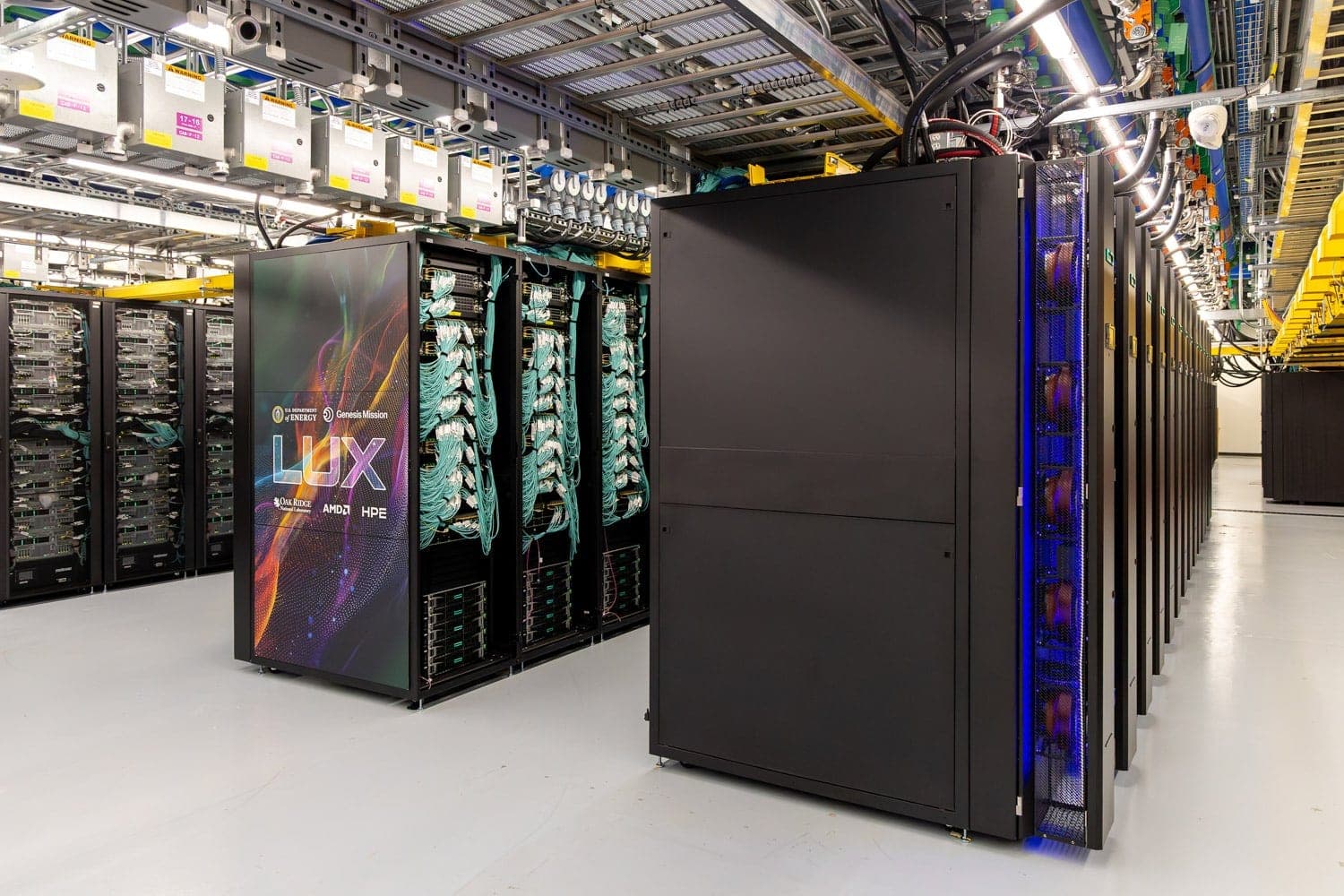
Lux, an AI supercomputer built by AMD and HPE, is now open to researchers at Oak Ridge National Laboratory. It is the first dedicated AI system for the Genesis Mission.

Tide
Ripple
Sci-fi
6/10
Reality
Shipping
A computer built to help science think faster.How we rate
AMD announced that its Lux supercomputer is open to scientific users at the Department of Energy's Oak Ridge National Laboratory.
Lux is the first dedicated AI Factory for the Genesis Mission and ranks 14th on the TOP500 list. It runs on AMD EPYC processors and Instinct MI355X GPUs, built by HPE. First projects cover fusion design, materials and water forecasts, and Discovery follows in 2028.
What to know
- AMD announced that the Lux supercomputer is open to scientific users at the US Department of Energy's Oak Ridge National Laboratory in Tennessee.
- Lux is the first dedicated US AI Factory for the Genesis Mission, a Department of Energy effort to speed up science with AI. It is ranked 14th on the TOP500 list of the world's most powerful supercomputers.
- It uses AMD EPYC processors, AMD Instinct MI355X GPUs, AMD Pensando networking and AMD ROCm software, in a system built by HPE.
- First projects cover fusion power plant design, materials development and a forecast of water availability in the Tennessee Valley.
AMD just announced that Lux, a new AI supercomputer, is open to scientists at Oak Ridge National Laboratory. It is the first computer of its kind built for a big US science push. Now the fun part: what does a lab actually do with a machine like this?
AMD announced the news on Monday, November 16, 2026. Lux came out of a partnership between AMD and the US Department of Energy, and HPE built the system.
First, what is a supercomputer?
A supercomputer is a huge group of computers wired together so they work on one problem at the same time. Think of a kitchen with thousands of cooks. Each cook has a tiny job, and the meal is ready far faster than one chef could manage.
Scientists use them to test ideas as math before testing them in the real world. A simulation is a computer experiment: you model a wing, a river or a metal and watch what happens, without building anything.
Lux ranks 14th on the TOP500 list, the twice-a-year ranking of the world's most powerful supercomputers. The new list came out on the same day as the announcement.
What makes Lux an "AI Factory"?
AMD calls Lux the first dedicated US AI Factory for the Genesis Mission. An AI factory is a computer built mainly to train and run AI models, not only to crunch classic simulations.
Lux does both jobs. AMD says it combines AI with high-performance modeling and simulation. That matters because many science problems need both. AI is good at spotting patterns in data. Simulation is good at following the laws of physics.
Why it matters: researchers can train and refine models on scientific data, combine AI with established simulation methods, and tackle problems that need more computing power than their home institutions have.
What is the Genesis Mission?
The Genesis Mission is a Department of Energy led effort to advance science with AI. It brings together national laboratories, industry and universities to apply AI, simulation and scientific data to energy, discovery science and national security.
Lux is, in the words of Georgia Tourassi, Oak Ridge's associate laboratory director for computing, "the first major addition to DOE's computing infrastructure in support of the Genesis Mission."
AMD says it is also working with Oak Ridge on the American Science Cloud. That is a national platform meant to spread advanced AI and high-performance computing across DOE laboratories, universities and mission partners.
What is inside Lux?
AMD and Oak Ridge list the main parts:
- Processors: AMD EPYC CPUs, the general-purpose brains of each server.
- GPUs: AMD Instinct MI355X, chips that do huge amounts of simple math at once. Oak Ridge lists more than 4,000 of them across more than 500 nodes, where a node is one server.
- Networking: AMD Pensando, the hardware that moves data between the servers.
- Software: AMD ROCm, AMD's toolkit for programming its GPUs.
- Builder: HPE assembled the system.
Each GPU carries 288 GB of fast memory, which adds up to about 1.1 petabytes across the machine. A petabyte is a million gigabytes.
In real life Picture a researcher with a huge pile of materials data. On a laptop, training an AI model on it would take months. On a machine like Lux, many GPUs share the work and the job finishes in a fraction of that time.
How fast is it?
Oak Ridge lists three headline numbers for Lux:
- AI inference: 40 exaflops of low-precision math. Inference means running a trained AI model to get answers.
- AI training: 20 exaflops. Training means teaching a model from data.
- Precise science math (FP64): 317 petaflops, the kind of exact 64-bit math physics simulations need.
An exaflop is a billion billion math operations a second. A petaflop is a thousand times smaller. The AI numbers use shorter, less precise math, which is why they look so much bigger.
By the numbers: the machine also has more than 24 TB of fast flash storage in each node and links to Oak Ridge's Orion file system, which holds over 600 petabytes.
What will scientists do with it?
AMD names three Genesis Mission projects that will run on Lux:
- Fusion power: AI-assisted design of a fusion power plant.
- Materials: an AI "foundation model factory" for materials development and advanced manufacturing. A foundation model is a large AI model that can be adapted to many tasks.
- Earth systems: forecasts of water availability, streamflow and river temperature in the Tennessee Valley Authority region.
Oak Ridge says half of Lux's yearly 3.5 million node-hours go to the Genesis Mission. The other half is available to partners, who can sign up for terms from six months to five years.
Why Oak Ridge, and what came before?
Lux builds on Frontier, the Oak Ridge machine that was the first supercomputer to break the exascale barrier. Exascale means a billion billion math operations a second.
AMD describes Lux as the next step of the long relationship between AMD, HPE, the Department of Energy and Oak Ridge. The two companies and the lab announced Lux and a bigger system, Discovery, in October 2025 as part of a joint investment of about $1 billion.
To see what these machines can do, look at Frontier: a plant-imaging analysis that took 168 hours was cut to under one minute on that system.
How do outside companies get time?
Oak Ridge says Lux is not only for government projects. Half of its capacity can be used by partners, including for proprietary work, meaning a company's private research.
The terms are set by the lab:
- Minimum: 175,000 node-hours per six-month period. A node-hour is one server running for one hour.
- Length: from six months up to five years, and a partner can start in any month.
- Tools: users can schedule jobs with Slurm, a common job queue for supercomputers, or with Kubernetes, a popular tool for running cloud-style AI services.
This is why the lab calls Lux a place for both classic supercomputing and cloud-native AI services: one machine, two ways of working.
What about security?
Lux runs under the Department of Energy's Moderate security controls, the same level as Frontier. Oak Ridge lists a planned upgrade to Moderate-Enhanced controls, which would support work with export-controlled data (ITAR) and protected health information.
The catch: that upgrade is a plan, not a finished feature. Until it arrives, work that needs the stricter controls has to wait.
How does the hardware talk to itself?
Big AI jobs spread across many GPUs, so the wires between them matter as much as the chips. Oak Ridge lists a 400G Ultra Ethernet network card for every GPU, meaning each chip has its own very fast connection to the rest of the machine.
Each GPU also moves memory at up to 8 TB/s. In plain terms, that is how quickly the chip can read the data it is working on. A GPU that waits for data is a GPU doing nothing, so speed here keeps the machine busy.
What is next?
The next system is Discovery. It will use AMD's next-generation EPYC Venice processors and Instinct MI430X GPUs, with delivery expected in 2028 and user access in 2029.
AMD says Discovery will connect AI and high-performance computing even more tightly. Together, Frontier, Lux and Discovery are meant to help researchers link simulation, AI and scientific data.
What's next: researchers and organizations who want time on Lux are asked to contact Oak Ridge's Leadership Computing Facility to discuss their needs and the access options.
What it means for you
- You will not use Lux directly. It is a research machine, and time on it goes to labs, universities and partners.
- You may feel the results. Better materials, power plant designs and water forecasts come from this kind of computing.
- Chip competition continues. Lux shows AMD GPUs doing top-tier AI and science work, a field Nvidia has led.
- More is coming. Discovery will arrive in 2028, so expect more news.
The bottom line
Lux is open, it is ranked among the 14 fastest computers in the world, and scientists can start using it now. It is built to mix AI with classic simulation. The real test is the discoveries that come out of it over the next few years.
Key facts
- System
- Lux, built by HPE with AMD chips
- Size
- 4,000+ MI355X GPUs in 500+ nodes
- TOP500 rank
- 14th, November 2026 list
- Location
- Oak Ridge National Laboratory, Tennessee
- Next system
- Discovery, delivery expected in 2028
Got questions?
Quick answers, plain wordsWhat is the Lux supercomputer?
Lux is an AI and high-performance computing system at Oak Ridge National Laboratory. AMD and the Department of Energy built it with HPE, and it opened to scientific users on November 16, 2026.
What is the Genesis Mission?
It is a Department of Energy led effort to use AI to speed up science. Lux is described as its first dedicated AI Factory, meaning a computer built mainly to train and run AI for research.
What chips does Lux use?
AMD EPYC processors, AMD Instinct MI355X GPUs and AMD Pensando networking, with AMD ROCm software. HPE built the system.
How big is Lux?
Oak Ridge's system page lists more than 4,000 MI355X GPUs across more than 500 nodes. A node is one server in the cluster.
How fast is Lux?
It ranks 14th on the TOP500 list published on November 16, 2026. Oak Ridge lists 317 petaflops of precise 64-bit math, 20 exaflops of AI training math and 40 exaflops of AI inference math.
Who can use Lux?
Researchers and organizations are asked to contact the Oak Ridge Leadership Computing Facility to discuss their needs and the access options. Oak Ridge says half of the yearly capacity serves the Genesis Mission and half is open to partners.
What will scientists do with it?
The first projects include AI-assisted fusion power plant design, an AI model factory for materials and advanced manufacturing, and forecasts of water availability, streamflow and river temperature in the Tennessee Valley.
What is Discovery?
Discovery is the next Oak Ridge supercomputer, built with AMD and HPE. It will use AMD EPYC Venice processors and Instinct MI430X GPUs, with delivery expected in 2028.
What is Frontier?
Frontier is the Oak Ridge supercomputer that was the first in the world to break the exascale barrier, meaning a billion billion math operations a second. Lux builds on that foundation.
Is this something I can use at home?
No. Lux is a research machine in a laboratory. You may feel its results later, in things like better materials, energy designs and weather and water forecasts.
SourcesAMD
Topics and tagsamd, supercomputing, genesis mission, oak ridge
Go deeper
- ExplainerWhat is a GPU, and why does AI need them?A GPU (graphics processing unit) is a chip that does huge numbers of simple calculations at the same time. Built to...
- ExplainerWhat is AI inference?AI inference is when a trained model is put to work on something new, like answering your prompt or recognizing a...
Related stories

Arm says its chip designs run the fastest supercomputers
The new TOP500 list has a record low of 27 new machines. Arm says its chip designs sit at No. 1 on both the speed list and the energy efficiency list.
Nvidia unveils Rubin HPC, a science GPU with over 50,000 cores
Nvidia's new Rubin HPC chip packs a record number of CUDA cores and is built for science simulations run by AI agents. It is due in 2028.

AMD confirms a Radeon driver bug that keeps writing to your SSD
A small background service in AMD's Radeon software can write to your system drive nonstop, even when the PC is idle. AMD says a fix is coming in Adrenalin 26.11.1.
More in brief
- ASELSAN's EJDERHA electromagnetic weapon disables 51 drones with one commandNov 21
- Microsoft To Do will shut down on June 30, 2027Nov 21
- Medtronic's Hugo surgical robot cleared for general surgery in the USNov 21
- Google's Gemini now turns noisy fire radio into text for Watch DutyNov 21
- Internet Archive staff move to unionize with CWANov 20
- Etsy sellers are leaving over new terms that allow AI trainingNov 20