
Technology·News & analysis
Nvidia unveils Rubin HPC, a science GPU with over 50,000 cores
Nvidia's new Rubin HPC chip packs a record number of CUDA cores and is built for science simulations run by AI agents. It is due in 2028.

Tide
Ripple
Sci-fi
6/10
Reality
Demo
A chip built to help robots run the experiments.How we rate
Nvidia announced Rubin HPC, a new GPU for science, engineering and analytics, at the SC26 supercomputing show.
It carries more than 50,000 CUDA cores on one GPU, a record for the company, plus seventh-generation NVLink. Nvidia has not shared the memory details or the physical layout. The chip is expected to be available in 2028.
What to know
- Nvidia announced Rubin HPC at the SC26 supercomputing show: a new GPU in the Vera Rubin family aimed at simulation and data work for science, engineering and analytics.
- It has more than 50,000 CUDA cores on one GPU, a record for Nvidia, plus a sparse data feature and seventh-generation NVLink.
- Nvidia has not shared memory size, memory speed or the chip's physical layout, and says Rubin HPC is expected in 2028.
- The same day, Nvidia also announced a Vera CPU rack for supercomputers, Nemotron for Science and new CUDA-X science libraries.
Nvidia just announced Rubin HPC, a new chip built for science. It has more than 50,000 tiny calculators on a single GPU, and Nvidia says that is a record. Now the fun part: why would a chip need that many, and who is going to use it?
Nvidia announced the chip on Monday, November 16, 2026, at SC26, the yearly supercomputing show. It will not arrive soon. Nvidia expects Rubin HPC to be available in 2028.
First, what is a GPU, and what are CUDA cores?
A GPU is a chip that does lots of simple math at the same time. It started out drawing video game graphics. Today it also powers AI and scientific computing.
Inside an Nvidia GPU sit thousands of small calculators called CUDA cores. Each one is weak alone. Together they chew through huge jobs, a bit like a stadium full of people each adding one number at once.
Rubin HPC is a new member of the Vera Rubin platform, Nvidia's current family of data center chips. It has more than 50,000 CUDA cores on one GPU. For comparison, the regular Rubin GPU has 224 processing blocks and 28,672 CUDA cores. So this one is a very different beast.
What does the chip do?
Nvidia built Rubin HPC to speed up simulation and data processing for science, engineering and analytics. A simulation is a computer experiment. Instead of building a real wing or mixing a real molecule, you test it as math first.
Nvidia's pitch is about AI agents, which means programs that take a goal and work through the steps on their own. Agents can help scientists try more candidate materials, molecules and designs. Each idea needs a simulation to test it. More ideas mean more simulations.
In real life Say a team wants a better battery material. An agent suggests 1,000 candidates. Instead of testing each in a lab, a supercomputer simulates all of them first, and the lab only builds the best few.
Ian Buck, Nvidia's vice president of hyperscale and high-performance computing, put it this way: "For agents tackling science and engineering, faster simulation means faster discovery."
What is new inside it?
Nvidia points to three things:
- A record core count: more than 50,000 CUDA cores on a single GPU.
- Sparse data acceleration: a feature that keeps those cores fed with data.
- Seventh-generation NVLink: NVLink is Nvidia's fast link between chips, and the new version speeds up GPU-to-GPU connections.
The second one is the interesting part. Nvidia describes a common shape of science work: a program reaches into an enormous dataset, picks up a handful of scattered values, calculates a result, and repeats that on a huge scale. Climate models, engineering simulations, genomic analysis and financial risk all work like this.
The big picture: a fast chip is useless if it waits for data. Nvidia says Rubin HPC has a balanced design that grows data movement and compute together, instead of growing compute alone. The cores spend their time calculating, not waiting.
Nvidia says this helps with patterns found in many programs, such as sparse matrix operations (math on grids that are mostly empty), stencil computations (updating each point from its neighbors) and sorting.
How does it compare with today's Rubin?
The jump is large. Today's Rubin GPU has 28,672 CUDA cores. Getting past 50,000 would usually take more silicon on the package, meaning more separate chip pieces, called dies, joined together.
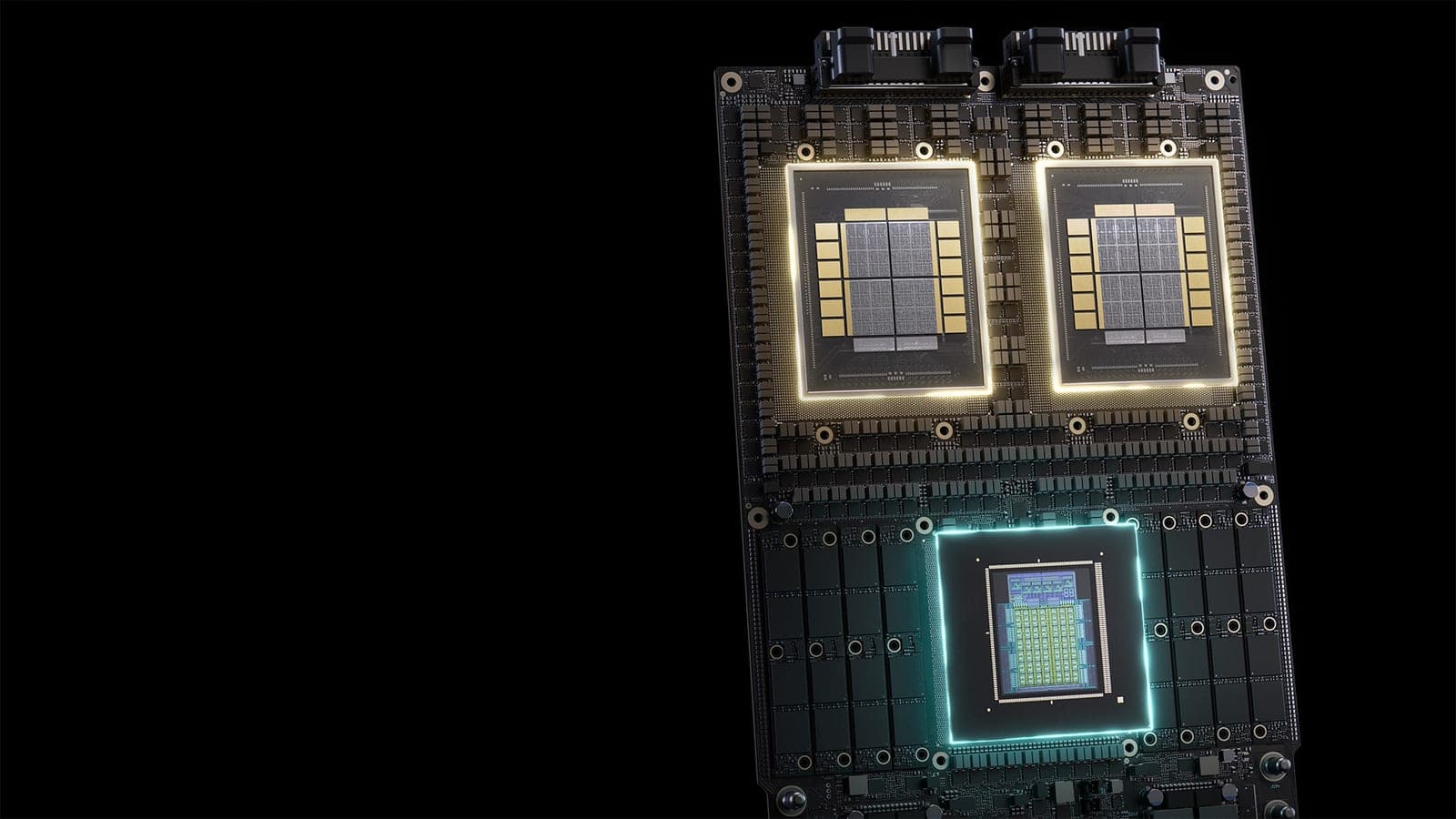
Nvidia has not shown or described the physical layout. Its own image does not settle the question either. So treat any talk of a four-die design as a guess for now.
The catch: the announcement leaves out several numbers people usually ask for first:
- Memory: no memory size or memory speed has been shared.
- Speed of the link: no new bandwidth figure for seventh-generation NVLink.
- Math precision: no word on whether Rubin HPC shifts more of its power toward FP64.
FP64 means 64-bit math, the very precise kind many physics and engineering simulations need. AI work often gets by with less precise math, which is faster. Nvidia's earlier Vera Rubin science announcement already listed native FP64 for the platform, with 5 petaflops (5 quadrillion math operations a second) in a full rack.
What else did Nvidia announce at SC26?
Rubin HPC was not alone. Nvidia used the show to push one theme: AI agents doing science.
- Vera CPU platform: a rack with 192 Vera CPUs linked by Quantum-X800 InfiniBand, Nvidia's fast network for supercomputers. Each CPU has 88 custom Olympus cores and up to 1.2 TB/s of memory bandwidth. Nvidia says it delivered 1.9 times the speed and 2.4 times the performance per watt of x86 systems (the older kind of server chips) on an airflow simulation. Dell, HPE, Lenovo and Supermicro will build full systems.
- Climate computing: the German Climate Computing Center, DKRZ, picked Vera CPUs for its HLRE-5 supercomputer, expected in early 2028.
- Nemotron for Science: a kit for building science agents, with an open chemistry dataset called LitmusBench v0.2 of nearly 50,000 questions. Open means researchers can download and adapt it.
- New CUDA-X libraries: ready-made software building blocks. One of them, cuPhoton, correlated black hole observations from the Event Horizon Telescope in eight minutes, work that took over a month before.
Why does Nvidia call it "for agents"?
Because the agent is the new customer for simulations. A person runs a few simulations a week. An agent can ask for thousands, then read the results and decide what to try next.
Nvidia describes a loop: hypothesis (a guess), simulation, refinement. The faster the simulation step, the faster the loop spins. Its CUDA-X libraries give agents ready tools for each step.
The company says that means researchers can pick next steps sooner and point lab work at the most promising candidates. Whether that happens depends on the software and the labs, not only on the chip.
Where does this fit in the Vera Rubin story?
Vera Rubin is the platform Nvidia is rolling out across its data centers, with the Vera CPU paired with Rubin GPUs. Earlier this year Nvidia said a Vera Rubin supercomputing rack with up to 144 GPUs can deliver more than 7 exaflops of AI for science and 5 petaflops of native FP64.
Research centers have already signed up for that line, including Leibniz Supercomputing Centre in Germany. Its Blue Lion system is planned to be about 30 times as powerful as the center's current machine and to come online in 2027. We covered how the same platform reaches business customers in our Vera Rubin story.
Rubin HPC adds a science-first option. It is a sibling chip tuned for simulation rather than a new platform.
What it means for you
- Not for your desk: Rubin HPC is a supercomputer part. You will not buy it.
- Slow burn: it arrives in 2028, so any effect on weather forecasts, drug research or materials comes later.
- More details to come: memory, layout and speed figures are still missing, so wait for those before judging the chip.
- Agents are the story: Nvidia is betting that AI agents will become heavy users of science computing.
The bottom line
Nvidia unveiled Rubin HPC, a science GPU with more than 50,000 CUDA cores, seventh-generation NVLink and a design that keeps those cores fed with data. It is expected in 2028, and the key specs are still unshared. For now it shows where Nvidia thinks supercomputing is heading: agents asking for simulation after simulation.
Key facts
- Chip
- Rubin HPC, a GPU in the Vera Rubin platform
- CUDA cores
- More than 50,000 on a single GPU
- Interconnect
- Seventh-generation NVLink
- Availability
- Expected in 2028
- Announced at
- SC26, November 16, 2026
Got questions?
Quick answers, plain wordsWhat is Nvidia Rubin HPC?
It is a new GPU in Nvidia's Vera Rubin platform. Nvidia designed it to speed up simulation and data processing for science, engineering and analytics work.
How many CUDA cores does Rubin HPC have?
More than 50,000 on a single GPU, which Nvidia calls a record number of CUDA cores. The regular Rubin GPU has 28,672.
When will Rubin HPC be available?
Nvidia says it is expected to be available in 2028. It is announced, not shipping.
What is a CUDA core?
A CUDA core is one of the many tiny calculators inside an Nvidia GPU. More cores let the chip do more math at the same moment.
What does the sparse data feature do?
Many science programs pick scattered values out of a huge dataset. Nvidia says the sparse data acceleration keeps the cores supplied with data so they spend their time computing instead of waiting.
What is NVLink?
NVLink is Nvidia's fast connection between chips. Rubin HPC uses the seventh generation, which Nvidia says speeds up GPU-to-GPU links.
Does Rubin HPC have the same layout as the regular Rubin GPU?
Nvidia has not said. The core count is far higher than a single Rubin GPU, which suggests more silicon pieces on one package, but the company has not confirmed the layout.
How much memory does Rubin HPC have?
Nvidia has not shared the memory size or memory speed yet.
Who is Rubin HPC for?
Scientists, engineers and analysts running simulations such as climate models, genomic analysis, engineering simulations and financial risk, often with AI agents driving the work.
Can I buy it for a home PC?
No. Rubin HPC is a data center chip for supercomputers and research centers.
SourcesNVIDIA
Topics and tagsNVIDIA, AI agents, AI chips, nvidia
Go deeper
- ExplainerWhat is a GPU, and why does AI need them?A GPU (graphics processing unit) is a chip that does huge numbers of simple calculations at the same time. Built to...
- ExplainerWhat are AI agents?An AI agent is an AI system that decides its own next steps and uses tools to get a task done, instead of just...
Related stories
AMD's 256-core Zen 6 server chip ships, and early tests show big gains
AMD's EPYC 9006 'Venice' server processors are on sale from today. Independent tests of the 256-core flagship show up to 93% more throughput than the last generation.
NVIDIA lets Korean AI chips plug into its systems with Rebellions and SK Telecom
Rebellions will connect its Rebel R200 chips to NVIDIA's platform, and SK Telecom plans to run the racks in its Korean data center.
Bolt Graphics powers on its first Zeus GPU test chip
The startup says its tiny 12nm test chip ran with no functional issues in 24 hours, but the full Zeus GPU is not due until 2028.
More in brief
- Mercedes starts rolling out hands-free city driving in the US and GermanyNov 16
- ULA Vulcan rocket fails and destroys 40 Amazon Leo satellitesNov 16
- Google Maps can now plan whole trips and book appointmentsNov 16
- Apple adds a video podcasts section to the Apple TV appNov 16
- Blue J raises $176 million to put AI agents to work on tax returns and IRS lettersNov 16
- FBI warns hackers are using the ARTEX AI tool to attack organizations worldwideNov 16