
Technology·News & analysis
Space Force retires the last of its Cold War missile-warning satellites
The final two Defense Support Program satellites, part of a missile early-warning system that began in 1970, have been moved to a graveyard orbit after more than 55 years of service.
Tide
Ripple
Sci-fi
4/10
Reality
Shipping
Cold War sentinels in orbit finally get to clock out.How we rate
The US Space Force has retired its last two Defense Support Program satellites, ending a missile early-warning program that began with a launch in 1970.
The satellites raised their orbits in September, a typical move into a graveyard orbit, Ars Technica reports. Newer infrared satellites already handle the job, and the first Next-Generation OPIR satellite could launch within a year.
What to know
- The US Space Force says the final two Defense Support Program (DSP) satellites have been retired, ending a program that began with a launch in 1970.
- DSP satellites used infrared sensors in geosynchronous orbit to spot missile launches, first for Soviet ICBMs and later for threats like Iraqi Scuds.
- The last two satellites raised their orbits by a few hundred kilometers in September, a typical move to a graveyard orbit, Ars Technica reports.
- Newer Space Based Infrared System satellites already handle the mission, and Next-Generation OPIR satellites are on the way.
For more than half a century, a handful of satellites sat quietly in high orbit, watching for the heat of a missile launch. That watch is over. The US Space Force says it has retired the last two Defense Support Program satellites, ending one of the longest-running programs in military space, Ars Technica reports.
What happened?
On Thursday, the Space Force said the final two surviving Defense Support Program (DSP) satellites took part in an on-orbit maneuvering exercise in early September. According to Ars Technica, they're presumably DSP-20 and DSP-22.
The final move: independent orbital tracking showed both satellites raised their orbits by a few hundred kilometers. That's a step typically used to dispose of a satellite in a graveyard orbit above geostationary space, out of the way of working satellites. The Space Force confirmed it marked the program's official retirement.
"The DSP constellation was foundational to the defense of our nation," said Col. Brandon Davenport, commander of Mission Delta 4, the unit that operated the satellites. "These last two satellites were the culminating end to over a half century of space-based early warning."
What did DSP do?
DSP satellites were early-warning sentinels. They used infrared sensors to spot the intense heat of missile launches and report them.
- The orbit: each satellite was launched into geosynchronous orbit, according to Ars Technica.
- The sensors: they were essentially very sensitive infrared telescopes. The whole satellite spun so its sensor array scanned the Earth six times a minute, according to Wikipedia.
- The mission: they were originally built to detect Soviet intercontinental ballistic missiles, making them essential for nuclear deterrence, Ars Technica says.
Who ran them: the Air Force's 460th Space Wing operated DSP until 2020, when Space Force Mission Delta 4 took over, according to Wikipedia. Its units, mainly the 2nd Space Warning Squadron at Buckley Space Force Base in Colorado, sent warning data to the NORAD and US Strategic Command early warning centers at Cheyenne Mountain.
DVIDS reports that DSP and the newer SBIRS constellation together provided both theater missile warning for troops in the field and strategic missile warning for the country.
For a time, DSP satellites were among the most important satellites the US flew, because they were how the country would detect a nuclear missile launched at it.
How did the program begin?
The first DSP satellite launched in November 1970 on a Titan IIIC rocket from what was then Cape Canaveral Air Force Station. Its payload was top secret at the time, Ars Technica notes, and the government only later disclosed what it was.
DSP replaced an earlier 1960s infrared warning system called MIDAS, and its first launch was helped by funding freed up when the Manned Orbiting Laboratory was canceled, according to Wikipedia.
By the numbers:
| Early DSP satellites | Later DSP satellites | |
|---|---|---|
| Mass | About 1 metric ton | About 2.5 tons |
| Infrared detectors | About 2,000 | More than 6,000 |
The first satellite had a design life of about 1.25 years, according to Wikipedia. The program ended up running for more than 55 years.
How did it change over time?
The military kept adding to the constellation and improving reliability and capability, Ars Technica reports. Over time, DSP's role grew beyond nuclear deterrence into conventional warfare.
- Gulf War: during Desert Storm, DSP detected Iraqi Scud missile launches and gave warning to civilians and military forces in Israel and Saudi Arabia, according to Wikipedia.
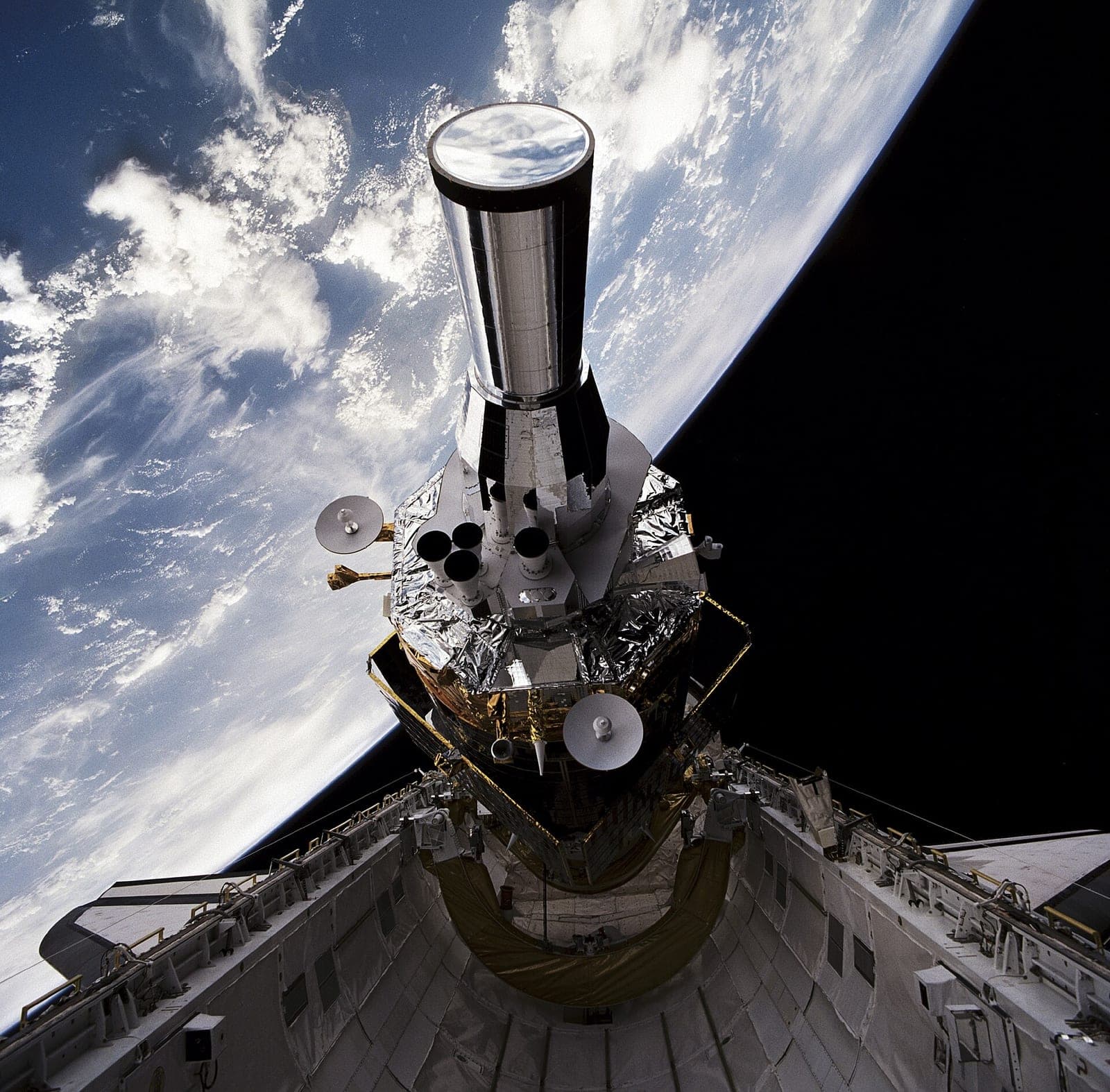
- The launches: DSP satellites flew on a range of rockets, from Titan rockets to the Delta IV Heavy. One, DSP-16, launched aboard Space Shuttle Atlantis in 1991, on mission STS-44.
- The last launch: the 23rd and final DSP satellite went up in 2007, on the first operational flight of the Delta IV Heavy, according to Wikipedia. All 23 were built by Northrop Grumman, formerly TRW.
There's a fun twist of history, too. Ars Technica points out that the launch pad used for that first 1970 mission, Space Launch Complex 40, was later handed over to a then-little-known startup called SpaceX.
In real life The photo above shows DSP-16 in 1991, rising out of the Space Shuttle's cargo bay with its upper stage attached, just before being sent on to its orbit.
Did every DSP satellite succeed?
Not all of them. According to Wikipedia, the program had its share of setbacks:
- DSP-19 (1999): its upper stage failed after launch on a Titan IVB. The two stages didn't fully separate, and the satellite was left out of control in a useless orbit.
- DSP-23 (2007): the final satellite's launch was delayed for months after cracks were found in the launch table at its pad. It finally flew in November 2007, then stopped working sometime in 2008 for unknown reasons. It's still adrift in geosynchronous orbit, and the Defense Department sent a spacecraft called MiTEx to inspect it.
- Two canceled: the program was originally planned for 25 satellites, but the last two were canceled, mainly because SBIRS satellites were taking over the job.
The satellites came in five major upgrade blocks from 1970 to 2007. Later versions grew to about 5,250 pounds with 1,275 watts of power, and their design life goal rose to ten years, Wikipedia says.
Beyond missiles: there was even some effort to use DSP's infrared sensors as an early warning system for natural disasters like volcanic eruptions and forest fires, according to Wikipedia.
How were the satellites retired?
DSP satellites were retired one by one as they aged. In March 2023, the Space Force held a celebration at Buckley Space Force Base in Colorado to mark the end of one DSP satellite's service, according to the Defense Visual Information Distribution Service (DVIDS).
At the time, Col. Miguel Cruz, then the unit's commander, called DSP a satellite with unmatched involvement in national defense. "No other satellite in the DoD inventory can claim this level of involvement and impact to National Defense," he said. DVIDS reported that there hadn't been a conflict or named operation since 1991 that the constellation didn't support.
That 2023 celebration brought together Space Force members, partners from the United Kingdom, Australia and Canada, industry representatives and members of the original engineering teams, DVIDS reported.
What replaces DSP?
What's next: the US isn't left without eyes in the sky.
- SBIRS: in 2011, the military began launching the Space Based Infrared System. Its better sensors can generally detect dimmer events and give longer warning time, Ars Technica reports.
- Next-Gen OPIR: the military is now developing Next-Generation Overhead Persistent Infrared satellites. The first could launch within the next 12 months on a Vulcan rocket.
For more on how rockets and launches are changing, see our story on SpaceX's Starship reaching orbit.
What it means for you
- No gap in protection: newer SBIRS satellites already handle missile warning, so retiring DSP doesn't leave the US blind.
- Less clutter: moving old satellites to a graveyard orbit keeps the busy geostationary belt clear for working satellites.
- A long run: a program designed in the 1960s and 1970s served for more than five decades, far beyond its original design life.
The bottom line
The last two Defense Support Program satellites have been retired, closing out a missile early-warning program that began in 1970 and helped define military space during the Cold War. Newer infrared satellites already carry the mission, with the next generation coming soon.
Key facts
- Program
- Defense Support Program (DSP), missile early warning
- First launch
- November 1970, on a Titan IIIC from Cape Canaveral
- Last launch
- 2007, on a Delta IV Heavy
- Satellites built
- 23, per Wikipedia
- Successors
- SBIRS, with Next-Generation OPIR coming
Got questions?
Quick answers, plain wordsWhat was the Defense Support Program?
DSP was a US military satellite program that used infrared sensors in geosynchronous orbit to detect missile launches. It was a key part of American nuclear deterrence during the Cold War.
When did the last DSP satellites retire?
The Space Force said Thursday that the final two satellites took part in an on-orbit maneuvering exercise in early September, which marked the program's official retirement, Ars Technica reports.
What happened to the satellites?
Independent tracking showed both raised their orbits by a few hundred kilometers, a move typically used to dispose of satellites in a graveyard orbit above geostationary space, according to Ars Technica.
How long did DSP run?
More than 55 years. The first DSP satellite launched in November 1970, and at least a handful were flying until September 2026.
How did DSP satellites detect missiles?
They carried very sensitive infrared telescopes that picked up the heat of a missile launch. Early satellites had about 2,000 infrared detectors, and later ones had more than 6,000, Ars Technica reports.
Was a DSP satellite launched on the Space Shuttle?
Yes. DSP-16 launched aboard Space Shuttle Atlantis in 1991, on mission STS-44.
Is the US now without missile warning satellites?
No. The military began launching the Space Based Infrared System (SBIRS) in 2011, which has better sensors and can detect dimmer events with longer warning time, Ars Technica reports.
What comes next?
The military is developing Next-Generation Overhead Persistent Infrared (Next-Gen OPIR) satellites. The first could launch within the next 12 months on a Vulcan rocket, according to Ars Technica.
Who operated the DSP satellites?
Mission Delta 4, headquartered at Buckley Space Force Base in Colorado, operated them.
SourcesUS Space Force
Topics and tagsSpace tech, space, satellites, space force
Related stories

SpaceX's Starship reaches orbit for the first time, despite losing an engine
SpaceX's Starship reached Earth orbit for the first time on its 14th test flight, deploying 26 Starlink satellites despite one of its engines shutting down early.

California legalizes plug-in balcony solar, but compliant kits aren't here yet
A new state law lets renters and homeowners plug small solar panels into a wall outlet starting in 2027, making California the 10th state to allow so-called balcony solar.

Apple is tightening Mac 'Full Disk Access' because of AI agents
Apple says some apps use the powerful macOS permission in risky ways, and that AI agents make the danger bigger, so granting it will soon take very explicit user action.
More in brief
- Anthropic commits $100 million to train 10,000 engineers to deploy ClaudeOct 2
- Runway's Praxis-1 wants to teach robots from video instead of demosOct 2
- Rivian's deliveries jump as its cheaper R2 starts to ramp upOct 2
- Nvidia ends the base Shield TV and raises the Shield TV Pro to $299Oct 2
- Slovenia's .si domain booms after the US starts calling AI 'super intelligence'Oct 2
- Epic pauses most product work after AI finds MyChart security flawsOct 2