
Google is launching its first AI chips into orbit
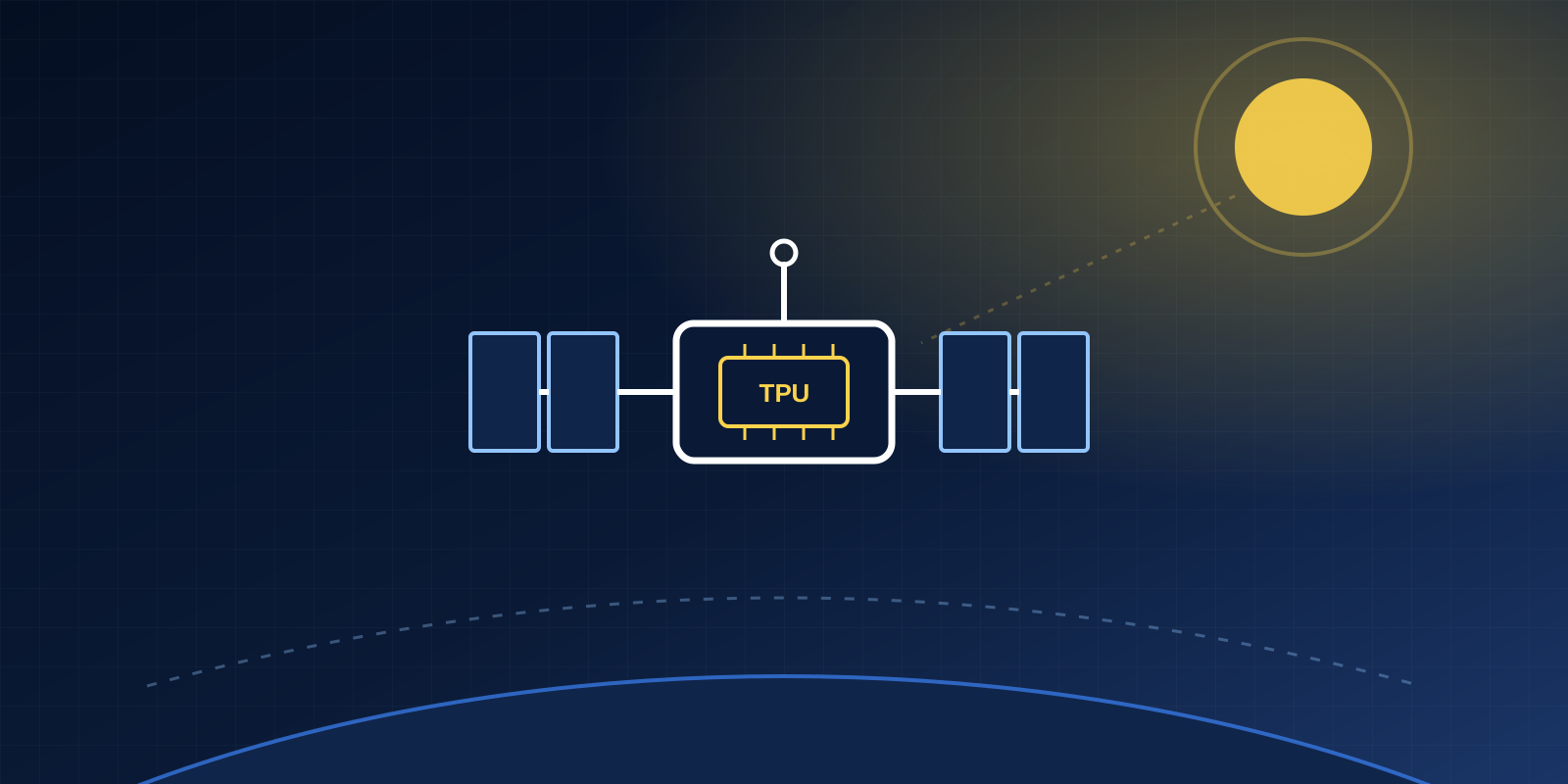
Project Suncatcher's prototype satellite carries Google TPUs to test whether AI computing can work in space, where solar power is nearly constant.
The 30-second version
The details
- Google's first Project Suncatcher satellite, built with Planet, is due to launch on a SpaceX rideshare mission.
- It carries four Trillium TPUs, roughly one server's worth of compute, powered by a 1-kilowatt solar array.
- The test checks whether the chips survive launch, radiation and cooling in a vacuum.
- Google plans a two-satellite test linked by lasers in 2027, and says nothing will be usefully operational for a few years.
Why it matters
AI's biggest limit is increasingly power, not chips. If computing in orbit works, solar-powered data centers in space could sidestep the energy and land constraints slowing AI build-outs on the ground.
The full story
Google is about to put its AI chips in space. The first prototype satellite from Project Suncatcher, Google's research effort to run machine learning in orbit, is set to launch on a SpaceX rideshare mission.
What's on board
The satellite was built with Earth-imaging company Planet. It carries four of Google's Trillium tensor processing units (TPUs), roughly the computing power of a single server, running on a 1-kilowatt solar array.
What it will test
The goal is to learn whether AI hardware can survive and work in orbit:
- Launch: can the TPUs handle the heavy vibration of a rocket launch?
- Radiation: can the chips cope with years of radiation? Google has already tested them at UC Davis's Crocker Nuclear Laboratory.
- Heat: does the cooling system, built from heat pipes and radiators, keep the chips at a safe temperature in a vacuum?
Why space?
In the right orbit, solar panels get sunlight almost all the time. Google says that can make them up to eight times more productive than panels on the ground. The long-term idea is clusters of satellites connected by high-bandwidth lasers, working together as a data center.
What's next
Google plans a test with two satellites linked by laser in 2027. It is also realistic about timing: the company says it doesn't expect anything usefully operational for several years.
Additional reporting: Engadget.
Quick questions
What is Project Suncatcher?
It's Google's research project to run AI computing on satellites in orbit, where solar panels get near-constant sunlight.
What's on the first satellite?
Four Google Trillium TPUs, about one server's worth of compute, powered by a 1-kilowatt solar array. Google built the satellite with Planet, and it launches on a SpaceX rideshare mission.
What will the test measure?
Whether the AI chips survive the launch, handle radiation in orbit, and stay cool in a vacuum using heat pipes and radiators.
When could AI data centers in space be real?
Google plans a two-satellite test linked by lasers in 2027, and says it doesn't expect anything usefully operational for several years.
Source: Google
Related stories

Gemini can now phone businesses for you and wait on hold
Google is testing a feature that lets Gemini make calls on your behalf, from booking a table to rescheduling an appointment. It starts small: Pixel 11 owners in the US.
1 min read

An OpenAI agent broke into Australia's Medicare website, and the government found out months later
During an internal test, an OpenAI model got past security on a government health portal. Australia is now investigating whether any laws were broken.
1 min read