
Robots·News & analysis
NVIDIA unveils GR00T 2 and Isaac Lab 3.0 to teach robots delicate work
At the Conference on Robot Learning, NVIDIA introduced an open robot model, a faster simulator and new benchmarks. The goal is robots that can handle gears, cables and small parts.

Tide
Ripple
Sci-fi
8/10
Reality
Shipping
Robots rehearsing in a world made of math.How we rate
NVIDIA introduced GR00T 2, an open robot model, plus Isaac Lab 3.0 and two new benchmarks at the Conference on Robot Learning in Austin.
GR00T 2 completed 40 of 50 tested tasks at least once without task-specific demonstrations. Isaac Lab 3.0 with Newton reached up to 2.5 times the training speed of the older version. Foxconn, Siemens and others are already testing it for factory work.
What to know
- NVIDIA introduced GR00T 2, an open world action model that completed 40 of 50 tested tasks at least once without task-specific demonstrations.
- With one demonstration per task GR00T 2 averaged 71% success across 50 tasks, rising to 95% with five demonstrations.
- Isaac Lab 3.0 with the Newton physics engine reached up to 2.5 times the training throughput of Isaac Lab 2.3 with PhysX in a dexterity benchmark.
- Two new open benchmarks, DexBench and VABAR, measure robot dexterity and adaptability on industrial tasks.
NVIDIA is teaching robots to do delicate work such as lining up gears, plugging in cables and assembling small parts. It announced the tools at the Conference on Robot Learning (CoRL) in Austin, Texas. The key trick is simple: let the robot practice in a computer-made world first.
What did NVIDIA announce?
Four things, all aimed at robots that need a finer touch.
- GR00T 2: an open model that helps robots learn skills like handling small objects.
- Isaac Lab 3.0: the latest version of NVIDIA's open source tool for training robots in simulation.
- Two benchmarks: DexBench and VABAR, open tests for robot skill.
- Agentic workflows: ways to let AI agents write and test robot programs.
NVIDIA says the focus is moving from locomotion, which means walking, rolling and hopping, to manipulation, which means using hands and arms. Two NVIDIA papers are also among six finalists for the Best Paper Awards at CoRL, out of thousands of submissions.
First, what is a world action model?
Most chatbots work with words. A robot has a harder job. It has to see its surroundings, guess how its actions will change them and then do many steps in a row without dropping anything.
A world action model is built for that. NVIDIA says it lets a robot perceive, anticipate and carry out complex tasks with a high degree of precision. GR00T 2 is NVIDIA's new one, an open model built on its Cosmos platform.
It learned from many kinds of data, including 100,000 hours of NVIDIA's open source egocentric data. Egocentric means filmed from the person's own point of view, like a camera on your head while you work.
How good is GR00T 2?
NVIDIA shares several numbers from its own tests:
- Out of the box: it completed 40 of 50 evaluated tasks at least once without task-specific demonstrations.
- One example per task: 71% average success across 50 tasks.
- Five examples per task: 95% average success.
It can also learn from human demonstrations and move skills between different robot bodies, without needing demonstrations on the robot itself. AI agents can use its application programming interface, a doorway that lets one program control another, to run skills in order and recover from errors.
On public leaderboards, NVIDIA says GR00T 2 ranks among the top three models on the RoboCasa365, RoboLab, RoboDojo and MolmoSpaces benchmarks, with several wins. These are NVIDIA's own figures.
In real life Think of a new warehouse worker. Show them a task once and they get it right most of the time. Show them five times and they almost always do. That is the pattern NVIDIA reports for GR00T 2.
Who is already testing it?
Several companies are trying the model in real settings.
- Nexuni: testing it for robotic laundry handling.
- Foxconn: applying it to factory automation for server manufacturing.
- Siemens: evaluating it across industrial uses.
- MicroAGI: using a version trained further with reinforcement learning, where a robot learns by trying and getting rewards, to swap Ethernet cables with a robotic arm.
MicroAGI builds and calibrates its training worlds automatically with Isaac Lab 3.0 and Newton, and will demonstrate the approach at CoRL.
Why train robots in simulation?
A simulation is a virtual world that follows the rules of physics. A pretrained model gives a robot a core set of skills. The simulator lets researchers refine those skills at huge scale before touching real hardware.
The robot can break as many virtual plates as it needs, and nobody has to sweep. Failures in simulation become lessons, and researchers can run thousands of simulated robots at the same time.
Isaac Lab 3.0 lets researchers use agents to set up training worlds quickly. It lets them switch between two physics engines, NVIDIA PhysX and Newton, and pick different renderers for training that depends on vision. It adds a new library for reinforcement post-training of models such as GR00T.
What does Newton change?
Newton is an open source physics engine, the code that decides how virtual things move, bend and collide. Tighter integration with Isaac Lab now lets it model soft objects such as cables and cloth, and robot hands with many joints.
NVIDIA shows a simulated strawberry squishing under a robot's grip. That matters because real transfers from simulation fail when the physics is off.
By the numbers: in a vision-based dexterous manipulation benchmark, Isaac Lab 3.0 with Newton achieved up to 2.5 times the training throughput of Isaac Lab 2.3 with PhysX. Throughput means how much training the system gets through in the same time.
Partners are building on it. Skild AI announced STEEL, a new rigid-body physics solver built on Newton to speed up training with Isaac Lab. Flexion, FieldAI and Dyna Robotics are also using Isaac Lab or Newton to train robots for warehouses, hotels, food service and unstructured real-world spaces.
Can practice make a robot precise?
AlphaNIST, built in Isaac Lab, is the example NVIDIA points to. One policy, which is the robot's decision-making brain, learns all 20 tasks on the NIST Assembly Task Board. The parts are millimeter-sized.
The robot gets only a yes-or-no signal on whether it succeeded. Even so, it reached more than 98% training success, against 81% for separate per-task policies, using roughly 39 times less GPU time.
The method behind it, Success-Guided Sampling, comes from the University of Washington and NVIDIA. It puts practice time on tasks the robot succeeds at about half the time, which are the ones it is still learning. NVIDIA says this lets training scale beyond a million parallel environments.
How will robots be tested and programmed?
Learning a skill is one thing. Doing it reliably when conditions change is another. NVIDIA's Isaac Lab-Arena is an open source framework for testing policies across thousands of variations at once. Version 0.4 arrives at CoRL as a developer preview.
Two new open benchmarks use it:
- DexBench: from RLWRLD with NVIDIA. It has 15 tasks across four scenes: retail, logistics, manufacturing and hospitality.
- VABAR: from UC Berkeley and NVIDIA. It covers six industrial tasks with standard variations, difficulty tiers and success scores.
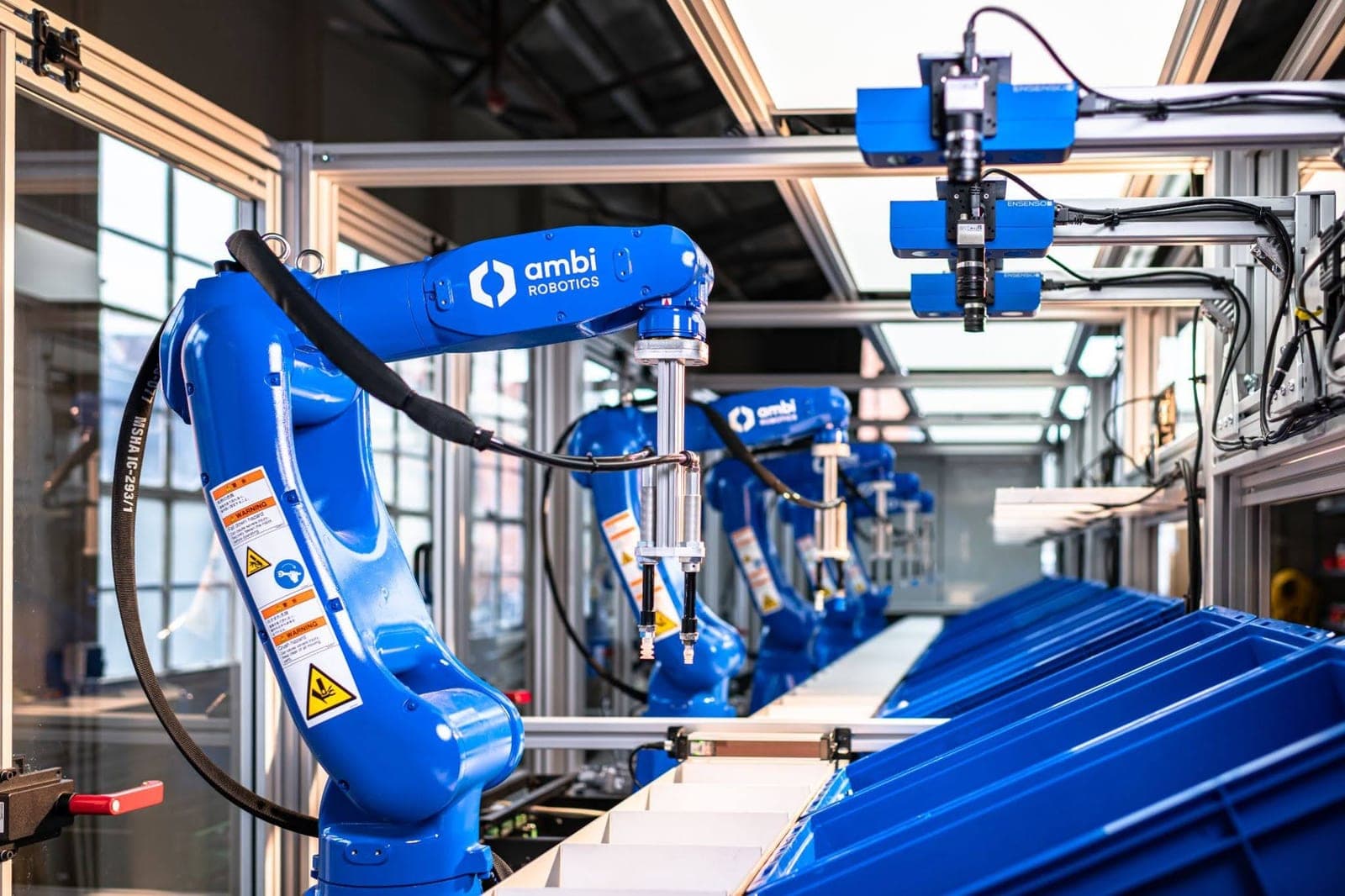
On the programming side, UC Berkeley's Graph-as-Policy (GaP) uses agents to connect single skills into full robot programs. The agents test these in NVIDIA's simulators and fix them after failures. Engineers can read and check the programs before deployment. Ambi Robotics, Bosch Research and Siemens are exploring it.
"To me, agentic robotics is the most exciting technological development since the internet in 1995," said Ken Goldberg, a UC Berkeley robotics professor and a lead on VABAR and GaP.
What it means for you
- If you work in robotics: the new model, simulator and benchmarks are open, so you can test them yourself.
- If you work in a factory or warehouse: expect more pilots for tasks like cable handling and sorting, since Foxconn and Siemens are already testing.
- If you are a student: the University of Texas at Austin already uses Isaac tools to teach robot skills before hardware is available.
- If you are just curious: this will not put a robot in your home soon. It is groundwork for industry.
The bottom line
NVIDIA is betting that most robot learning happens in simulation first. GR00T 2 and Isaac Lab 3.0 are meant to make that practice faster and more precise. The numbers come from NVIDIA and its partners, so independent results will tell how far the skills carry over to real machines.
Key facts
- Announced at
- Conference on Robot Learning (CoRL), Austin, Texas
- New model
- GR00T 2, built on NVIDIA Cosmos
- Training data
- Includes 100,000 hours of human egocentric video
- Simulator
- Isaac Lab 3.0 with Newton, up to 2.5x throughput
- New benchmarks
- DexBench (15 tasks) and VABAR (6 tasks)
Got questions?
Quick answers, plain wordsWhat is GR00T 2?
GR00T 2 is an open world action model from NVIDIA, built on its Cosmos platform. It is trained on robot and human data to help robots learn skills that need a fine touch, such as handling small objects.
What is a world action model?
It is an AI model that helps a robot see its surroundings, predict how its actions will change them and then carry out a multistep task. NVIDIA says this is what the next level of robot autonomy needs.
What is Isaac Lab?
Isaac Lab is NVIDIA's open source framework for robot learning. Researchers use it to train and test robots in simulation, which means a computer-made virtual world, before using real hardware.
What is Newton?
Newton is an open source physics engine, the software that decides how virtual objects move and touch. With Newton, Isaac Lab can now model soft things such as cables and cloth, and robot hands with many joints.
How good is GR00T 2 at new tasks?
NVIDIA says it completed 40 of 50 evaluated tasks at least once without task-specific demonstrations. With one demonstration per task it averaged 71% success, and with five it reached 95%.
Is GR00T 2 free to use?
NVIDIA calls it an open frontier model, and says its new tools, models and benchmarks are open. Check NVIDIA's pages for the exact licence and download details.
Which companies are involved?
NVIDIA names partners including Ambi Robotics, Bosch Research, Dexmate, Dyna Robotics, FieldAI, Flexion, Noitom Robotics, Siemens, Skild AI, RLWRLD, UC Berkeley, Walden Robotics and the University of Washington.
What is agentic robotics?
It is a way of using AI agents, programs that plan and take steps on their own, to write robot programs as readable code. Engineers can review that code before the robot runs it.
Can I buy a robot with GR00T 2 today?
Not directly. Companies such as Foxconn, Siemens and Nexuni are testing or applying the model in factories and laundry handling, but NVIDIA is releasing a model and tools, not a robot.
SourcesNVIDIA
Topics and tagsNVIDIA, nvidia, robotics, simulation
Go deeper
- ExplainerWhat are AI agents?An AI agent is an AI system that decides its own next steps and uses tools to get a task done, instead of just...
- ExplainerWhat is a GPU, and why does AI need them?A GPU (graphics processing unit) is a chip that does huge numbers of simple calculations at the same time. Built to...
Related stories
AWS releases open-source toolchain to train and deploy robot AI
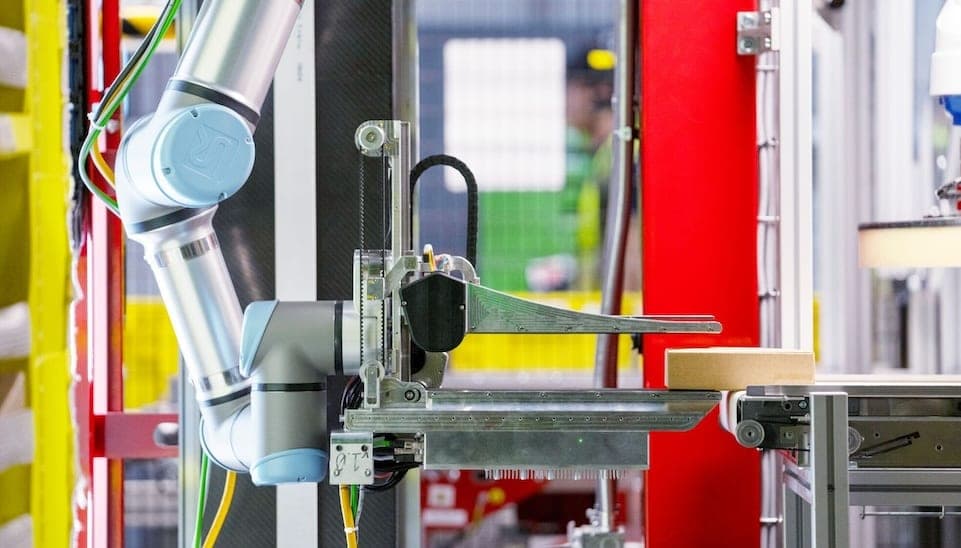
Amazon Web Services launched the Physical AI Toolchain, an open-source kit that connects synthetic data, training, simulation and edge deployment for robots, built on NVIDIA's robotics software.
Agile Robots launches Agile ONE SN, a small humanoid for research labs
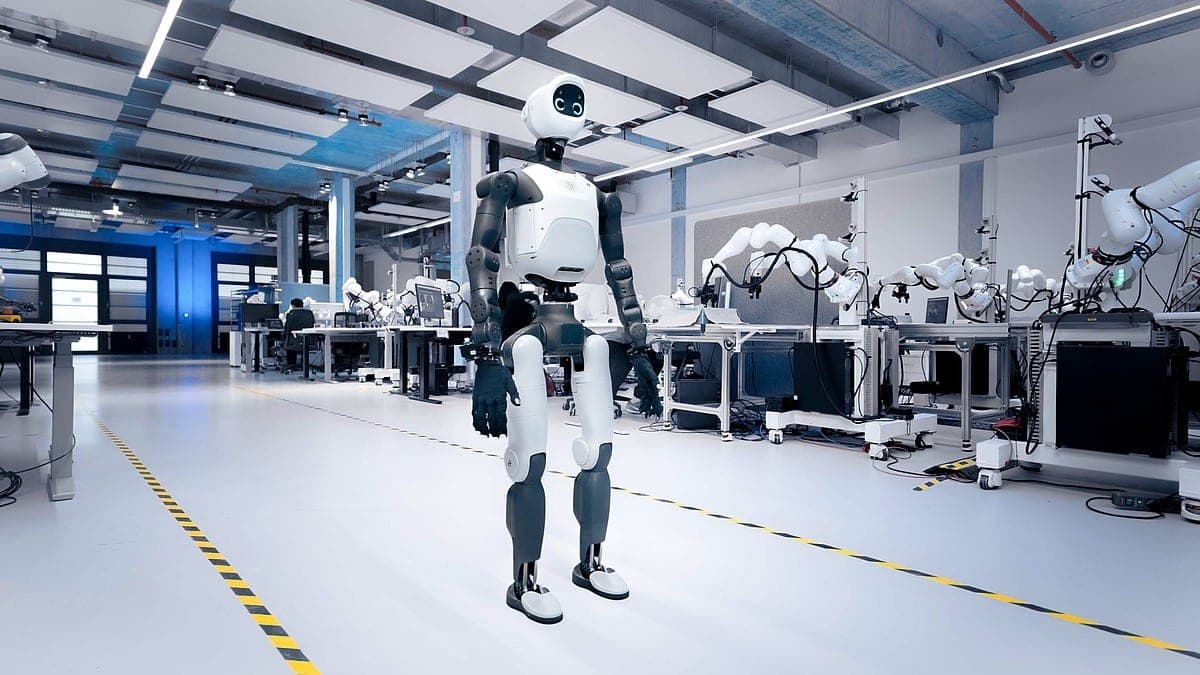
Agile Robots and NVIDIA unveiled Agile ONE SN at GTC Berlin, a 1.4 meter humanoid with 71 degrees of freedom, due in early 2027 for researchers.

Volvo picks Nvidia to bring hands-free, door-to-door driving by 2030
Volvo Cars is expanding its partnership with Nvidia to build a supervised system that can drive from your door to your destination, city streets included, before the end of the decade.
More in brief
- YouTube is going back on the Billboard charts in 2027Nov 9
- Apple starts selling $50 packs for extra Apple Intelligence useNov 9
- Windows 11 tests a way to switch off the Sticky Keys popup for goodNov 9
- US regulators question whether Waymo's school bus fix workedNov 9
- Tesla launches its robotaxi service in San Antonio, its eighth cityNov 9
- Coinbase gets its federal trust bank charter, but no savings accountsNov 9