
Robots·News & analysis
X Square Robot launches WALL-OSS-1.0 with a planning harness and API
The Shenzhen company's new robot foundation model reports a 55.1% zero-shot success rate across 312 real-robot tasks. It also ships with XR Harness, a planning framework, and a developer API.

Tide
Ripple
Sci-fi
5/10
Reality
Demo
A robot brain that plans, tries, and replans like a patient intern.How we rate
X Square Robot introduced WALL-OSS-1.0, a vision-language-action foundation model for robots, with a planning framework called XR Harness and a developer API.
The company reports a 55.1% zero-shot success rate across 312 real-robot tasks. Lite (4B) and Nano (2B) versions target cheaper hardware. Code and weights are promised soon, while the XR Harness developer preview is open now.
What to know
- X Square Robot introduced WALL-OSS-1.0, a vision-language-action model built on Qwen3.5, in a family that includes Lite (4B), Nano (2B), Gen and AR variants.
- The company says the model reached a 55.1% zero-shot success rate across 312 freely chosen real-robot tasks, without task-specific training.
- XR Harness splits long jobs into planning, execution and robot control, and is open as a developer preview next to WALL-API-1.0.
- Code and model weights are only promised: the company says they will open-source soon.
X Square Robot introduced WALL-OSS-1.0, a new foundation model for robots, which means one large general-purpose AI model that is trained once and then adapted to many jobs.
It comes with a planning framework called XR Harness and a developer API, which means a set of ready-made commands that other programs can call. The company says the model succeeded on 55.1% of 312 real-robot tasks it had never been trained for.
What is WALL-OSS-1.0?
It is a vision-language-action model, often shortened to VLA. That means it combines vision (what the cameras see), language (what you tell it) and action (what the arms do).
You give it camera images and a written instruction, and it outputs actions for a robot.
It is built on the Qwen3.5 base model and trained in one unified, autoregressive way, meaning it learns to predict the next piece of output step by step, the way a text model predicts the next word. The model has billions of parameters, which means adjustable internal numbers that store what it has learned.
The company describes it as native to the physical world: perception, language and control live in one model, not in three glued-together parts.
For action output, a flow-matching Action Expert produces smooth continuous action chunks. A Mixture of Trajectory design handles precise execution. An improved X-Tokenizer turns continuous trajectories into discrete tokens, so the same model can serve different robot bodies.
The big picture: this is a successor to WALL-OSS-0.5, which the company says it beats by 52.5% on a 15-task real-world test.
What is XR Harness?
A model that moves a gripper is not the same as a system that can clean a table. XR Harness is the layer in between. It is an agentic framework, which means software that acts like an AI agent: it makes a plan, takes steps, checks the result and adjusts. It splits a long job into three systems:
- System 2: high-level planning and replanning.
- System 1: execution of each step with WALL-OSS-1.0.
- System 0: the link to robot controllers and sensors, through the Robot Agent Protocol.
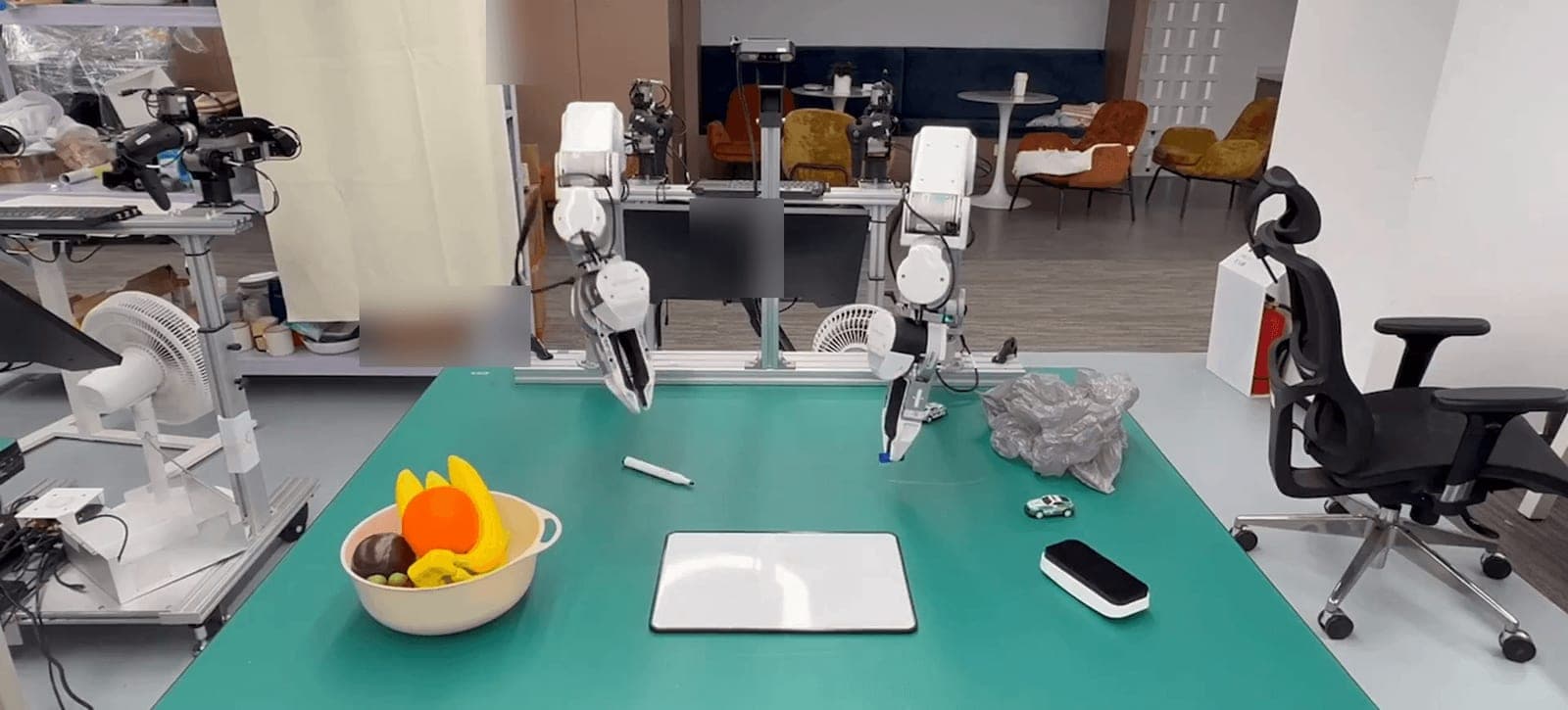
If a step fails, the planning layer looks at what the robot sees and revises the plan. The company shows this on tabletop cleanup, turning an abstract request into concrete steps, and replanning from feedback.
In real life Say "tidy the desk." System 2 decides to move the marker, then the eraser. System 1 does each move. System 0 makes the arms actually do it, and System 2 tries again if the marker rolls away.
XR Harness is open as a developer preview for researchers and developers. A companion, WALL-API-1.0, is aimed at developers who want to use the model's abilities through an API.
How good are the numbers?
All of the figures below come from the company's own testing, so read them as claims until others repeat them.
- Open-ended zero-shot: 55.1% success across 312 unique real-robot tasks, chosen freely and without task-specific training.
- ManipArena: 50.67% success on 15 real-world tasks, 1,101 of 1,500 points, and 78% on semantic manipulation tasks.
- X2Real simulation: 67.55 out of 100, which the company says is 65% above Lingbot-VLA-2.0's 40.94.
- Mobile manipulation: a 44.17 mean score, which it says is 77.9% above π0.5's 24.83.
- RoboDojo: WALL-OSS-1.0-Lite ranks first among policies without agent systems, with 42.59.
The headline result is the 312-task test: a robot that gets about every second unseen task right is still far from a butler, but it is a real step beyond one that needs retraining for each chore.
One more figure matters for the language side. On vision-language benchmarks the company reports 79.2%, against 79.4% for the base Qwen3.5. In other words, teaching the model to act did not make it much worse at understanding.
Which versions are there?
The release is a family, not a single file. Fine-tuning, which means a short extra round of training on your own robot and your own tasks, is the main way developers are expected to use the smaller ones:
| Version | What it is |
|---|---|
| WALL-OSS-1.0 | The full vision-language-action model |
| Lite | 4B parameters, which means 4 billion adjustable internal numbers, built for efficient fine-tuning |
| Nano | 2B parameters; supports 18 robots on one Blackwell GPU, per the company |
| Gen | Adds generative learning to use ego video and dexterous manipulation |
| AR | Autoregressive actions with real-time chunking for faster inference, meaning quicker answers while the robot runs |
The public Lite checkpoints have a narrower evaluation scope than the headline results, which is worth remembering when the weights arrive.
What did it learn from?
The training mix blends language pretraining, vision-language data and robot-derived supervision. The robot part covers 15 task categories, 32 scene categories and 110 object categories, from homes to workshops.
It comes from several sources: UMI demonstrations (people showing a task with a hand-held gripper), robot teleoperation (a person steering the robot by remote), policy interventions and open-source datasets. Annotations come at four levels: task, subtask, action and segment. The company says more than 20 automated checks validate the data.
By the numbers: 15 task types, 32 scenes, 110 object types, 4 annotation levels, 20+ quality checks.
Does it work outside the lab?
The company points to a parcel-sorting deployment. Because the model is pretrained, it says, the data needed dropped by roughly 100 times: fine-tuning took about 10 hours instead of more than 1,000.
It also reports that the model kept more than 90% of its performance when moved between production sites, even though the environments differed. Kernel optimization and quantization (running the model with smaller numbers) gave a 4x or better inference speedup, where inference means the model working out its answer while the robot is running.
The catch: these are the company's own deployments, described in its own words. There is no outside audit yet, and the weights are not public.
Who is behind it?
X Square Robot is based in Shenzhen and was founded in 2023. In September 2025 it announced over $100 million in Series A+ funding. Alibaba Cloud, HongShan and INCE Capital were new investors, joined by existing backers Meituan, Legend Star and Legend Capital.
It builds its own hardware too. The Quanta X2 is a wheeled humanoid with 62 degrees of freedom, dual 20-DoF dexterous hands and seven-DoF arms. The company has said it wants robotic butlers to be a reality within five years.
WALL-OSS began as an open-source model, published on GitHub and Hugging Face, and Hugging Face's LeRobot library later added support for it.
What's next?
The company says the code and weights for WALL-OSS-1.0 will open-source soon, with no date. Open weights, which means the trained model files anyone can download and run, are what let outside labs check the claims. The model is not open-weight until they are out. The announcement gives no pricing for the API and no funding news. Technical details are on the company's blog.
What does the data say about cost?
The company's own framing is about data, not about hardware. Robot data is expensive, because someone has to demonstrate each task many times, on real machines, in real rooms.
A pretrained model that needs about 10 hours of fine-tuning instead of more than 1,000 would change who can afford to build a robot product. That is the claim in the parcel-sorting example, and it is why the 100x figure is the one to watch.
The Nano version aims at the other cost, compute: running 18 robots from a single Blackwell GPU means a small team could serve a fleet from one card, by the company's account.
Why it matters: cheaper data and cheaper compute are what move robot foundation models from demos into products.
What it means for you
- Robotics developers: the XR Harness preview and the small Lite and Nano versions point to a model you can fine-tune without a giant cluster.
- Everyone else: nothing ships to your home. This is research infrastructure that makes future helper robots cheaper to train.
- Watch for: the open weights and independent tests of the 312-task result.
The bottom line
WALL-OSS-1.0 pairs a robot foundation model with a planner and an API, and its numbers are strong for unseen tasks. They are also the company's own, and the weights are still a promise. The real test starts when other labs can run it.
Key facts
- Model
- WALL-OSS-1.0, built on Qwen3.5
- Zero-shot result
- 55.1% across 312 real-robot tasks
- Sizes
- Lite 4B, Nano 2B, plus Gen and AR variants
- Availability
- XR Harness developer preview; weights to follow
Got questions?
Quick answers, plain wordsWhat is WALL-OSS-1.0?
It is a vision-language-action model from X Square Robot. It takes camera images and a written instruction and produces robot actions, and it is built on the Qwen3.5 base model.
Who is X Square Robot?
A Shenzhen company founded in 2023 that builds embodied AI and its own Quanta robots. It announced over $100 million in Series A+ funding in September 2025, with Alibaba Cloud, HongShan and INCE Capital among the new investors.
What does 55.1% zero-shot success on 312 tasks mean?
The company tested the model on 312 real-robot tasks that were chosen freely and that it had not been trained for. It says about 55 out of every 100 attempts succeeded. The figure is the company's own.
What is XR Harness?
It is an agentic framework that connects task planning, model execution and robot control. System 2 plans and replans, System 1 runs each step with WALL-OSS-1.0, and System 0 talks to the robot's controllers.
What is WALL-API-1.0?
A developer-facing API for reaching the model's embodied AI capabilities. The release gives no pricing and no access terms.
Can I download WALL-OSS-1.0 today?
Not yet. The company says code and weights will open-source soon. Earlier WALL-OSS models were published on GitHub and Hugging Face.
What are the Lite and Nano versions?
Lite has 4 billion parameters, which means adjustable internal numbers that store what the model learned, and is meant for efficient fine-tuning. Nano has 2 billion and, per the company, can support 18 robots on a single Blackwell GPU.
Does the model work on real factory jobs?
The company describes a parcel-sorting deployment where fine-tuning took about 10 hours instead of more than 1,000, and where more than 90% of performance carried across sites. These are company-reported results.
How much does it cost?
The announcement gives no pricing for the API or the harness. Earlier WALL-OSS models were open source.
SourcesX Square Robot, The Robot Report
Topics and tagsx square robot, wall oss, robot foundation model, embodied ai
Go deeper
- ExplainerWhat are open-weight AI models?An open-weight AI model is one whose trained parameters (the 'weights') are published for anyone to download and run....
- ExplainerWhat is fine-tuning an AI model?Fine-tuning takes an AI model that has already learned from huge amounts of general data and trains it a bit more on...
Related stories
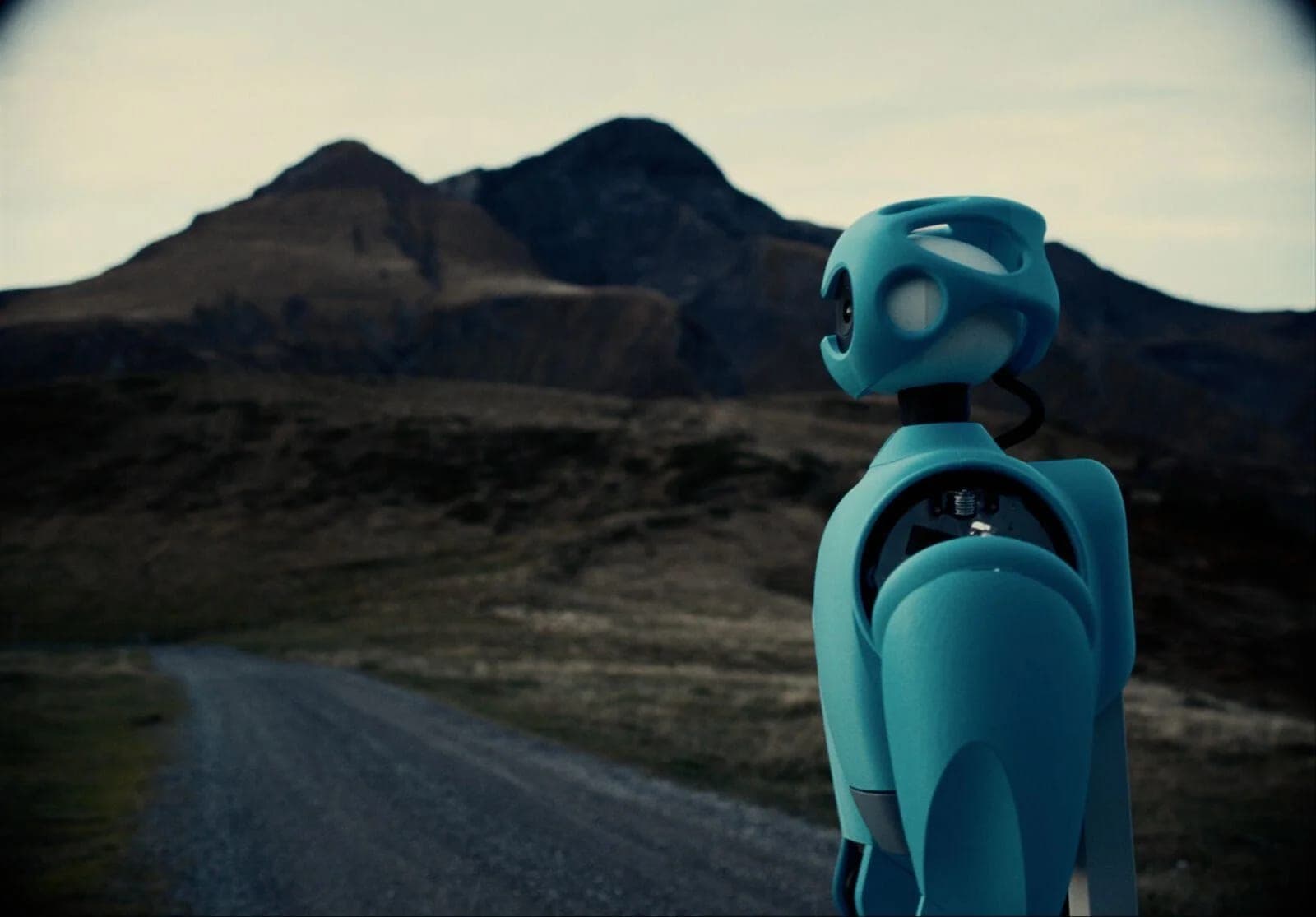
Embodied AI unveils AIR, a wheeled robot built to work beside people without a cage
The Swiss startup's two-armed robot keeps its heavy parts in the torso, learns each job from a remote operator, and aims for CE marking in 2027.

Four of six AGIBOT robots pass a 24-hour convenience store shift
AGIBOT put six G2 humanoid robots to work in a real Shanghai convenience store for a full day. They finished 1,730 tasks, and two of them failed the final review.
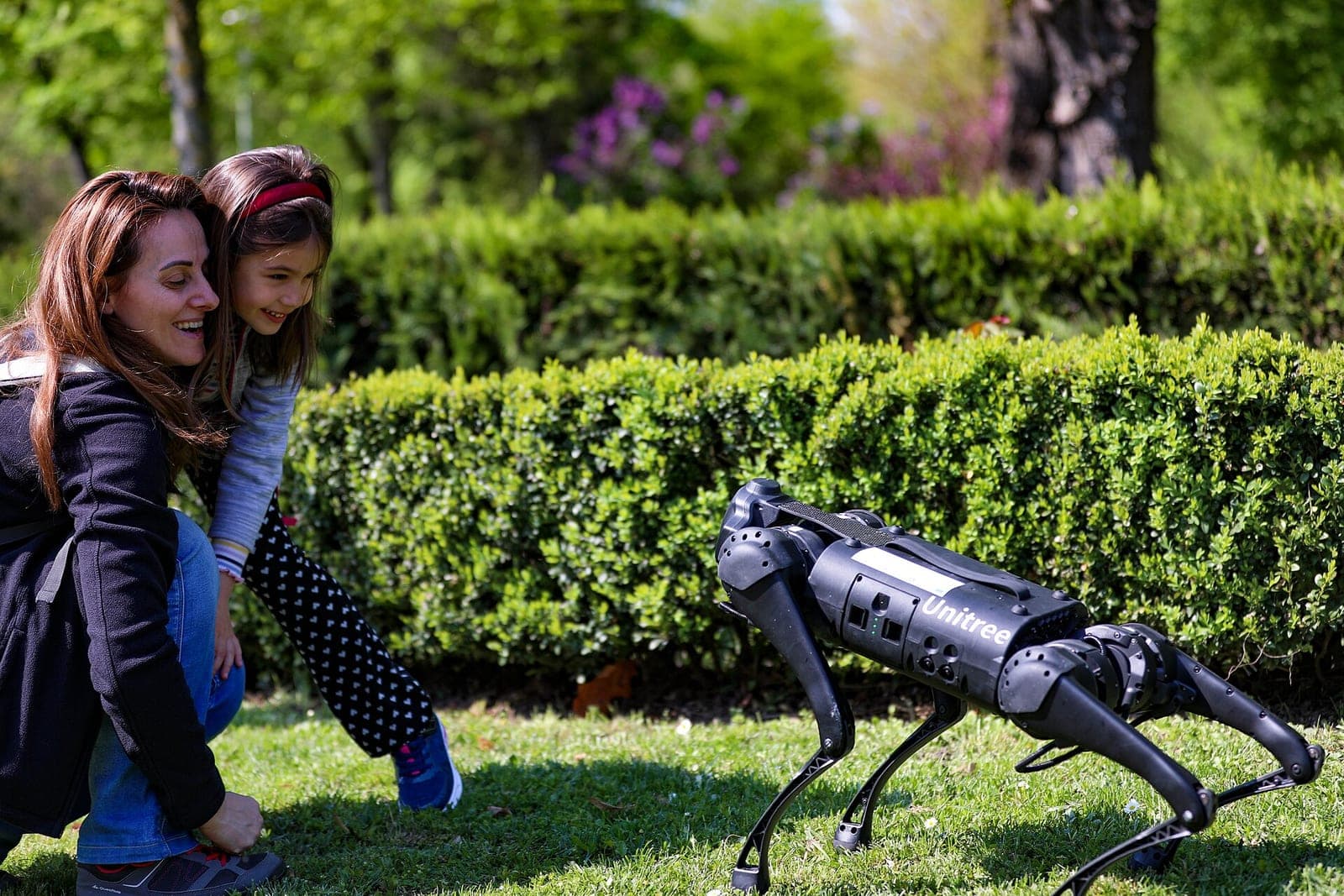
Robots race up Mount Tai's 3,100 stone steps in China's first mountain contest
The inaugural CMG World Robot Mount Tai Competition sent legged and humanoid robots up a real mountain trail. A Unitree robot dog won the legged race in 43 minutes and 41 seconds.
More in brief
- Dutch privacy regulator tells shoppers not to buy AI camera glassesNov 23
- Amazon buys Decart's AI speed-up software and hires its foundersNov 23
- Meta's Muse can now shop Walmart's Black Friday deals for youNov 23
- Alecto raises $20M for an AI-native law firm that handles house movesNov 23
- OpenAI's chief scientist wants a shared speed limit for AINov 22
- Nomadic raises $6 million for drones that charge on live power linesNov 22