
AI·News & analysis
Amazon buys Decart's AI speed-up software and hires its founders
Amazon signed a deal for the Decart Optimization Stack and will bring the startup's three co-founders and researchers on board to speed up its own AI chips.

Tide
Ripple
Sci-fi
5/10
Reality
Demo
Squeezing more brainpower out of every chip.How we rate
Amazon signed an agreement to buy the technology behind Decart's Optimization Stack, software that makes AI models run faster on chips, and to bring Decart's three co-founders and its researchers to Amazon.
The two companies have worked together on Trainium, Amazon's own AI chip, since 2025. Amazon did not state a price. The deal still needs customary closing conditions, including regulatory clearance.
What to know
- Amazon signed an agreement to buy the technology behind the Decart Optimization Stack (DOS).
- Decart's co-founders Dean Leitersdorf, Moshe Shalev and Orian Leitersdorf, plus their researchers, will join Amazon.
- The software should help Amazon's own chips, such as Trainium, train and run AI models faster and at lower cost.
- The deal needs regulatory clearance, and Amazon did not publish a price.
Amazon announced on Monday that it signed a deal to buy the technology behind the Decart Optimization Stack, and to hire Decart's three co-founders and their researchers.
That's the news. Now the fun part: why would the company behind one of the biggest online stores want a startup whose main trick is making chips work harder?
What did Amazon announce?
Amazon signed an agreement to buy the proprietary technology behind the Decart Optimization Stack, or DOS. It will also bring Decart's AI co-founders to Amazon: Dean Leitersdorf, Moshe Shalev and Orian Leitersdorf. Their team of AI researchers and engineers comes along.
The goal, in Amazon's words, is to help it "further optimize" inference and the performance of its custom chips. More customers could then train and run AI models faster and at lower cost.
Completion is subject to customary closing conditions, including regulatory clearance. Amazon's announcement does not give a price.
Why it matters: this is a deal for software and people, not for a product you can buy off a shelf. Think of it as Amazon hiring a pit crew for its own race cars.
First, what is inference?
Training is how an AI model learns. It reads huge amounts of data and adjusts itself over and over. That takes a lot of computing power.
Inference is what happens afterward, each time someone uses the model. You type a question, the model works out an answer. That is inference.
Every chat reply, every generated image and every AI search result is inference. It happens billions of times a day. Even a small speed-up on each run adds up to big savings.
Amazon says it has long believed that inference speed and compute efficiency are central to the future of AI. It says that work covers language models (the kind that write text), multimodal systems (multimodal means models that handle text, images and video together), agentic systems (an AI agent, which means an AI that carries out tasks for you) and world models.
What is Trainium, and what does "custom silicon" mean?
"Silicon" is shorthand for computer chips, because chips are made from it. "Custom silicon" means chips a company designs itself instead of buying them off the shelf.
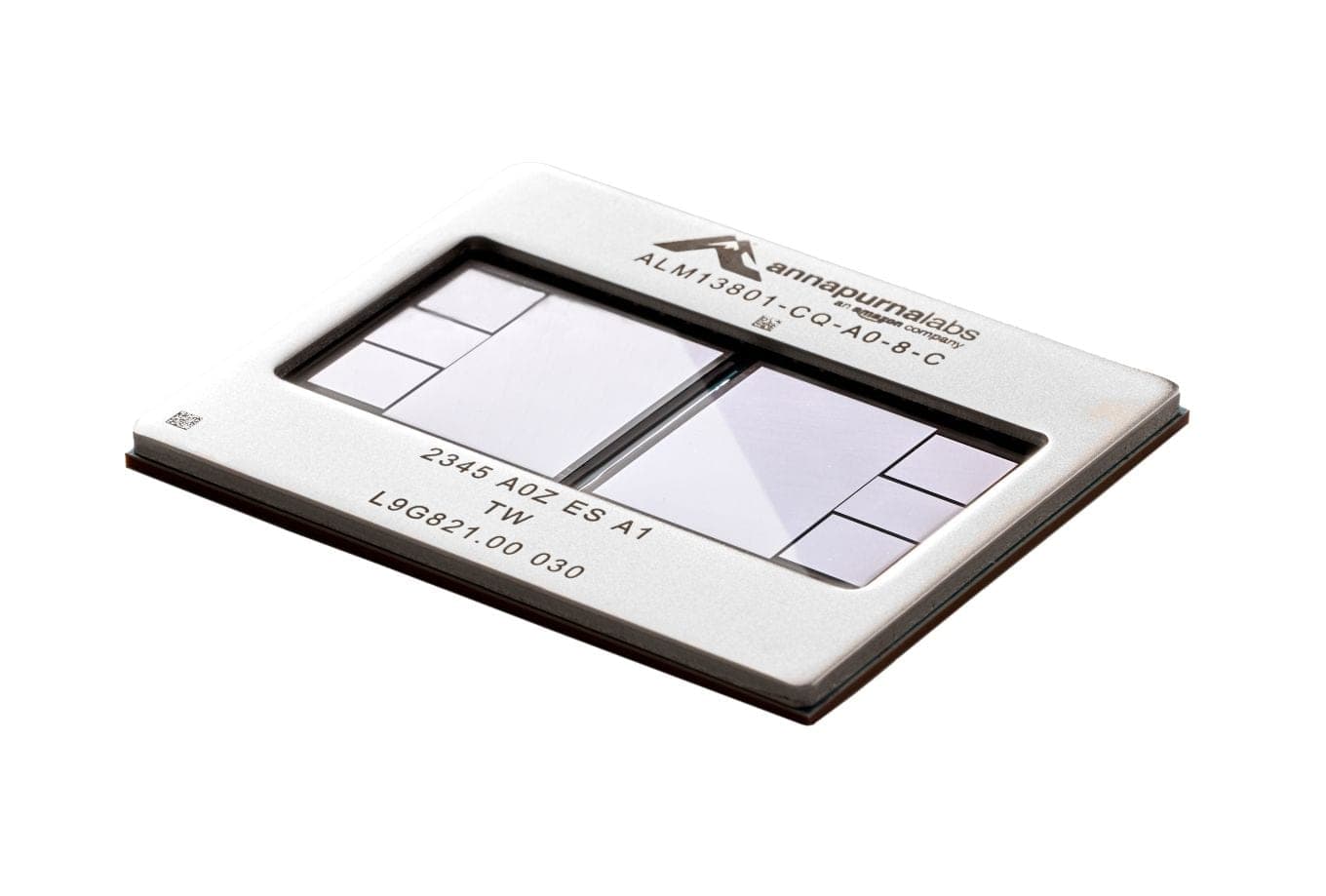
Amazon has several of these. The announcement names two families: Graviton, and Trainium, which is built to train and run AI models.
Why build your own? Control. If you design the chip, you can tune it for your own workloads and you depend less on other suppliers.
But a chip is only as good as the software that tells it what to do. That is where Decart comes in.
What does Decart's software actually do?
Developers usually have to tune an AI model for each chip it runs on. Decart says that process, called optimization, can take months. Decart says DOS shrinks it to a few weeks.
That also makes it easier to move AI work from one kind of chip to another when needs change.
Decart has said DOS runs across Nvidia GPUs, Google TPUs and Amazon Trainium. In May 2026, when it released DOS 2.0, it claimed its software lets AI agents process more than 1,600 tokens per second. A token is a small chunk of text, a bit shorter than a word. Decart put the industry average at around 200.
It also said the software lets world models handle up to 100 frames of high-definition video per second. These are Decart's own numbers. We have not seen independent tests.
In real life Imagine two bakeries with the same oven. One bakes 200 loaves an hour and the other 1,600, because the second one organized its kitchen better. DOS is meant to be the kitchen reorganization.
How long have Amazon and Decart worked together?
Not long, but closely. Amazon says it began working with Decart in 2025. Since then, Decart's team has worked with Amazon on Trainium, using what Amazon calls a full-stack approach: software and hardware together.
Amazon says the teams shared "a full-stack view of performance" and an appetite for hard science and engineering problems.
In May, Decart said its Lucy2 video model ran on Trainium3, Amazon's newer chip generation. Nafea Bshara, a vice president at Amazon's Annapurna Labs, which designs Amazon's chips, said Lucy2 exceeds 80% Model FLOPS Utilization. In plain words: most of the chip's raw power is doing useful work, instead of sitting idle.
Who is Decart?
Decart is a startup that builds real-time video AI, world models and the optimization software Amazon is buying. A world model is an AI that learns how a scene behaves, so it can generate video or environments that react to what you do.
It has three products:
- DOS: the optimization stack, the part Amazon is buying.
- Lucy: a model that changes live video as it plays, used for things like virtual try-on and live streaming.
- Oasis: a world model for generated environments, pushed toward robotics and driving simulation.
Its money history is quick. Decart closed a $32 million round at a $500 million valuation in December 2024. It raised $100 million at a $3.1 billion valuation in 2025. In May 2026 it announced $300 million at a valuation of nearly $4 billion, led by Radical Ventures, with Nvidia among the investors.
What about the reported price and Anthropic?
Amazon did not name a price. Earlier reports did.
In October, The Wall Street Journal reported, citing people familiar with the matter, that Amazon was in talks to buy Decart for around $7 billion. A separate report from Calcalist's CTech put a possible valuation at about $5.5 billion. None of those numbers has been confirmed by Amazon or Decart.
Anthropic was also reported to have considered buying Decart for roughly $6 billion in August, and to have walked away in September after due diligence.
The catch: Amazon's deal, as announced, covers the DOS technology and the team. It says nothing about Lucy, Oasis or Decart's other customers. We don't know what becomes of them.
Why does a chip-maker want this?
Chips are not interchangeable in practice. A model tuned for one chip can run badly on another until engineers rework it.
If Amazon can cut that work from months to weeks, its Trainium chips become easier to adopt. Customers who already use Nvidia hardware could move some jobs over with less pain.
That is a business reason as much as a technical one. Cheaper compute for Amazon can mean a better offer for AWS customers, though the announcement promises no price cuts.
Amazon's own quote makes the case. Peter DeSantis, who leads foundational AI models and custom silicon at Amazon, said more efficient compute means "better training, better reinforcement learning, faster inference, and better models for customers at a lower cost." Reinforcement learning, which means teaching a model by rewarding good results, is one of the ways models are trained.
What's next?
The deal has to close first. Regulators have to clear it, and Amazon has to bring the team and technology in.
Amazon's own statement lists the risks. It says it may be unable to integrate the technology, or to hire and keep Decart's people. It also says the benefits it hopes for may not appear.
For now, there are no new products and no dates. The first thing to watch is whether Trainium gets easier to use.
What it means for you
- If you use AI apps: nothing changes today. Over time, faster and cheaper inference could mean quicker replies.
- If you build on AWS: watch for tools that move models between chips. Nothing is announced yet.
- If you follow the chip race: Amazon is betting that better software matters as much as better silicon.
- If you used Decart's tools: the announcement does not say what happens to Lucy and Oasis.
The bottom line
Amazon is buying Decart's speed-up technology and the people who built it. The aim is to get more out of its own chips and make AI cheaper to run.
The price is not public, and the deal still needs to close. It's a quiet kind of AI news: no new chatbot, just a faster engine under the hood.
Key facts
- What Amazon buys
- The technology behind the Decart Optimization Stack (DOS)
- People joining
- Co-founders Dean Leitersdorf, Moshe Shalev, Orian Leitersdorf, plus researchers
- Working together since
- 2025, on Amazon's Trainium chips
- Price
- Not disclosed by Amazon
- Status
- Signed, pending customary closing conditions and regulatory clearance
Got questions?
Quick answers, plain wordsWhat did Amazon announce?
Amazon said it signed an agreement to buy the proprietary technology behind the Decart Optimization Stack (DOS). It will also bring Decart's three AI co-founders and their team of researchers and engineers to Amazon.
What is the Decart Optimization Stack?
DOS is Decart's software for making AI training and inference faster. Inference means running a trained model to get an answer. Decart says DOS works across Nvidia GPUs, Google TPUs and Amazon Trainium chips.
How much is Amazon paying?
Amazon did not say in its announcement. The Wall Street Journal reported in October, citing people familiar with the matter, that talks were around $7 billion. That figure is a report, not a confirmed price.
Who are the people joining Amazon?
Amazon names Dean Leitersdorf, Moshe Shalev and Orian Leitersdorf, the Decart co-founders, along with Decart's team of AI researchers and engineers.
What is Trainium?
Trainium is Amazon's own family of chips built to train and run AI models. It sits in Amazon's custom silicon line-up, which also includes the Graviton processors.
Is the deal final?
Not yet. Amazon says completion is subject to customary closing conditions, including regulatory clearance.
What happens to Decart's other products, Lucy and Oasis?
Amazon's announcement is about the optimization technology and the people. It does not say what happens to Decart's world models Lucy and Oasis, so that is unknown for now.
Will this make AWS cheaper for me?
Amazon says the goal is for more customers to train and run AI models faster and at lower cost. It has not announced any new prices or products, so nothing changes on your bill today.
Did anyone else try to buy Decart?
Anthropic was reportedly considering a purchase of roughly $6 billion in August and reportedly ended those talks in September after due diligence. Neither company confirmed the details in what we reviewed.
Why does inference speed matter?
Inference is what happens every time you ask an AI a question. Faster, cheaper inference means cheaper AI features and shorter waits, which is why Amazon calls it central to the future of AI.
SourcesAmazon
Topics and tagsAmazon, AI chips, Funding & deals, amazon
Go deeper
Related stories

Palo Alto Networks to buy Applied Compute for $4.5 billion in stock
The cybersecurity giant announced the all-stock deal alongside a record quarter, with revenue up 39% to $3.44 billion and a sharply higher full-year forecast.

NVIDIA's revenue more than doubles to $115.8 billion in its first quarter after Huang
The AI chip maker reported $65.3 billion in profit and forecast $130 billion for the next quarter, while interim CEO Colette Kress and the new board chair said Jensen Huang will not return.
Jensen Huang resigns as NVIDIA CEO, CFO Colette Kress steps in
NVIDIA's board says its co-founder has left as CEO and board member, effective immediately. CFO Colette Kress takes over on an interim basis while the company searches for a permanent chief.
More in brief
- Dutch privacy regulator tells shoppers not to buy AI camera glassesNov 23
- Meta's Muse can now shop Walmart's Black Friday deals for youNov 23
- X Square Robot launches WALL-OSS-1.0 with a planning harness and APINov 23
- Alecto raises $20M for an AI-native law firm that handles house movesNov 23
- OpenAI's chief scientist wants a shared speed limit for AINov 22
- Nomadic raises $6 million for drones that charge on live power linesNov 22