
Technology·News & analysis
Tesla's Model 3 and Model Y can now power your house in a blackout
Tesla turned on Powershare Home Backup for new Model 3 and Model Y cars in the US. Paired with a Powerwall 3, the car can keep a home running for over two extra days.
Tide
Wave
Sci-fi
4/10
Reality
Shipping
Your driveway quietly becomes a backup power plant.How we rate
Tesla turned on Powershare Home Backup for new Model 3 and Model Y cars, letting them power a house during an outage alongside a Powerwall 3.
Tesla says the car adds over two days of backup for a typical home. Until now only the Cybertruck could do this, and these are Tesla's two best-selling cars. Powerwall 2 and Powerwall+ support is coming soon, with no date yet.
What to know
- Tesla turned on Powershare Home Backup for new Model 3 and Model Y cars, so they can feed a house during a power outage.
- It needs a Powerwall 3, works in the US and Puerto Rico, and is guaranteed on cars ordered on October 1, 2026 or later.
- Tesla says Premium and Performance trims add over two days of backup for a home using 30 kWh a day, at up to 11.52 kW.
- Tesla also opened 2.4 kW vehicle-to-load across the US Model 3 and Model Y lineup, so the cars can run tools and appliances directly.
Tesla just turned its two best-selling cars into backup batteries for your house. Now the practical question: what do you actually need for it to work when the lights go out?
Tesla Energy announced on Tuesday, October 6, that Powershare Home Backup is now available for new Model 3 and Model Y cars with a Powerwall 3. Its post on X promised to "extend your home backup by over 2 days with your vehicle." Until today, the Cybertruck was the only Tesla that could do this.
First, what is Powershare?
Powershare is Tesla's name for bidirectional charging. Normally power flows one way: from the wall into the car. Bidirectional means it can also flow back out, from the car's battery into something else.
Tesla uses the name for a few different things:
- Home Backup: the car feeds your house through its wiring during an outage. This is the new part for Model 3 and Model Y.
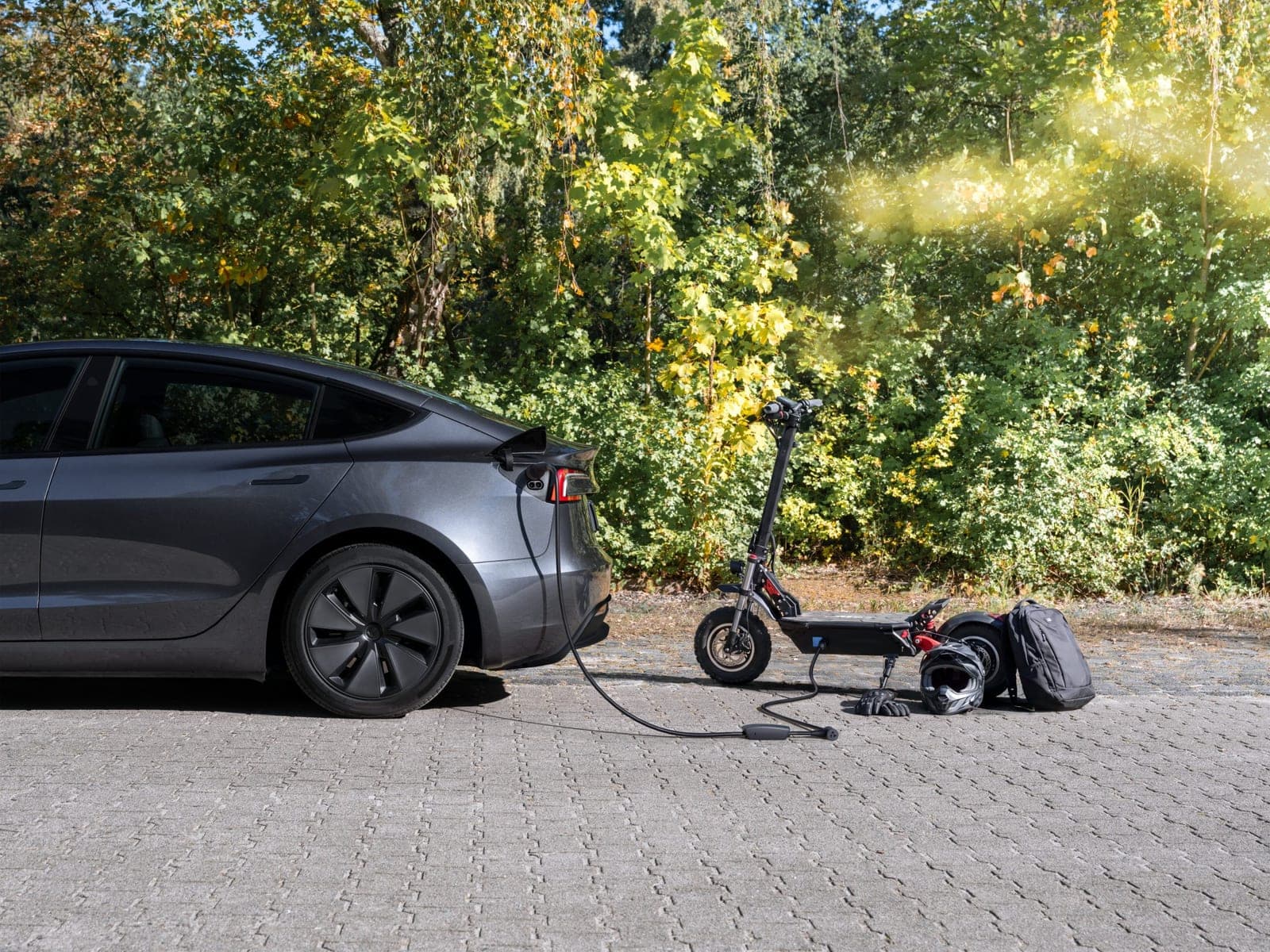
- Vehicle-to-load (V2L): you plug devices straight into the car with Tesla's Outlet Adapter.
- Grid Support: the car sends energy to the power grid when demand is high. That one stays Cybertruck-only.
Think of a Powerwall as a water tank on your roof and the car as a tanker truck parked in the driveway. The tank handles the daily stuff. The truck keeps it topped up when the pipes from the street run dry.
How does it work at home?
The setup is simple on paper. You plug the car into a Wall Connector or Universal Wall Connector at a home that has a Powerwall 3, Electrek reports. When the grid goes down, the car's battery pack extends the backup the Powerwall already provides.
According to Tesla's updated Powershare page, homes with a Powerwall 3 and a Wall Connector need no additional equipment. Not a Tesla App notes that Powerwall owners don't need the separate Powershare Gateway that standalone Cybertruck setups use. Electrek adds one step: you have to contact Tesla support to get the feature turned on.
Inside the car, you can set limits on how much of the battery Powershare is allowed to drain, Not a Tesla App reports. That matters, because you probably still want enough range to drive somewhere once the storm passes.
In real life If a winter storm knocks out power on your street, your Powerwall 3 starts running the house as usual. With a new Model Y plugged into the Wall Connector, the car tops it up, so the fridge, the furnace fan and the Wi-Fi keep going for days instead of hours.
How many days of power are we talking?
Tesla's numbers assume an average US home using 30 kWh a day and a car charged to 90%:
| Vehicle | Extra home backup (Tesla estimate) |
|---|---|
| Model 3 or Model Y Premium and Performance | Over 2 days |
| Model 3 or Model Y Standard | Up to 2 days |
| Cybertruck | Over 3 days |
By the numbers: the new cars can push up to 11.52 kW continuously at 240 volts, Not a Tesla App reports, the same as the Cybertruck's Powershare. That's enough to run big household loads, not just a lamp and a phone charger. The outlet notes a 185A motor start rating and UL1741 CRD certification.
For scale, a Powerwall 3 holds 13.5 kWh of usable energy. Not a Tesla App estimates a Model 3 or Model Y stores roughly five to six times as much. The Cybertruck's 123 kWh pack is why it lasts longer.
Your own mileage will vary. A small apartment-sized load stretches further. A house running central air in August burns through it faster.
Will my current Tesla work?
This is the part to read twice. Tesla only guarantees Powershare Home Backup on Model 3 and Model Y cars ordered on October 1, 2026 or later, in the US and Puerto Rico.
For older cars, Tesla says "some, but not all" have the capability. It comes down to one part: an inverter Tesla calls PCS2 Lite, which handles the bidirectional power. Electrek notes Tesla hasn't said when that part went into production for each trim.
Checking takes ten seconds:
- Step 1: on the touchscreen, open Controls, then Software.
- Step 2: tap Additional Vehicle Information.
- Step 3: look for "Powershare Support." If it says enabled, your car has the hardware.
Drive Tesla points out that October 1 isn't a hard line. Some cars built shortly before then are compatible too.
What's not included yet?
Electrek lists the current limits:
- Powerwall 3 only: Powerwall 2 and Powerwall+ support is "coming soon," with no date.
- No Powerwall, no backup: the Model 3 and Model Y can't use the Powershare Gateway that lets a Cybertruck back up a home on its own.
- No selling power back: Tesla says Grid Support is "not available for Model 3 or Model Y."
- No Model S or Model X: the bigger sedan and SUV aren't part of this rollout.
- US and Puerto Rico only: Tesla's Canadian site still lists Powershare as a Cybertruck feature, Electrek reports. Drive Tesla notes Canadian buyers haven't gotten the V2L expansion either.
What's next: Not a Tesla App expects Powerwall 2 and Powerwall+ support in the US to arrive first, followed by other markets. Tesla recently added V2L to Model 3 and Model Y cars built at its Shanghai factory, which the outlet says could put them next in line.
What about plugging in a power tool?
Tesla also expanded vehicle-to-load across the US Model 3 and Model Y lineup, Drive Tesla reports. Before this, US V2L was limited to Model Y Premium trims, which got a 2.4 kW Outlet Adapter in August, according to Electrek.
The Outlet Adapter gives you up to 2.4 kW at 120 volts and 20 amps. That covers camping gear, power tools, a coffee maker or an e-scooter that needs a top-up. It won't back up a whole house, which is what Powershare Home Backup is for.
Not a Tesla App points out that base Model 3 and Model Y cars didn't support V2L at all before. New orders go straight from no bidirectional power to full home backup.
How did Tesla get here?
Bidirectional charging has been a long road for Tesla:
- March 2023: at Tesla's Investor Day, Drew Baglino, then Tesla's SVP of powertrain and energy engineering, said bidirectional charging could come "within the next two years," according to Electrek.
- Late 2023: Powershare launches with the Cybertruck, Electrek reports.
- August 2026: the Model Y Premium gets the 2.4 kW Outlet Adapter.
- September 2026: the Cybertruck's Powershare starts working together with a Powerwall 3, after the 2026.27.10 software update, Electrek reported.
- October 6, 2026: Model 3 and Model Y get Home Backup with a Powerwall 3.
At that same 2023 event, Elon Musk said, "I don't think very many people are going to want to use bidirectional charging, unless you have a Powerwall," Electrek reports. The version shipping today follows that thinking: the car works as an add-on to a home battery.
Who else does this?
Tesla isn't the first carmaker here, and the feature has been spreading across the industry:
- Ford: launched home backup on the F-150 Lightning in 2022, with 9.6 kW of output, according to Electrek.
- GM: promised in 2023 to bring vehicle-to-home to every Ultium-based EV by model year 2026. GM Energy's list now includes the Equinox EV, Blazer EV, Silverado EV, the 2027 Bolt, GMC's Sierra EV and Hummer EV, and five Cadillacs, Electrek reports.
- Kia: offers it on the EV9 through a Wallbox bidirectional charger.
- Nissan: the Leaf offered power-to-grid charging years ago, The Verge notes.
The big picture: with Tesla's best-sellers joining in, home backup from a car is moving from a pickup-truck perk to something ordinary families can order. If you're curious how many of these cars are on the road, our story on Tesla's third-quarter deliveries has the latest numbers.
What it means for you
- Shopping for a Model 3 or Model Y: any car ordered from October 1 in the US is guaranteed to support Powershare. That's worth knowing if your area gets outages.
- Already own one: check Software, then Additional Vehicle Information, for "Powershare Support" before planning anything.
- Have a Powerwall 3 and Wall Connector: you shouldn't need new hardware, but you'll need to ask Tesla support to switch it on.
- Have a Powerwall 2 or Powerwall+: wait for Tesla's "coming soon" update. There's no date yet.
The bottom line
Tesla's two best-selling cars can now keep a house running during a blackout, as long as there's a Powerwall 3 on the wall. Tesla says that adds over two days of backup for a typical home. The fine print matters: new orders are guaranteed, older cars may or may not have the right hardware, and it's US and Puerto Rico only for now.
Key facts
- Who gets it
- New Model 3 and Model Y ordered on or after October 1, 2026
- Required at home
- Powerwall 3 plus a Wall Connector or Universal Wall Connector
- Extra backup
- Over 2 days (Premium, Performance), up to 2 days (Standard)
- Max continuous output
- 11.52 kW at 240V
- Where
- US and Puerto Rico
Got questions?
Quick answers, plain wordsWhat is Tesla Powershare Home Backup?
It's Tesla's vehicle-to-home feature. During a power outage, a compatible Tesla plugged into your home's Wall Connector sends energy from its battery into the house, working alongside a Powerwall to keep the lights on longer.
Which Model 3 and Model Y cars support it?
Tesla guarantees it on new Model 3 and Model Y cars ordered on October 1, 2026 or later in the US and Puerto Rico. Tesla says some, but not all, earlier cars also have the needed hardware.
How do I check if my older Tesla can do it?
On the touchscreen, go to Controls, then Software, then Additional Vehicle Information. If it lists Powershare Support as enabled, your car has the PCS2 Lite inverter that makes bidirectional power possible.
Do I need a Powerwall?
Yes. For the Model 3 and Model Y, a Powerwall 3 is required. Tesla says Powerwall 2 and Powerwall+ support is coming soon. Only the Cybertruck can back up a home without a Powerwall, using a Powershare Gateway.
Do I need to buy extra hardware?
If you already have a Powerwall 3 and a Wall Connector, Tesla says no extra hardware is needed. Electrek reports you have to contact Tesla support to get the feature turned on.
How long can a Model 3 or Model Y power my home?
Tesla estimates over two extra days for Premium and Performance trims and up to two days for Standard trims, assuming a home that uses 30 kWh a day and a car charged to 90%. Your results depend on how much power you use.
Can I sell power from my Model 3 or Model Y back to the grid?
No. Tesla says Powershare Grid Support is not available for the Model 3 or Model Y. It's still a Cybertruck feature in limited markets.
Does it work on the Model S or Model X?
No. The Model S and Model X are not included in this rollout.
Is it available in Canada?
Not yet. Tesla's Canadian site still lists Powershare as a Cybertruck-only feature, and no Canadian rollout has been announced.
What's the difference between Powershare and V2L?
V2L (vehicle-to-load) powers devices plugged straight into the car through Tesla's Outlet Adapter, up to 2.4 kW. Powershare Home Backup sends power through your home's electrical system during an outage, up to 11.52 kW.
SourcesTesla
Topics and tagsTesla, tesla, electric vehicles, home batteries
Related stories
Tesla delivered 486,532 cars in Q3, beating every Wall Street estimate
Deliveries slipped 2.1% from last year's tax credit record but topped the analyst consensus by about 25,000 cars, as Tesla sold more than it built for a second quarter in a row.
Lucid's production drops to its lowest level since early 2025 as it sells off unsold cars
Lucid built 2,954 vehicles and delivered 3,806 in the third quarter. The company says the cut is deliberate, as its new CEO works through a pile of unsold cars and a $1.4 billion cost reset.
Rivian's deliveries jump as its cheaper R2 starts to ramp up
Rivian delivered 19,248 vehicles in the third quarter, up about 46% from a year earlier, as production of its more affordable R2 picked up and the wider EV market cooled.
More in brief
- Google launches Nano Banana 2.1, a better image model at half the priceOct 6
- Anthropic opens its strongest hacking-capable AI to more security teamsOct 6
- RemoveMacAI turns off Apple Intelligence on macOS 27 and frees up about 12GBOct 6
- The Emmys are leaving broadcast TV for Prime Video, and they'll stream free worldwideOct 6
- Paramount closes its $110B Warner Bros. Discovery deal, creating SkydanceOct 6
- Mistral Large 4 'Le Chonk' is a 1-trillion-parameter open model built for cyber defenseOct 6