
Robots·News & analysis
AWS releases open-source toolchain to train and deploy robot AI
Amazon Web Services launched the Physical AI Toolchain, an open-source kit that connects synthetic data, training, simulation and edge deployment for robots, built on NVIDIA's robotics software.
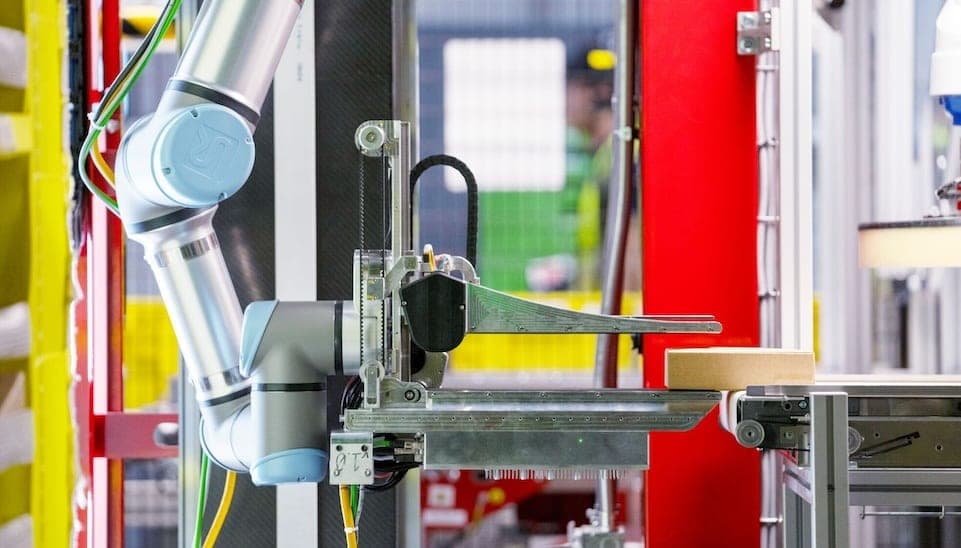
Tide
Ripple
Sci-fi
7/10
Reality
Shipping
A school for robots, with a cloud as the principal.How we rate
Amazon Web Services launched the open-source Physical AI Toolchain, which links synthetic data, training, simulation and edge deployment for robots in one workflow.
It pairs AWS services with NVIDIA's Isaac, GR00T and Cosmos software and works with any robot hardware. Amazon says it drew on a fleet of more than 1 million of its own robots. Companies can use the whole pipeline or pick single pieces.
What to know
- Amazon Web Services launched the Physical AI Toolchain, an open-source stack for building robots and other machines that act in the real world.
- It covers five stages: synthetic data generation, model training, simulation and validation, edge deployment, and continuous improvement.
- It combines AWS services like SageMaker and IoT Greengrass with NVIDIA's Isaac Sim, Isaac Lab, Isaac GR00T and Cosmos.
- It is hardware-neutral and modular: teams can adopt the whole pipeline or a single piece.
Amazon announced the Physical AI Toolchain on AWS, an open-source kit for building robots that learn. That's the news. Now the fun part: what do you actually need to teach a machine to pick up a box?
What is the Physical AI Toolchain?
It is a free, open-source starting kit. AWS describes it as reference architectures, infrastructure code and deployment automation for the whole life of an AI-powered machine.
It is built on Amazon cloud services and integrated with NVIDIA's physical AI software. The code is public on GitHub.
The Robot Report says the goal is to connect the many pieces between a trained model and a robot that works reliably. "We're trying to make this easy button," said Sri Elaprolu, director of Frontier AI Science and Engineering at AWS.
In real life Think of a flight school. You don't hand a student the keys to a jet. You use a simulator, then a trainer plane, then the real thing. This toolchain builds that school for robot brains.
Why do robots need their own toolchain?
Because a robot is not a chatbot. Amazon says physical AI lets machines sense their environment, reason with cloud-trained models and adapt in real time, instead of repeating fixed instructions.
AWS's own blog lists five problems that make this hard:
- Compute mix: Training, simulation and the robot itself each need different kinds of GPUs.
- Artifact sprawl: Datasets, scenes, robot descriptions and checkpoints pile up fast.
- Validation depth: A failed robot restarts into a physical world that has already changed.
- Data economics: Real robot data is expensive to collect.
- Control path: Decisions that move a robot are limited by latency, power and heat.
Elaprolu put the data problem plainly. There is a lot less robot data than text on the internet, he told The Robot Report, so companies have to generate it.
What's inside the toolchain?
The toolchain spans five pillars, according to Amazon. Each one feeds the next.
- Synthetic data generation: AI-made environments create training scenarios without costly real-world collection.
- Model training: Models learn from human demonstrations and from practice in simulation.
- Simulation and validation: Behavior gets tested in virtual worlds before it touches real hardware.
- Edge deployment: Optimized models are pushed to machines, where they decide in real time without constant cloud contact.
- Continuous improvement: Data from deployed machines flows back to create new training data.
Amazon calls the whole thing a flywheel: robots in the field produce data, the data improves the models, and the better models go back to the robots.
Which AWS and NVIDIA parts does it use?
Amazon says AWS provides SageMaker for training, EC2 GPU instances for simulation, AWS IoT Greengrass for edge deployment and Bedrock AgentCore for orchestration. NVIDIA provides the robotics layers.
- Isaac Sim: physics-accurate simulation.
- Isaac Lab: reinforcement learning, where a robot learns by trial and error.
- Isaac GR00T: training humanoid robot models from demonstrations.
- Cosmos: synthetic world generation.
AWS's blog adds NVIDIA OSMO for workflow orchestration and Jetson hardware as the target for edge inference. It also names open formats: LeRobot for data, PyTorch and Hugging Face for training, ONNX for portable models, and ROS 2 for on-robot control.
The big picture: a bottom layer built on the Strands Agents SDK lets teams describe what they want in plain language, and AWS says it then picks which components to run.
What does the GitHub repo include?
The public repository lists modules for each stage, according to its README. It is labeled as AWS sample code, and it marks some parts, such as the validation module, as a preview.
- Reinforcement learning: Isaac Lab training with 4,096 parallel environments, run on SageMaker and AWS Batch.
- Imitation learning: fine-tuning of NVIDIA's GR00T N1.6 model on SageMaker and Batch.
- World model training: fine-tuning of DreamZero, a 14-billion-parameter World Action Model, using LoRA on SageMaker.
- Data ingest: conversion of teleoperation recordings from Zarr, ROS bags and CSV into the LeRobot v2 format.
- Deployment: export to TensorRT and rollout to a robot fleet through Greengrass.
It also includes an agent layer where Strands Agents can drive robots in natural language. By default that layer uses a MuJoCo simulation, and real hardware is opt-in.
Why is this launching now?
Amazon points to a growing crowd. A Global Startup Trends Report on physical AI, which Amazon cites, says one in seven startups worldwide is now building physical AI. It also says 72% of builders call cloud computing essential to their systems.
AWS's blog cites the Capgemini Research Institute: 79% of organizations are already engaging with physical AI, and 60% of executives believe it will enable robotics in areas that were once impractical.
Those are survey figures from third parties, quoted by Amazon. They show why a cloud company wants to be the default home for this work.
Do you have to use all of it?
No. AWS says each component is an independent Terraform module with no hard dependencies on the others. A team can adopt one stage or deploy the full pipeline.
Amazon says customers can also manage the entire cycle from a single control plane, with fleet tools to provision, secure and update thousands of machines over the air.
The toolchain stays neutral about hardware. "The toolchain is intentionally staying neutral to that final step," Elaprolu told The Robot Report, referring to the physical robot itself.
AWS also says each module ships with a working example. The GR00T training module, for instance, includes 27 supplied UR3 pick-and-place episodes, so you can confirm it runs before swapping in your own data.
Who is already using the pieces?
Amazon highlights three companies building physical AI on AWS:
- NEURA Robotics: developing cognitive humanoid robots, with a goal of millions of robots on the market by 2030.
- RLWRLD: building an 8.1-billion-parameter model for dexterous robot hands.
- Config: a data pipeline holding more than 200,000 hours of robot action data.
The Robot Report adds that Elaprolu pointed to Telexistence, which has deployed more than 300 humanoids in Japanese convenience stores, and to Bedrock Robotics, which trains construction robots on AWS.
He said the individual components were already used by customers, including companies in AWS's Physical AI Fellowship with MassRobotics and NVIDIA. The new release packages them into one workflow.
What's the catch?
The catch: this is infrastructure, not a finished robot. AWS says the toolchain provides patterns and guidance, not ready-made robot behaviors.
You also need an AWS account with approved GPU quota, an NVIDIA NGC API key and a Hugging Face token, according to AWS's guide. The company says some AWS familiarity is assumed, but physical AI expertise is not.
Amazon says the toolchain lets manufacturers launch physical AI capabilities in weeks rather than the years it would take from scratch. That is Amazon's claim, and independent results will take time to appear.
It is also not a replacement for RoboMaker. The Robot Report says that simulation service shut down in 2025, and Elaprolu described it as one component of AWS's robotics stack.
What does Amazon bring to this?
Experience, by the numbers. Amazon says it operates more than 1 million robots across its network, handling millions of packages a day alongside hundreds of thousands of employees.
The Robot Report notes that Amazon's Vulcan, a robot that uses touch sensing to pick and stow items, was recently named its 2026 Robot of the Year. Amazon says the toolchain is built with guidance inspired by lessons from its own operations.
But Elaprolu admitted a warehouse is a controlled place. A convenience store has lower fault tolerance and needs faster responses, he said.
What it means for you
- If you build robots: you get a tested path from demonstrations to deployment, and you can start with the one stage that is slowing you down.
- If you run a factory or warehouse: more vendors may ship machines that improve from fleet data, which Amazon says makes later deployments smarter than the first.
- If you are just curious: the code is public, and the workshop runs on a small supplied dataset.
- If you are an everyday reader: nothing changes this week. The effect shows up later, in the machines you meet at work, in stores and on job sites.
The bottom line
AWS wants to be the place where robot brains go to school, and it is giving away the curriculum. The toolchain does not build a robot for you, but it removes a lot of plumbing between the lab and the factory floor.
Key facts
- Product
- Physical AI Toolchain on AWS
- License
- Open source
- Pipeline stages
- 5 (data, training, simulation, edge, improvement)
- Built with
- NVIDIA Isaac Sim, Isaac Lab, Isaac GR00T, Cosmos
- Amazon's own robots
- More than 1 million
Got questions?
Quick answers, plain wordsWhat is the AWS Physical AI Toolchain?
It is an open-source collection of reference architectures, infrastructure code and deployment automation that covers the full development cycle of AI-powered machines, from synthetic data to edge deployment, built on AWS and NVIDIA's physical AI software.
Is the Physical AI Toolchain free?
The toolchain itself is open source, so anyone can use and modify it. The AWS compute it runs on is billed as usual, and AWS's own guide asks users to follow the tear down steps to avoid incurring costs.
What is physical AI?
Physical AI is artificial intelligence that operates in the real world through robots, autonomous vehicles and smart factories. Instead of producing text on a screen, it senses its surroundings and acts on them.
Does it only work with Amazon's robots?
No. AWS says the toolchain is robot-agnostic and task-agnostic. Teams bring their own robot description, their own demonstration data and their own task, and the infrastructure handles the rest.
Which NVIDIA tools are included?
Isaac Sim for simulation, Isaac Lab for reinforcement learning, Isaac GR00T for training robot models from demonstrations, Cosmos for synthetic data, and OSMO for workflow orchestration, according to AWS.
Does it replace AWS RoboMaker?
No. The Robot Report reports that AWS's Sri Elaprolu said the toolchain is not a direct replacement for RoboMaker, the simulation platform shut down in 2025. RoboMaker was one component of the older stack, while the new toolchain covers a broader set of tools.
Can I use only part of it?
Yes. Each component is an independent Terraform module, so a team can adopt one stage at a time or deploy the full pipeline. Amazon also says customers can choose standalone simulation, training or deployment tools.
Who is already building on it?
Amazon names NEURA Robotics, RLWRLD and Config as companies building physical AI on AWS. Amazon also says the individual components were already used by customers in AWS's Physical AI Fellowship with MassRobotics and NVIDIA.
Where does the robot's decision-making happen?
On the robot. AWS says the cloud coordinates training and fleet management but cannot be the control loop for safety-relevant physical tasks, so optimized models are pushed to edge hardware such as NVIDIA Jetson.
SourcesAmazon, AWS, github.com
Go deeper
- ExplainerWhat is a humanoid robot?A humanoid robot is a machine built in the shape of a person, with a torso, head, arms and usually legs, so it can...
- ExplainerWhat is a GPU, and why does AI need them?A GPU (graphics processing unit) is a chip that does huge numbers of simple calculations at the same time. Built to...
Related stories
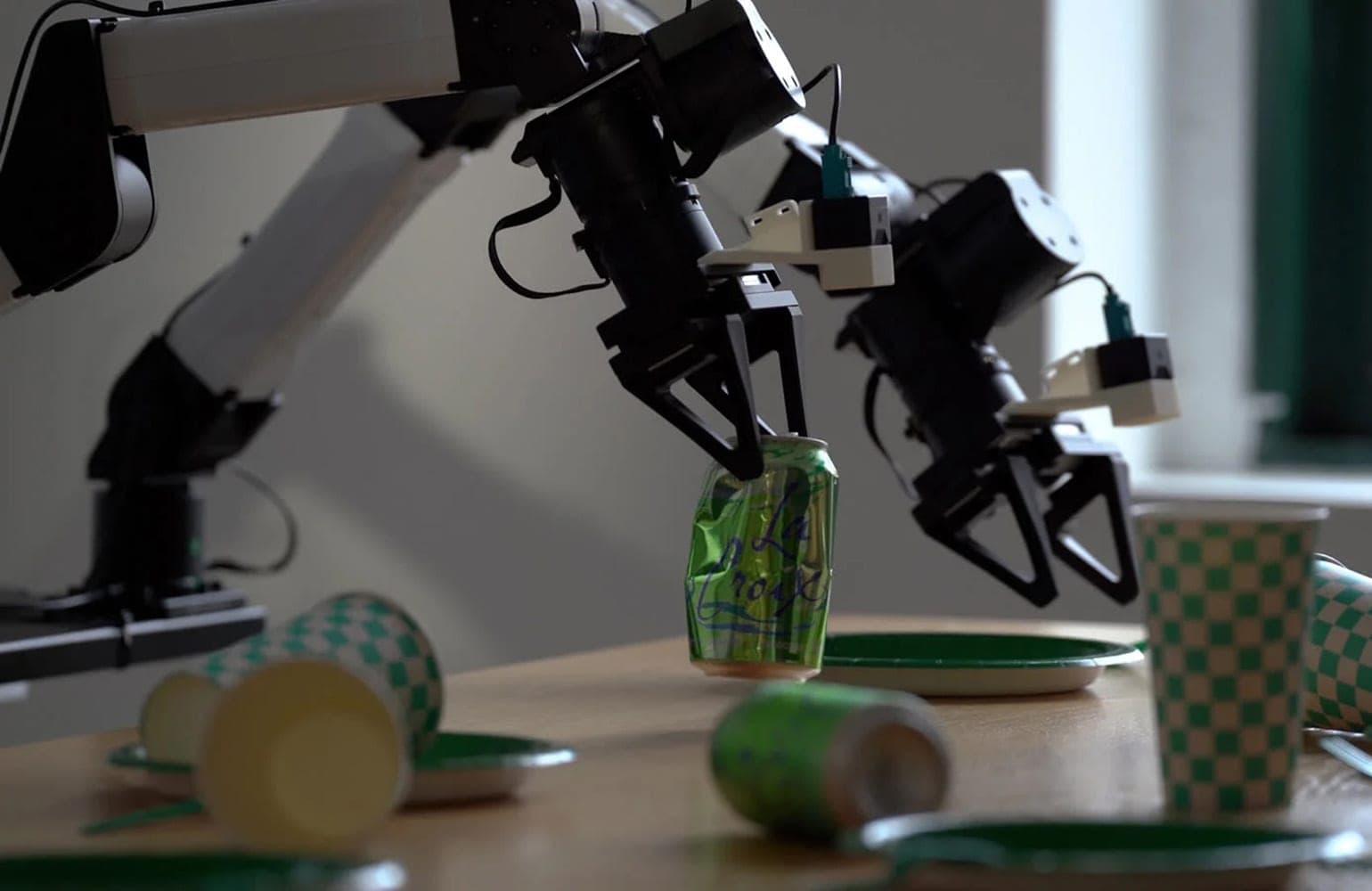
Runway's Praxis-1 wants to teach robots from video instead of demos
The AI video company announced Praxis-1, an open-weight model that turns its video pretraining into robot control, and is testing it with early partners before a public release.

Boston Dynamics names former Alexa chief Rohit Prasad as its new CEO
The man who helped build Alexa now runs the company behind Spot, Stretch and Atlas. He starts on October 7 with a clear brief: put more AI in the robots.
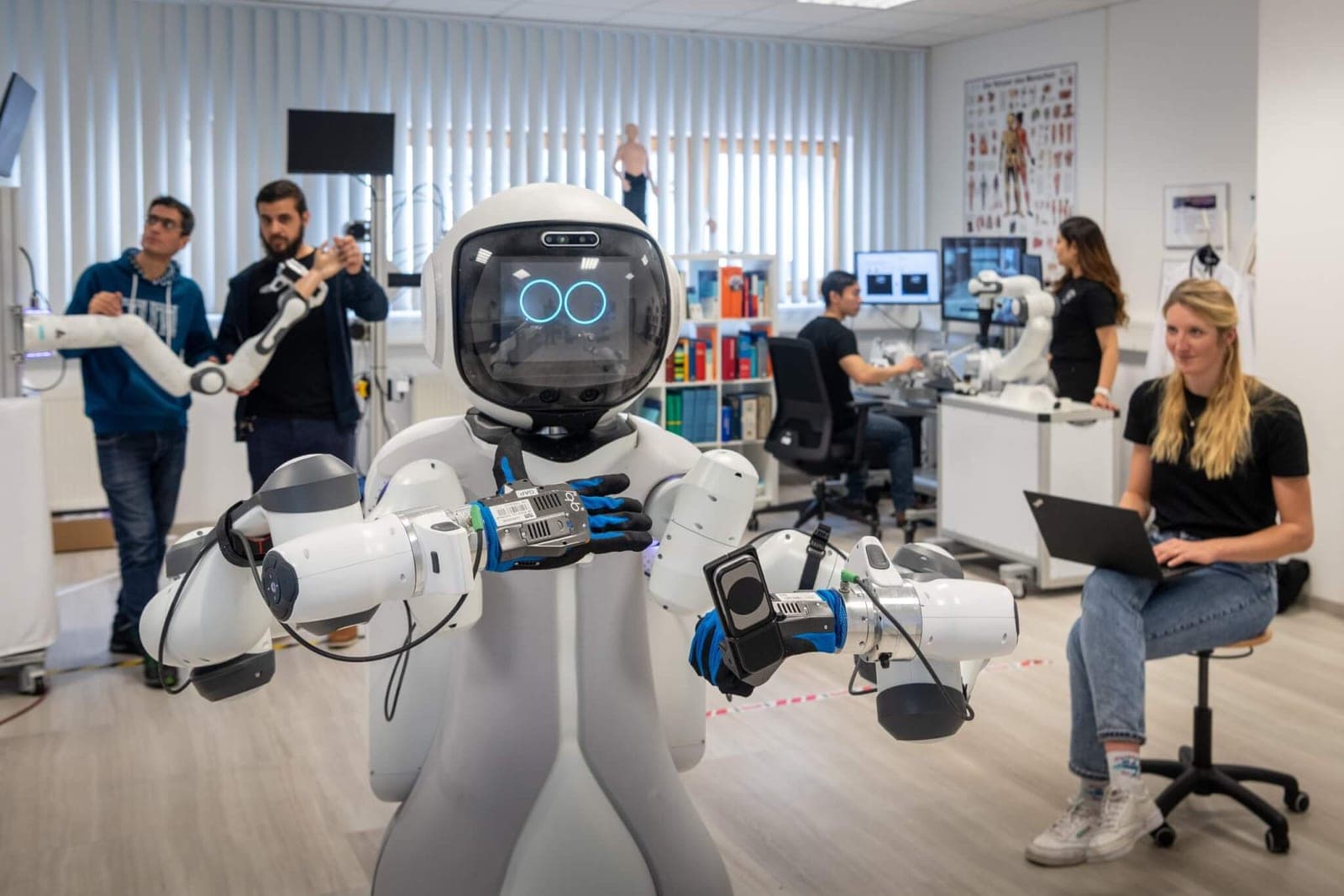
A data company just built a lab whose only job is teaching robots to move like us
Innodata opened a motion-capture lab in New Jersey, built with Vicon, that captures sub-millimeter 3D movement data to train humanoid and industrial robots how to move more naturally.
More in brief
- Google opens its SynthID Detector so anyone can check if media is AI-madeOct 8
- Microsoft Execution Containers now give AI agents a locked roomOct 7
- Microsoft's Surface Laptop Ultra opens for preorder at $2,599, built to run AI on the laptop itselfOct 7
- Dutch tax office drops Microsoft 365 and takes its email in-houseOct 7
- Rapidus signs up 17 design firms to find customers for its 2nm chipsOct 7
- Arizona court hack exposed data on 1.3 million people after one phishing clickOct 7