
AI·News & analysis
Meta lets smart glasses owners opt out of AI training on their visual data
A new setting in the Meta AI app lets smart glasses owners stop Meta from using camera-fed 'visual data' to train its AI models, though opting out can disable some features.
The 30-second version
The details
- Meta has begun rolling out a setting in the Meta AI app that lets smart glasses owners opt out of providing 'visual data' from AI experiences for AI training.
- Visual data is collected only during certain AI features, like asking Meta AI about something you're looking at or using Live AI, not ordinary photos and videos captured with the record LED on.
- Opting out means that data isn't stored after processing, but it can disable features like visual reminders that rely on Meta remembering what the glasses saw.
- Meta's help center confirms visual data may be reviewed by humans as part of training and improving its AI models.
- The change lands days after Meta Connect, where the company's smart glasses lineup, including new camera-free audio-only glasses, dominated the show floor.
Why it matters
Meta's smart glasses put a camera and microphone on your face by design, and the company has faced 'pervert glasses' surveillance criticism before. A visible, working opt-out for AI training data is a real test of whether Meta will give wearers meaningful control as it pushes deeper into agentic AI features.
The full story
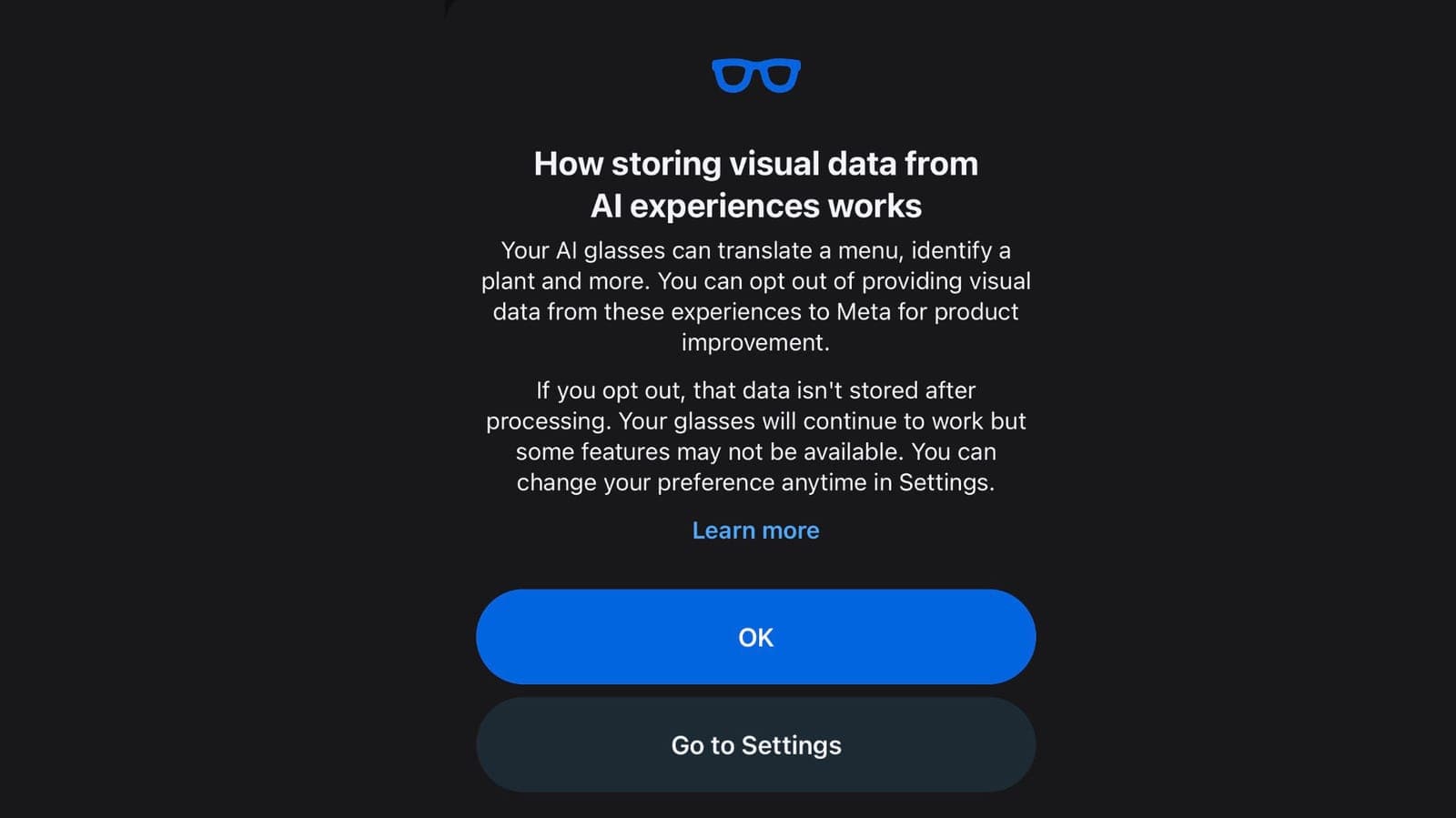
Meta is giving smart glasses owners a way to say no to AI training on what their glasses see. Engadget reports that the company has begun rolling out a setting in the Meta AI app letting people opt out of providing "visual data" collected during AI experiences for AI training, with pop-up notifications now appearing to alert glasses owners to the change.
How the opt-out actually works
The setting lives inside the Meta AI app rather than on the glasses themselves. To find it, open the app, go to your glasses' settings, select "Meta AI," and scroll down to an option labeled "store visual data from AI experiences." Meta requires your glasses to be out of their case and actively connected to your phone before the setting can be changed, and if you own more than one pair, each pair needs its own separate opt-out.
Meta's in-app notification frames the choice plainly: "Your AI glasses can translate a menu, identify a plant and more. You can opt out of providing visual data from these experiences to Meta for product improvement. If you opt out, that data isn't stored after processing."
What "visual data" does and doesn't mean
The term is doing a lot of work here, and Meta has drawn a specific line around it. Visual data refers only to what the camera captures during particular AI-driven interactions, things like asking Meta AI to identify an object, translate text you're looking at, or using the company's Live AI feature, which keeps a running visual and conversational context active. According to Meta, this is distinct from ordinary photos and videos you intentionally capture using the glasses' capture LED, which are not covered by this setting at all.
That distinction matters because it shapes what the opt-out can and can't protect against. Turning off visual data collection doesn't change how Meta handles content you deliberately record; it only affects the incidental visual context the glasses process while an AI feature is actively running.
Meta confirms human review is part of the process
Alongside the new setting, Meta published an expanded help center article describing how visual data feeds into its AI systems. The company states plainly that visual data collected through AI experiences "may use it to power glasses features and improve Meta products," adding that "this includes the process of training and improving AI models, which may be automated or manual (human)."
That's a direct acknowledgment that people, not just algorithms, could end up looking at footage of what a glasses wearer saw during an AI interaction. Meta hasn't detailed how much human review actually happens, what safeguards exist around it, or how footage is selected for that kind of review.
Why "human review" isn't a hypothetical for Meta's glasses
That disclosure lands with more weight because of what's already been reported about how Meta's glasses footage gets handled. In February 2026, Swedish publications Svenska Dagbladet and Göteborgs-Posten published a joint investigation into Meta's AI training pipeline for its glasses lineup, which spans the Ray-Ban Meta Wayfarer (Gen 2), Ray-Ban Display, and Oakley Meta HSTN models. The investigation found that contractors in Kenya were reviewing footage submitted by users who had opted into data sharing for AI training, and what those contractors described went well beyond the menus and plants Meta uses in its own examples.
"We see everything, from living rooms to naked bodies," one contractor told the investigation. Another worker described watching footage of someone undressing or using the bathroom, adding, "I don't think they know, because if they knew they wouldn't be recording." Fortune reported that contractors, whose job was to manually label content to help train the AI, said they had also seen users' credit card numbers and financial documents on-screen. In one documented case, a pair of glasses left on a bedside table reportedly recorded a partner who had never consented to being filmed at all.
The report led to a federal class-action lawsuit against Meta, which argues the company marketed the glasses as privacy-protective, a 2023 promotional statement called them "built with privacy at their core," while quietly routing sensitive footage to human reviewers overseas. Meta responded to the original investigation by telling reporters that, like other companies, it sometimes uses contractors to review shared content as part of improving its products.
Separately, Meta's glasses have another data category users can't fully control: voice recordings. Since a policy update in April 2025, audio triggered by the "Hey Meta" wake word is stored in Meta's cloud by default, and that storage can no longer be opted out of, a limitation the new visual-data setting doesn't touch.
The trade-off for opting out
Meta warns that declining to share visual data isn't consequence-free. The company specifically points to "visual reminders" as a feature that depends on this data: the ability to look at an object, like a product on a store shelf, and ask Meta AI to remind you about it later. If the underlying visual data isn't retained, that kind of reminder presumably can't function the same way.
Meta hasn't published a complete list of every feature this setting might touch, so it's possible other AI capabilities degrade in ways the company hasn't spelled out yet. For now, the disclosed trade-off is narrow, but incomplete.
Why this is arriving now
The timing isn't coincidental. This announcement comes just days after Meta Connect, the company's flagship annual hardware and software event, where smart glasses were, by TechCrunch's account, "pretty much everywhere." Staff and the influencers who attend the show reportedly wore the glasses constantly, and most product demos centered on them.
One of the event's more notable reveals was a new, still-unreleased line of audio-only smart glasses. These have six microphones but no camera at all and no native way to record surroundings, a design choice Meta appears to be making partly in response to earlier criticism. The company had faced accusations that its camera-equipped smart glasses amounted to "pervert glasses," with critics warning that discreet, wearable cameras could be used to record people without their knowledge or consent. The audio-only glasses sidestep that entire category of concern by simply not including a camera.
Meta also used Connect to push deeper into agentic AI on its glasses hardware, showing off tighter integration with Muse, the company's personal AI agent capable of carrying out tasks on a user's behalf. Wearers will reportedly be able to speak directly to Muse through the glasses and even choose from customizable digital avatars to represent the agent during interactions, though this integration isn't yet publicly available.
The bigger privacy picture for AI wearables
Meta's smart glasses sit at an unusually sensitive intersection: a camera and microphone worn on the face, feeding an AI system that's explicitly designed to observe and respond to the wearer's surroundings in real time. That combination has made the product line a recurring target for privacy scrutiny, well beyond this week's opt-out announcement.
Giving users a visible, documented way to limit what feeds AI training is a meaningful step, but it also puts pressure on Meta to be transparent about enforcement: whether opted-out data is genuinely never stored, how the company audits that promise, and whether future hardware or software updates might quietly expand what counts as "visual data" in ways users don't anticipate. As Meta leans further into agentic features like Muse, that transparency is likely to keep mattering more, not less. More: Meta news.
Additional reporting: TechCrunch, Fortune, Tom's Guide.
Key facts
- Where to find it
- Meta AI app > glasses settings > Meta AI > "store visual data from AI experiences"
- What triggers collection
- AI experiences like Live AI or asking Meta AI about what you're looking at
- What's excluded
- Photos and videos captured with the capture LED on are not 'visual data' under this setting
- Review disclosed
- Meta says visual data may be used in automated or manual (human) AI training and improvement
- Trade-off
- Opting out can disable features like visual reminders; other affected features aren't fully specified
- Context
- Announced days after Meta Connect, where Meta's glasses lineup, including new camera-free audio-only glasses, was the centerpiece
Quick questions
What is Meta's new smart glasses AI-training opt-out?
It's a setting in the Meta AI app that lets people using Meta's smart glasses stop the company from using 'visual data' collected during AI experiences to train its AI models. If you opt out, Meta says that data isn't stored after it's processed.
Where do I find the opt-out setting?
In the Meta AI app, go to your glasses' settings, select 'Meta AI,' and scroll to 'store visual data from AI experiences.' Your glasses need to be out of their case and connected to your phone to change it, and you'll need to repeat the step separately for each pair of glasses you own.
What exactly counts as 'visual data'?
Visual data is what your glasses' camera captures during specific AI-powered experiences, like asking Meta AI to identify a plant, translate a menu, or using Live AI. Meta says this does not include ordinary photos and videos you deliberately capture with the glasses' capture LED lit up.
Does Meta use human reviewers to look at this data?
Meta's help center says visual data may be used to train and improve its AI models through a process that 'may be automated or manual (human),' meaning a person could review some of the footage as part of that process.
What do I lose if I opt out?
Meta says opting out can disable certain features, specifically citing 'visual reminders,' where you look at an object and ask Meta AI to remind you about it later. The company hasn't detailed whether other features are affected.
Is this opt-out on by default, or do I have to turn it off myself?
Meta is rolling out the setting with a pop-up notification in the Meta AI app directing glasses owners to it, but the framing is opt-out, meaning visual data collection for AI training appears to be the default unless you actively change the setting.
Why is Meta doing this now?
The company hasn't given a specific reason, but the change follows months of scrutiny over its smart glasses' privacy implications, including 'pervert glasses' criticism about camera-equipped specs being used to record people without consent, and comes right after Meta Connect put the glasses lineup at the center of its biggest annual event.
Are all of Meta's smart glasses affected by this setting?
The setting applies to Meta AI app users with camera-equipped smart glasses that support AI experiences like Live AI. Meta's newly demoed audio-only glasses, which have no camera at all, wouldn't generate this kind of visual data in the first place.
What did Meta show off at Meta Connect this year?
Smart glasses dominated the event. Alongside existing camera models, Meta demoed new audio-only glasses with six microphones and no camera, aimed at communication and entertainment, plus deeper integration with Muse, Meta's personal AI agent, including customizable avatars.
Can I change this setting again later?
Yes. Meta says the preference can be changed at any time from the same settings menu.
Has Meta glasses footage actually been reviewed by humans before?
Yes. A February 2026 investigation by Swedish publications Svenska Dagbladet and Göteborgs-Posten found that contractors in Kenya were reviewing footage from users who had opted into AI training, including deeply personal content, which led to a federal class-action lawsuit against Meta.
What did Meta say about the contractor review reports?
Meta told reporters at the time that, like other companies, it sometimes uses contractors to review content people share with Meta AI as part of improving its products, without disputing that human review occurs.
Source: Engadget
Related stories

Meta launches camera-free AI glasses, a $1,299 VR headset and hearing help
Ray-Ban Meta Audio drops the camera entirely after privacy criticism, Ray-Ban Meta Gen 3 gets slimmer, and Meta VR Glasses weigh about 100 grams. Here's what each costs and when.

Meta's Muse agent gets a Tamagotchi-like device, video avatars and Mac control
At Connect 2026, Meta showed Muse Charm, a pocket device for its AI agent, and gave Muse its own email, real-time avatars and the ability to use Mac apps.

Bill Gates warns AI is 'powerful enough' to cause a billion deaths
The Microsoft co-founder says AI could drive catastrophic harm if misused, and called for mandatory government oversight rather than relying on tech companies to self-regulate.