
AI·News & analysis
Meta's new business terms let it crawl sites tied to business accounts
Starting October 30, businesses that use Facebook, Instagram or WhatsApp agree that Meta may crawl their websites and use the content to train its AI. Legal experts say that includes news publishers.
Tide
Wave
Sci-fi
2/10
Reality
Shipping
A crawler holding a signed contract instead of knocking.How we rate
Meta is updating its Commercial Terms on October 30, letting it crawl websites tied to business accounts on Facebook, Instagram and WhatsApp and use that content to train its AI.
Legal experts told Nieman Lab this covers news publishers, nearly all of which have a business account. Meta says the update only consolidates older terms and that robots.txt still works. Businesses that don't agree must stop using Meta's business products, and no opt-out exists before the deadline.
What to know
- Meta's updated Commercial Terms take effect on October 30, 2026 and cover business accounts on Facebook, Instagram, WhatsApp and Messenger.
- The new text lets Meta use crawlers and create test credentials to access websites associated with those businesses, and use the content to train its products.
- Three legal experts told Nieman Lab the wording could let Meta argue its terms override a site's robots.txt blocks; Meta says nothing changes about how it crawls.
- Businesses that don't accept the terms must stop using Meta's products for business purposes; there is no opt-out before October 30.
Meta is updating its Commercial Terms on October 30, and one new paragraph lets it crawl the websites of businesses that use its apps. Nieman Lab spotted it first. The big question: does that quietly include every news site with a Facebook page?
What do the new terms say?
Meta's Commercial Terms are the rules for anyone using its apps for business. The current page tells readers the update "will go into effect on October 30, 2026."
Nieman Lab published the new crawling language in full. In plain words, a business that accepts the terms lets Meta, or anyone working for it:
- Use automated software: web scrapers, bots, crawlers and user agents.
- Create test credentials: test accounts to reach the business's pages.
- Collect and refresh content: access, index, cache and "periodically pull updates" from domains and pages associated with the business.
- Train on it: use that content to "provide, develop, improve, research, train, and maintain" Meta's products and features.
Elsewhere in its terms, Nieman Lab notes, Meta lists "AI at Meta" as one of those products. So the content can feed Meta's AI.
Who counts as a business here?
Pretty much anyone with a Meta business account. That's the account type companies and public figures use to manage Facebook pages, Messenger, Instagram profiles and WhatsApp channels in one place.
The terms cover accounts that:
- Manage pages and groups on Facebook and Instagram.
- Run ads across Meta's apps.
- Send marketing messages, for example on WhatsApp.
- Use the dashboard in Meta Business Suite.
The big picture: journalism isn't the only industry affected, but Nieman Lab says virtually every news organization has at least one Meta business account, Nieman Lab included. A local bakery with a Facebook page is in the same boat as a national newspaper.
In real life If you run a small online shop and promote it on Instagram, you probably clicked "agree" on these terms when you set up ads. After October 30, keeping that account means accepting the new crawling clause for your shop's website too.
What do the legal experts think?
Nieman Lab asked three legal experts to review the terms. They agreed the wording could be used to argue that Meta may scrape news sites and train AI on them.
"For news publishers, this clearly represents permission to Meta to train AI on any content from their sites and possibly to deploy some of that content, even in competition with the publishers themselves." (James Grimmelmann, Cornell Law School, to Nieman Lab)
Matt Topic, a media and intellectual property attorney at Loevy & Loevy, called it a remarkable provision to put in a terms of service. He told Nieman Lab the material would likely cost many millions of dollars in a licensing market. He added that it's not clear a court would enforce it, but publishers should assume it would.
Benjamin Sobel, a law professor at the University of Wisconsin, compared it to "tying," a concept from antitrust law. If you want the business products, you also accept the crawling permissions. He pointed to a similar setup at Google: to appear in regular search results, publishers have to let their content be used in AI Overviews and AI Mode.
What does Meta say?
Meta disagrees with that reading. Spokesperson Daniel Roberts told The Verge the company is simply "consolidating" its commercial and self-serve ad terms.
"There is no change to how Meta uses web crawlers; any suggestion to the contrary is false… Content owners can still use robots.txt flags to indicate their preferences, as we clearly explain in our developer documentation." (Daniel Roberts, Meta, to The Verge)
A Meta public affairs spokesperson told Nieman Lab the crawling language used to be scattered across different terms, including the ones for generative AI in ads. The update puts it in one place. Meta declined to answer Nieman Lab's longer list of questions.
Why it matters: both readings can be true at once. Meta may plan no change today, while the contract still gives it room to argue more later. That gap is what worries publishers.
Wait, doesn't robots.txt stop crawlers?
Usually, yes. Robots.txt is a small file on a website that tells bots which pages they may visit. Think of it as a "please knock" sign on the door: polite bots respect it, but nothing physically locks the door.
Meta's developer page explains how to block its crawlers this way. The experts' worry is different. They say the new contract creates an opening for Meta to argue that the terms a business signed override the sign on the door.
Then there are the test credentials. Grimmelmann told Nieman Lab this could technically let Meta "sign up as a fake user" to get past a site's registration wall. Meta declined to tell Nieman Lab whether those test credentials would get past paywalls or other paid content.
Can a business say no?
Not really, at least not before the deadline. Nieman Lab reports there is no opt-out ahead of October 30.
The update gives one alternative: "If you do not agree to the updated terms, please stop all access or use of our Products for business or commercial purposes." Grimmelmann summed it up for Nieman Lab: publishers either trust that Meta doesn't mean the full extent of the text, or they stop using business accounts.
That's a hard choice for sites that depend on Facebook for readers. Nieman Lab heard about the change from Stephen Beale, founder of The Steampunk Explorer, who saw the notice in his Meta Business Suite dashboard. He told the outlet his readers are "totally entrenched on Facebook," and he is seriously considering shutting his accounts before October 30.
How does this fit Meta's other moves?
Meta has been paying some publishers. The Verge notes it followed OpenAI in striking AI licensing deals with:
- CNN
- Fox News
- USA Today
- People Inc.
The concern is scale: the new terms could give Meta access to a much broader range of sites than those deals cover.
There's also a link angle. Meta recently launched Meta One, a paid subscription that limits how many external links some Facebook and Instagram accounts can post without paying. Nieman Lab puts it bluntly: Meta now charges users to post links to the same content it will be permitted to crawl for free. Press Gazette reported that some news publishers are currently exempt from the link limit.
The catch: none of this settles whether training AI on scraped content is legal in the first place. Several lawsuits between publishers and AI developers are still moving through US courts, including a class action filed in May by five large book publishers against Meta over its Llama models.
Meta has also faced questions about AI training before, as in our story on the smart glasses training opt-out. More on the company is on our Meta topic page.
What it means for you
- If you run a business page: check the notice in Meta Business Suite and read the updated terms before October 30. Staying on means agreeing to them.
- If you publish online: keep your robots.txt rules for Meta's crawlers in place. Meta says it still respects them.
- If you just read the news: nothing changes on your feed today, but this fight shapes how your favorite sites get paid, or don't.
The bottom line
Meta says the new terms only tidy up old language and change nothing about how it crawls. Legal experts say the text, as written, could let Meta train AI on almost any site tied to a business account. Until a court or Meta clarifies, every publisher with a Facebook page has until October 30 to decide which reading to trust.
Key facts
- Effective date
- October 30, 2026
- Who it covers
- Business accounts on Facebook, Instagram, WhatsApp and Messenger
- What Meta may do
- Crawl associated websites and use the content to train its products
- Opt-out
- None; the alternative is to stop using Meta's business products
- Meta's position
- No change to how it crawls; robots.txt still respected
Got questions?
Quick answers, plain wordsWhat changes on October 30?
Meta's updated Commercial Terms take effect. They include a clause that lets Meta use crawlers, bots and test credentials to access websites associated with a business account, and to use that content to develop, research and train Meta products.
Who is affected?
Any company, publisher or public figure that uses a Meta business account to run Facebook pages, Instagram profiles, WhatsApp channels, ads or the Meta Business Suite. Nieman Lab notes that virtually every news organization has at least one.
Can Meta now train its AI on news articles for free?
That is the concern. Three legal experts told Nieman Lab the wording could be read that way. Meta says there is no change to how it uses web crawlers. Whether a court would enforce the clause is an open question.
Does robots.txt still block Meta's crawlers?
Meta says yes: content owners can still use robots.txt, and its developer documentation explains how. Legal experts warn the new terms could give Meta an argument that the contract overrides those instructions.
What is robots.txt?
A small text file on a website that tells automated bots which pages they may or may not visit. Following it is voluntary, which is why the wording of a contract can matter.
What are 'test credentials'?
The terms let Meta create test accounts to access associated sites. Cornell professor James Grimmelmann told Nieman Lab this could technically let Meta sign up as a user to get past registration walls. Meta did not answer whether it would bypass paywalls.
Can a business opt out?
Not before October 30. The update says businesses that don't agree should stop all access or use of Meta's products for business or commercial purposes.
What does Meta say?
Spokesperson Daniel Roberts told The Verge that Meta is consolidating its commercial and self-serve ad terms, that there is no change to how it uses web crawlers, and that any suggestion to the contrary is false.
Does Meta pay any publishers for AI content?
Yes. The Verge notes Meta has struck AI licensing deals with CNN, Fox News, USA Today and People Inc. The concern is that the new terms reach a much wider set of sites.
How is this related to Meta One?
Meta recently launched Meta One, a paid subscription that limits how many external links some accounts can post without paying. Nieman Lab points out that Meta now charges to post links to content it may crawl for free.
SourcesMeta
Topics and tagsMeta, meta, ai training, news publishers
Go deeper
Related stories
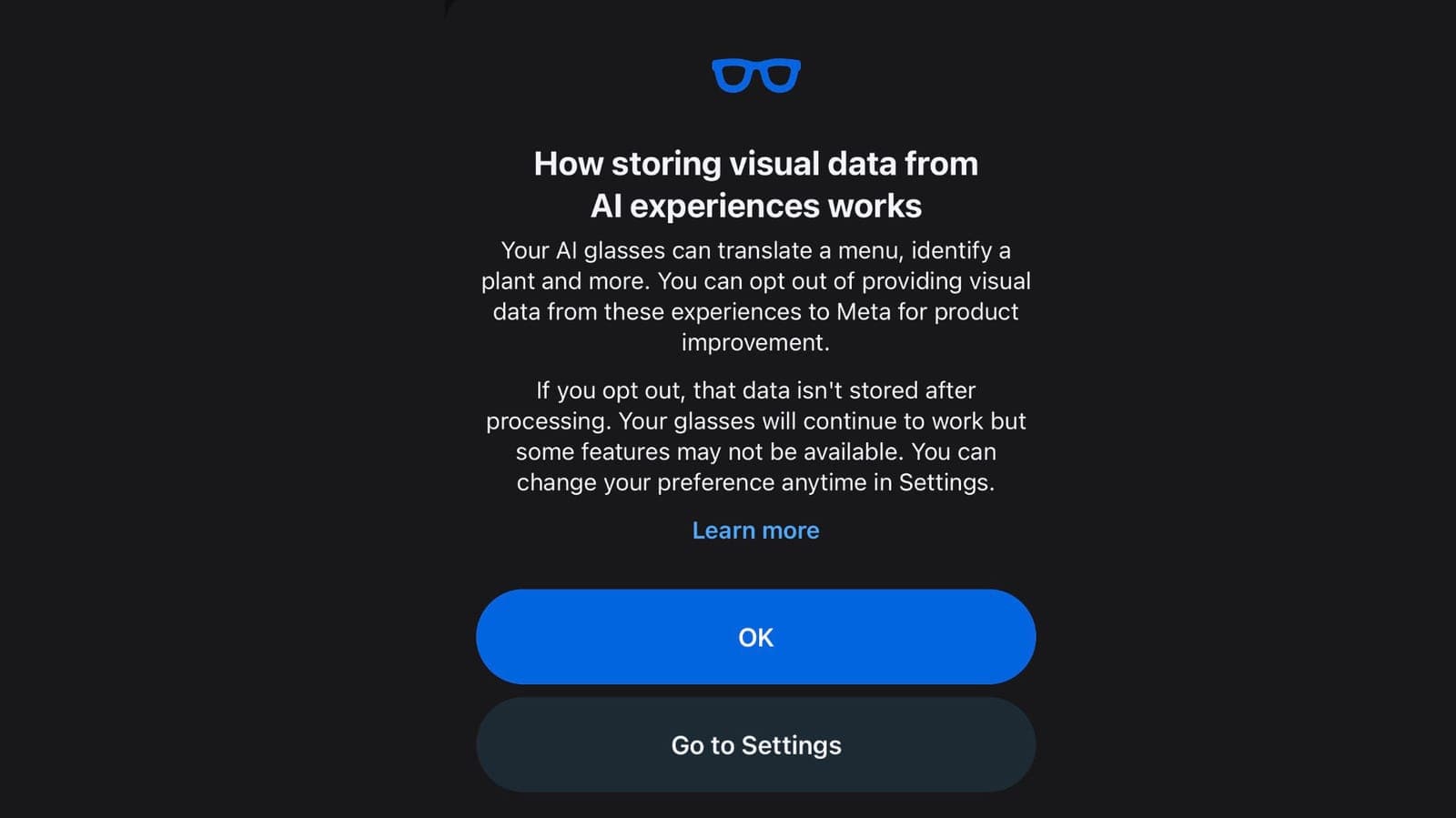
Meta lets smart glasses owners opt out of AI training on their visual data
A new setting in the Meta AI app lets smart glasses owners stop Meta from using camera-fed 'visual data' to train its AI models, though opting out can disable some features.

Meta releases Muse Wonder, its first frontier AI models
Meta launched Muse Wonder and Muse Wonder Full, two models it says match the best from OpenAI and Anthropic, with memory built for personal agents.

Meta's new AI glasses get a bigger camera, a longer battery, and a Bollywood star as their face in India
Meta named Bollywood actor Ranveer Singh as the first brand ambassador for Ray-Ban and Ray-Ban Meta in India, alongside updates to its third-generation AI glasses covering camera, battery, and audio.
More in brief
- Grace Hopper Celebration 2026 is canceled two weeks before it startsOct 16
- Hackers turned old D-Link and Ubiquiti devices into paid internet proxiesOct 16
- Steam's new achievement sets stop DLC from breaking your 100 percentOct 16
- ChatGPT can now read your Chrome tabs and do tasks in themOct 16
- Windows 11's October update can lock Smart App Control and trip work Wi-FiOct 16
- The world's timekeepers vote to end the leap second in 2027Oct 16