
Robots·News & analysis
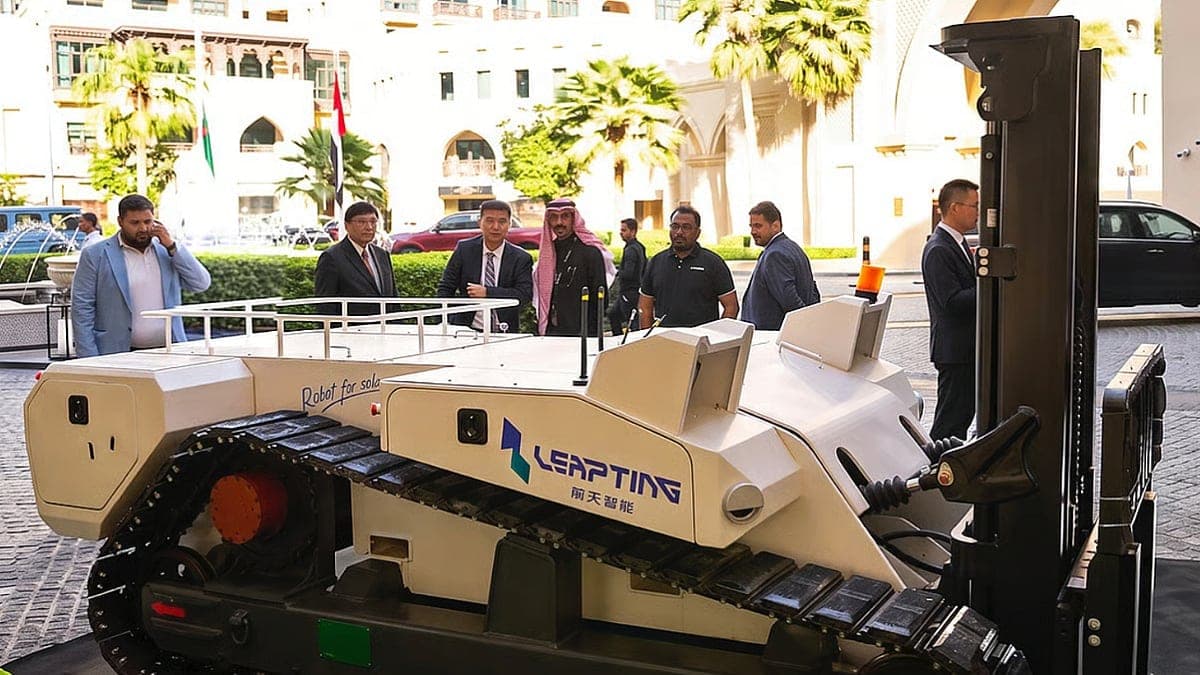
LEAPTING launches a self-driving forklift robot for solar farm construction
The tracked robot carries 3,000 kg pallets of solar panels from storage yards to installation rows with no driver and no flagman.
Tide
Ripple
Sci-fi
6/10
Reality
Shipping
A forklift on tank tracks that finds its own pallets in the desert.How we rate
LEAPTING launched the Auto-Navigation Forklift Robot, a tracked machine that carries 3,000 kg pallets of solar panels across construction sites with no driver.
It finds pallets and fork holes on its own using GPS-RTK, laser mapping and 3D cameras. The company says it has shipped more than 10,000 robots for solar projects. The forklift completes its fleet for building and running large solar farms.
What to know
- LEAPTING launched the Auto-Navigation Forklift Robot (AFR), which moves pallets of solar panels across construction sites with no human driver.
- It lifts up to 3,000 kg to a height of 3 m and finds pallets with GPS-RTK, laser SLAM and 3D computer vision.
- Steel tracks, a 30-degree climbing ability and IP67 protection are meant for sand, gravel and mud, with at least 8 hours per charge.
- The AFR feeds LEAPTING's mounting robot, which the company says places a panel every 40 seconds, 3 to 5 times faster than people.
LEAPTING announced a forklift robot that drives itself around solar construction sites, unveiled at a launch event in Dubai. That's the news. Now the fun part: why does a solar farm need a robot just to move boxes?
Why does a solar farm need a robot forklift?
A big solar farm is built from many thousands of panels. They arrive on pallets, sit in a storage area called a laydown yard, and then have to travel to each row where they get installed.
Today that usually means a person driving a forklift, often with a second person, a flagman, walking ahead to guide it. LEAPTING says its Auto-Navigation Forklift Robot, or AFR, does the trip alone. The company calls it "the missing link" in moving solar materials around a site.
Why it matters: at the launch, panelists from LEAPTING, Jinko Solar, DNV and Solarabic talked about labor shortages, rising labor costs and harsh desert sites. Those are the problems LEAPTING says its robots are built to solve.
What can it actually lift?
Here are the main numbers, from LEAPTING's announcement and the datasheet details PV Magazine and TaiyangNews reported:
| Spec | AFR |
|---|---|
| Rated load | 3,000 kg (about 6,600 lb) |
| Lift height | 3 m |
| Size | 4.8 m x 1.8 m x 2.15 m |
| Weight | 5,500 kg |
| Top speed | 3 km/h loaded, 4 km/h empty |
| Climbing | 30 degrees or more |
| Battery | 48 V, 400 Ah, 19.2 kWh |
| Runtime | 8 hours or more per charge |
The robot weighs 5,500 kg on its own, so it is heavier than the biggest load it carries.
It moves at about walking pace. On a site where safety matters more than speed, that is the point.
How does it find a pallet with no driver?
The AFR combines three ways of seeing the world, LEAPTING says:
- GPS-RTK: satellite positioning, corrected in real time, so the robot knows where it is on the site down to a small margin.
- Laser SLAM: a laser scanner that maps the area around the robot and keeps its position accurate up close.
- 3D computer vision: cameras that find each pallet, its angle and the exact spot of the fork holes.
From there, the robot plans how to slide its forks in and pull the pallet out, and adjusts its mast and forks to match. PV Magazine reports it can also tell whether a pallet is loaded, and recognize common European (EUR/EPAL) and Japanese (JIS) pallet standards.
It is a bit like a self-parking car that also has to pick up a 3-ton box at the end of the parking spot.
In real life Picture the last time you tried to slide a hand truck under a heavy box without looking. Now picture doing it with a 3,000 kg pallet, in the sand, all day. The AFR does the looking for you.
Operators are not locked out. Besides full autonomy, the AFR has a semi-automatic mode and a manual remote-control mode, according to PV Magazine and TaiyangNews.
Can it handle desert sand and mud?
That is what the tracks are for. Instead of wheels, the AFR rides on engineering-grade steel tracks, like a small tank. LEAPTING says they suit desert sand, gravel, mud and steep slopes, with low pressure on the ground.
Two separately driven 4 kW motors power the tracks, PV Magazine reports. Electrek puts the total at about 10 horsepower. Because each track runs on its own, the machine can turn on the spot.
The rest of the toughness list:
- Weather: IP67 protection, which means it is sealed against dust and can handle being dunked in water.
- Water crossings: up to 0.3 m deep, PV Magazine reports.
- Slopes: besides the 30-degree climbing rating, the datasheet lists a maximum forward tilt of 4 degrees and a maximum pitch of 11 degrees, PV Magazine reports.
- Charging: automatic charging, or manual fast charging on 220 V or 380 V power.
PV Magazine lists an operating range of -10 C to 50 C, and a storage range of -20 C to 60 C. That matters on sites in the Gulf, where LEAPTING held the launch.
Is it safe around people?
A driverless 5.5-ton machine has to know when to stop. LEAPTING lists several layers:
- Eyes all around: multi-line LiDAR sensors watch 360 degrees for obstacles.
- Warnings: sound and light signals as it moves.
- Brakes: three tiers, electronic, mechanical and parking.
- Big red buttons: emergency stops at several points on the outside.
- Tilt sensor: an inertial measurement unit tracks how far the machine leans and stops it with an alarm if it passes a set limit.
The pitch is simple: no driver in the seat and no flagman walking in front of a loaded forklift.
Where does it fit in LEAPTING's robot fleet?
The AFR is the newest member of a family of solar robots, all run by one cloud software platform, LEAPTING says. It covers both building a solar farm and keeping it running:
- AFR (forklift): moves pallets from the yard to the rows.
- MMR (mounting robot): places panels on trackers every 40 seconds, which LEAPTING says is 3 to 5 times faster than people, with under 1 mm of error.
- G2 (cleaning robot): drives between rows without rails.
- G1 (row cleaner): a self-powered, water-free cleaner that sits on the rows. LEAPTING says it boosts power output by 5 to 15%.
- MIR (inspection robot): patrols with regular and thermal cameras, and uses AI to map panel defects into a digital twin, a virtual copy of the plant.
So the forklift is the link between the truck and the mounting robot. Robots building things on their own is a growing trend: we covered autonomous construction fleets earlier this month.
Who is LEAPTING?
LEAPTING is a Chinese company, founded in 2022 in Shanghai, with factories in Huzhou and another site in China. It builds robots only for the solar industry.
By the numbers: LEAPTING says its technology has been used on more than 15 GW of projects worldwide. It says it has shipped over 10,000 robots and runs a 24/7 service network across the Middle East, Australia, Europe, India, the Americas and Africa.
In September, it received the RE Robotics Technology Leader Award at the Solarabic Saudi Awards 2026 in Riyadh, the company says. At the Dubai launch, it gave partnership awards to regional partners including OMAS and Kabbani Construction Group.
The catch: LEAPTING has not shared a price or delivery dates for the AFR in its launch materials, and the speed and accuracy figures come from the company.
What it means for you
- If you work on solar construction: a driverless forklift that handles sand, mud and slopes could take one of the riskiest jobs on site away from people.
- If you follow robotics: this is the kind of robot that spreads fastest. It does one boring, heavy job in one kind of place, very well.
- If you pay an electricity bill: cheaper and faster solar construction is one of the many small pieces that shape what new solar power costs.
The bottom line
LEAPTING built a self-driving forklift on tank tracks that finds pallets of solar panels and carries 3 tons at a time across rough ground. It fills the gap between the delivery truck and the robot that mounts the panels. If the company's numbers hold up on real sites, building a solar farm becomes a little less about heavy lifting by hand.
Key facts
- Rated load
- 3,000 kg (about 6,600 lb)
- Lift height
- 3 m
- Navigation
- GPS-RTK, laser SLAM, 3D vision
- Battery
- 19.2 kWh, 8+ hours per charge
- Top speed
- 3 km/h loaded, 4 km/h empty
Got questions?
Quick answers, plain wordsWhat is the LEAPTING AFR?
The Auto-Navigation Forklift Robot is a battery-powered, tracked forklift that drives itself. It carries pallets of solar panels from storage areas to the rows where they will be installed, without a driver or a flagman.
How much can the AFR carry?
LEAPTING rates it for 3,000 kg, about 6,600 pounds, per load. It can lift that load to a height of 3 m.
How does the robot find a pallet?
It combines satellite positioning (GPS-RTK), laser-based mapping (SLAM) and 3D computer vision. LEAPTING says it spots each pallet, works out where the fork holes are and plans how to slide its forks in.
How fast does it drive?
Up to 3 km/h with a full load and 4 km/h empty, according to the specifications PV Magazine and TaiyangNews published. It can turn on the spot.
How long does the battery last?
At least 8 hours under standard conditions, LEAPTING says. PV Magazine reports a 48 V, 400 Ah lithium battery with 19.2 kWh of energy, and automatic or manual fast charging.
Can a person still control it?
Yes. Besides fully autonomous driving, operators can pick a semi-automatic mode or drive it by remote control, according to PV Magazine and TaiyangNews.
How does the AFR stay safe around workers?
It uses 360-degree LiDAR to detect obstacles, sounds and lights for warnings, emergency stop buttons and three kinds of brakes. A tilt sensor stops the machine and sounds an alarm if it leans too far.
Who makes the AFR?
LEAPTING, a robotics company founded in 2022 in Shanghai. It says it has shipped more than 10,000 robots and worked on more than 15 GW of solar projects worldwide.
How much does the AFR cost?
LEAPTING has not published a price in its launch announcement, and none of the reports we read include one.
What other robots does LEAPTING make?
A module mounting robot that installs panels, the G2 cleaning robot that drives between rows, the G1 cleaner that sits on the panel rows, and the MIR inspection robot that uses thermal cameras and AI to find damaged panels.
SourcesLEAPTING
Topics and tagsSelf-driving, robots, solar energy, autonomous machines
Go deeper
Related stories
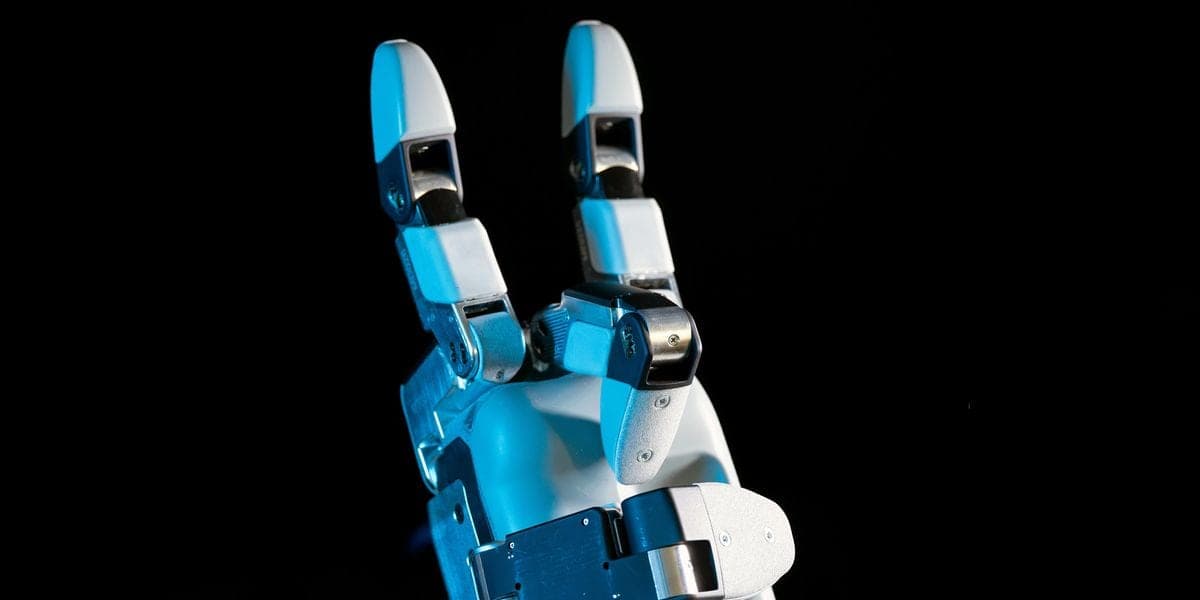
Boston Dynamics gave its Atlas robot a four-fingered hand on purpose, and it works better than five
Boston Dynamics redesigned Atlas's hand with 13 degrees of freedom and only four digits, dropping the pinky entirely because the team found reliability and manufacturability mattered more than looking human.
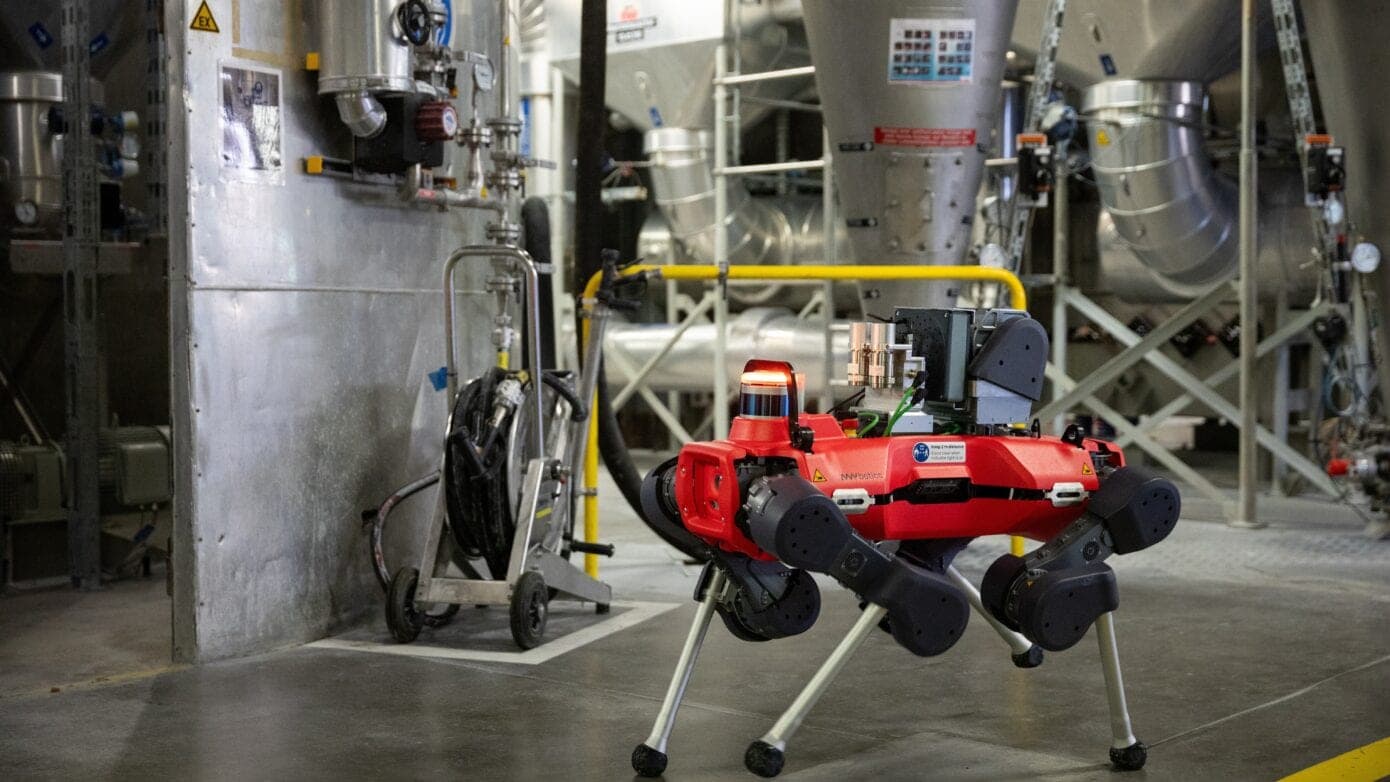
Robot dogs are now doing the night shift at factories, and software just started supervising them
ANYbotics rebranded its Data Navigator software into Shift, a platform that schedules and supervises fleets of its four-legged ANYmal robots as they inspect industrial plants around the clock.

SoftBank is betting $225 million that self-driving bulldozers can fix a labor shortage
SoftBank invested $225 million in Utah robotics company ASI and formed a joint venture to deploy autonomous haul trucks, dozers, loaders and compactors on big construction projects.
More in brief
- Nvidia makes DLSS 5 twice as fast with a smaller AI modelOct 18
- MapQuest's new Surveillance Layer shows where license plate readers areOct 18
- Six AI agents chased an impossible train refund. Grok sent 187 emailsOct 18
- Windows will stop mounting ReFS-formatted USB drives in JanuaryOct 18
- New York congressman wants the games you buy to be yours, not a licenseOct 18
- Disney plans $180 million for Character.AI's team as the startup goes bankruptOct 18