
AI·News & analysis
AI short film about a boy who rebuilds his late mother wins $3.5 million XPRIZE
Independent filmmaker Jeff Synthesized won Google and XPRIZE's first Future Vision competition, beating over 2,500 entries with a story about technology built from empathy rather than fear.
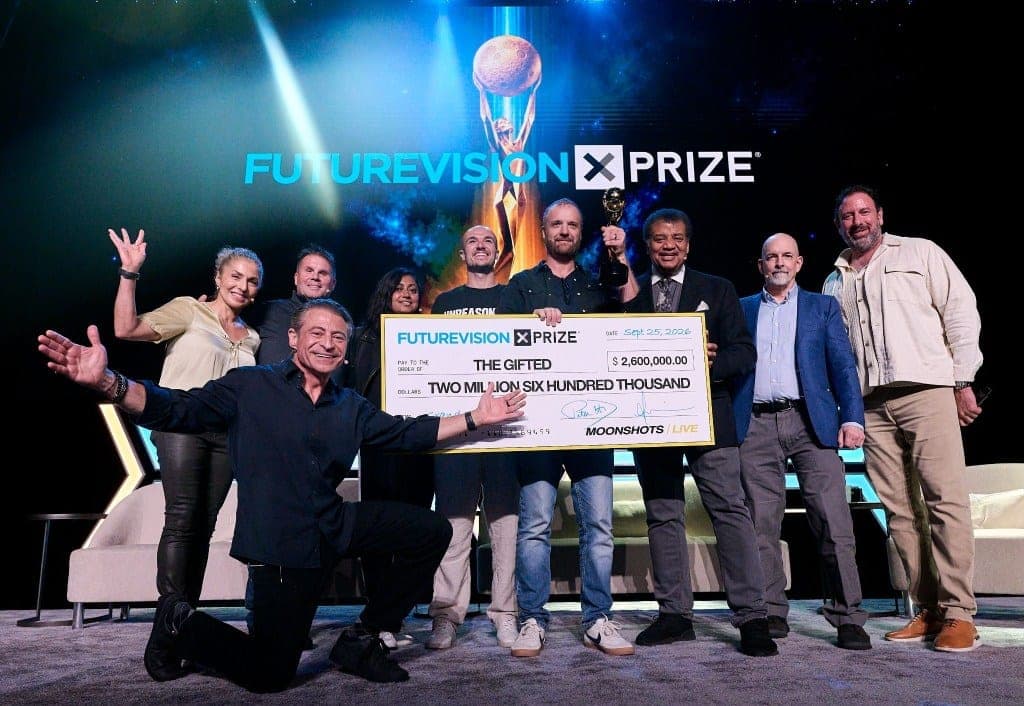
Google and XPRIZE built this competition to reward hopeful visions of AI, a counterweight to the doom-heavy narratives dominating AI coverage lately.
Filmmaker Jeff Synthesized's short 'The Gifted' won out of more than 2,500 entries with a story about AI built for empathy rather than control. The prize totals $3.5 million, including a $2.5 million equity investment toward a full feature film. It's real money and a real production path, not just a trophy.
What to know
- Independent filmmaker Jeff Synthesized won the inaugural Future Vision XPRIZE with his short film 'The Gifted,' beating more than 2,500 global entries.
- The film tells the story of an 11-year-old boy who rebuilds his late mother's voice and personality from her texts, voice recordings, and diary.
- The prize totals $3.5 million: $2.5 million as an equity investment toward a full feature film, plus $100,000 in cash for screenplay development.
- A five-judge panel included astrophysicist Neil deGrasse Tyson, novelist Neal Stephenson, and Google VP Mira Lane.
- Google's 100 ZEROS initiative and Range Media Partners will back the feature production, with Republic Film planning a public investment campaign for fans.
Most AI headlines this month have been about existential risk, IPO warnings, and models behaving badly. This one is about a kid who codes his mother back to life, and it just won $3.5 million.
What won
Independent filmmaker Jeff Synthesized took the grand prize in the inaugural Future Vision XPRIZE with his short film "The Gifted," beating out more than 2,500 entries submitted from around the world.
- The premise: an 11-year-old boy rebuilds his late mother's voice and personality from her texts, diary entries, and voice recordings.
- The twist: what emerges doesn't take control or give orders. It quietly cares for the boy's entire community instead.
- The theme: technology's greatest value framed as empathy and connection, not power or control.
The catch: this isn't a one-off trophy. The prize comes with real production money and a defined path to becoming a full feature film.
The money
The total award exceeds $3.5 million, split between two very different kinds of support:
- $2.5 million as an equity investment specifically earmarked for producing the full-length feature version of the film.
- $100,000 in cash to fund screenplay development.
That structure means the prize isn't just recognition. It's direct financing meant to actually get the feature made, with real producers already attached.
Google's bigger film play
The Future Vision XPRIZE is one piece of a larger effort. Google's 100 ZEROS initiative, a multi-year partnership with Range Media Partners announced last year, is designed to fund and co-produce film and TV projects that engage seriously with Google's own newer technologies, including AI, spatial tools, and immersive features.
The strategic angle: 100 ZEROS isn't primarily about owning a distribution platform. Google reportedly isn't treating YouTube as the main outlet for this work, and is instead aiming to sell finished projects to traditional studios and streamers, the same path most conventional film financing follows.
A related program, "AI On Screen," commissions short films specifically exploring the relationship between humanity and AI from a range of filmmakers and genres, of which the Future Vision XPRIZE and "The Gifted" are effectively the highest-profile result so far.
Who's backing the feature
Range Media Partners and Google are supporting development and production through Google's 100 ZEROS initiative, a program built to fund ambitious creative projects with technology at their core.
Republic Film is also involved and plans to launch a public investment campaign, letting fans invest directly in the production themselves rather than leaving funding entirely to studios and venture backers. It's an unusual financing model for a project that started as a solo short film competition entry.
Who judged it
A five-person panel decided the winner, mixing scientific, literary, and industry credibility:
- Neil deGrasse Tyson, astrophysicist
- Neal Stephenson, novelist known for his science fiction work
- Mira Lane, Google's VP of Technology & Society
- John Zissimos, Salesforce's Chief Brand and Creative Officer
- Rod Roddenberry, CEO of Roddenberry Entertainment, the company built around his father Gene Roddenberry's Star Trek legacy
By the numbers: the panel narrowed more than 2,500 submissions down to five finalists, which were screened live at Moonshots LIVE in downtown Los Angeles before the winner was announced on stage.
Why Google built this competition
The Future Vision XPRIZE exists as a deliberate counterweight to dystopian AI storytelling. Google, XPRIZE, and Range Media Partners created the competition specifically to surface stories where advanced technology serves human connection rather than control, surveillance, or destruction, genres that have dominated AI-adjacent film and television for years.
That framing lines up with the broader tension playing out across the AI industry right now. Companies are simultaneously racing to ship more capable systems while publicly warning about the risks those same systems pose, and a competition explicitly rewarding hopeful narratives is Google's attempt to put a thumb on the scale toward optimism, at least in fiction.
XPRIZE's track record
XPRIZE itself has a three-decade history of using large cash incentives to push innovation forward, dating back to its founding in 1994. Its most famous success came in 2004, when SpaceShipOne won the original Ansari XPRIZE by becoming the first privately funded craft to reach space twice within two weeks, a result that directly seeded the technology behind Virgin Galactic's later spacecraft.
Other notable wins: the Qualcomm Tricorder XPRIZE's $10 million grand prize went to a small, family-led medical device company that beat out much larger industry players, and XPRIZE currently has a $101 million Healthspan prize scheduled to be awarded in 2030 for research aimed at reversing biological aging.
The Future Vision XPRIZE represents a notable departure from that pattern: rather than rewarding a working piece of hardware or a scientific breakthrough, it's rewarding a piece of storytelling, betting that culture and narrative can shape how the public relates to AI as powerfully as the underlying technology itself.
Who Jeff Synthesized is
Details on the winning filmmaker remain relatively sparse. Jeff Synthesized works independently and has built an audience of roughly 80,000 followers spread across Instagram, X, and YouTube. "The Gifted" was developed as a solo project before catching the attention of a panel that included some of the most recognizable names in science communication and entertainment.
That a single independent creator, without a studio or production company behind the original short, could win financing on this scale says something about competitions like this one.
XPRIZE-style contests are increasingly functioning as an alternative pipeline into major production funding, bypassing the traditional pitch-and-development process entirely.
The bigger picture
"The Gifted" arrives at a moment when AI's relationship with grief and memory is already a live, and often uncomfortable, cultural conversation. Startups including HereAfter AI, StoryFile, and Seance AI already let people build chatbots or video avatars of deceased loved ones from old messages, voicemails, and social media posts, a real-world version of exactly what the film's fictional boy builds from his mother's texts and diary.
Why it's contentious: most scholars studying the space, and roughly 95% of respondents in one survey, oppose building these "griefbots" without the deceased person's consent, and no consistent legal framework currently prevents it. Some services sidestep that problem by having people record their own life story in advance for their own future avatar, but plenty of others don't.
California recently became the first state to regulate AI companion chatbots specifically, though that law targets safety protocols for general companion bots rather than grief-tech specifically.
The film doesn't resolve that tension so much as lean directly into it, betting that audiences are ready for a version of that story where the outcome is tenderness rather than horror. Whether the eventual feature film can sustain that tone at full length, rather than just a trailer's worth of it, is the real test still ahead.
The bottom line
A film about a boy coding his dead mother back into existence winning a competition explicitly designed to reward hope isn't the AI story anyone expected this week, next to leaked IPO warnings about existential risk and researchers arguing those same warnings are marketing spin.
It's a reminder that the same underlying technology fueling those darker headlines is also, apparently, capable of funding a very different kind of story, one enough judges and a $2,600,000 oversized check decided was worth actually making into a full feature.
Key facts
- Winning film
- The Gifted
- Filmmaker
- Jeff Synthesized
- Total prize
- $3.5 million+
- Entries competed against
- 2,500+
- Feature funding
- $2.5 million equity investment
Got questions?
Quick answers, plain wordsWhat is the Future Vision XPRIZE?
A global film competition created by Google, XPRIZE, and Range Media Partners seeking hopeful, technology-enabled visions of the future, as a deliberate contrast to dystopian AI narratives.
Who won and what is the film about?
Independent filmmaker Jeff Synthesized won with 'The Gifted,' about an 11-year-old boy who rebuilds his late mother's voice and personality from her texts, diary, and voice recordings, using code to quietly care for his community.
How much did the film win?
More than $3.5 million total: a $2.5 million equity investment toward producing a full feature film, plus $100,000 in cash for screenplay development.
How many other films competed?
More than 2,500 entries from around the world. Five finalists were screened live at Moonshots LIVE in Los Angeles before the winner was announced.
Who judged the competition?
A five-person panel including astrophysicist Neil deGrasse Tyson, novelist Neal Stephenson, Google VP of Technology & Society Mira Lane, Salesforce Chief Brand and Creative Officer John Zissimos, and Roddenberry Entertainment CEO Rod Roddenberry.
Who is producing the feature film?
Range Media Partners and Google, through Google's 100 ZEROS initiative, will support development and production. Republic Film plans to launch a public investment campaign letting fans invest directly in the production.
Who is Jeff Synthesized?
An independent filmmaker with roughly 80,000 followers across Instagram, X, and YouTube, who worked on 'The Gifted' as a solo project before winning the grand prize.
Why did Google create this competition?
As a counterweight to dystopian AI storytelling, explicitly seeking narratives where advanced technology serves human connection and empathy rather than control, surveillance, or destruction.
SourcesDeadline
Topics and tagsGoogle, xprize, google, ai filmmaking
Related stories
Judge dismisses Chegg and Penske antitrust suits over Google's AI Overviews
Chegg and Rolling Stone publisher Penske Media said Google forced them to feed AI Overviews for free. Judge Amit Mehta ruled their antitrust claims don't hold up.
Google's Guided Vision lets Gemini Live describe the world for blind and low-vision users
Point your Android phone's camera at something and Gemini describes it out loud, then tells you how to move the camera if it can't see well. Google built it with the blind and low-vision community.

Google is quietly funding Hollywood movies to make AI look less scary
Google partnered with talent agency Range Media Partners on 100 Zeros, a fund that co-produces films and TV shows aiming to show technology, especially AI, in a more optimistic light than shows like Black Mirror.
More in brief
- arXiv limits researchers to two papers a month as AI drives submissions to a recordOct 2
- California will fine robotaxi companies that block first responders for over 30 minutesOct 2
- Microsoft launches real-time transcription and new voice models for AI voice agentsOct 1
- Apple's smart home hub reportedly launches October 13, with a camera that never records videoOct 1
- Cloudflare releases Clef, open-weight AI models that make yes-or-no decisions fastOct 1
- GrayKey maker reportedly found a way around the iPhone's Inactivity RebootOct 1