
Robots·News & analysis
China Post is testing 45 Robotera humanoid robots at a Hangzhou parcel hub
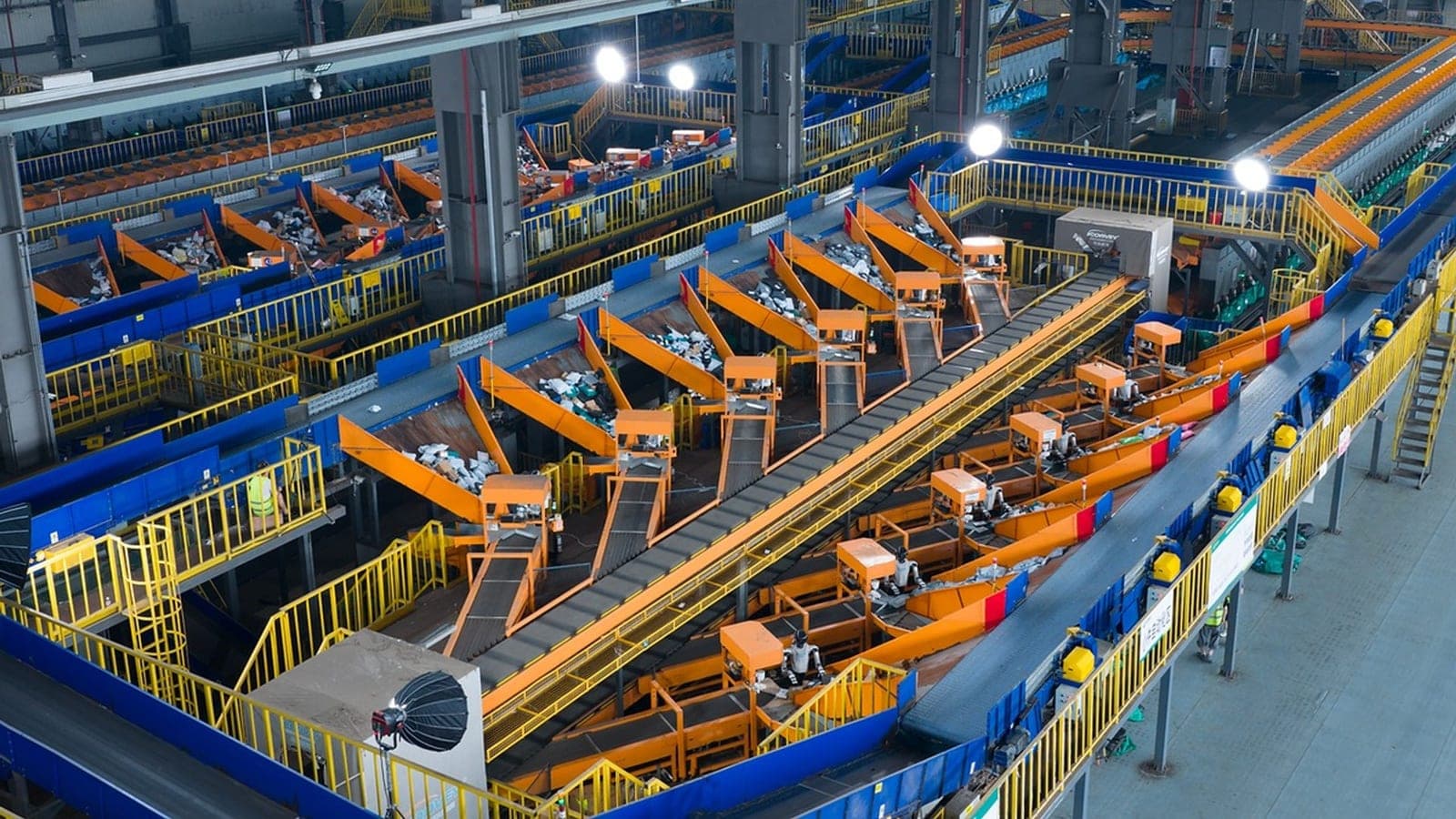
Robotera says 45 of its humanoid robots now feed parcels into the sorting line at China Post's Hangzhou center, at up to 1,200 parcels an hour in some tests.

Tide
Ripple
Sci-fi
7/10
Reality
Shipping
Robots at the mail room, catching boxes at conveyor speed.How we rate
Robotera announced that 45 of its humanoid robots are being tested at China Post's Hangzhou Postal District Center, feeding parcels onto sorting platforms.
The company says speed rose from 500 to 600 parcels an hour to about 1,200 in specific test periods, with accuracy above 90%. It calls this the largest such deployment in comparable postal operations in China. China Post's Hangzhou branch plans to add more automated equipment across its operations.
What to know
- Robotera says 45 of its humanoid robots are being tested at China Post's Hangzhou Postal District Center, a testing program that began in April 2026.
- The robots pick up parcels, turn them the right way, reject odd-shaped ones and place the rest on induction platforms, the stations that feed the sorting line.
- Speed rose from 500 to 600 parcels an hour at the start to about 1,200 an hour in specific test periods, with accuracy above 90%, the company says.
- A separate rollout in Guangdong, announced on November 17, covers 11 postal hubs in 8 cities and averages more than 1,500 parcels an hour.
Robotera announced on November 26, 2026 that 45 of its humanoid robots are being tested at China Post's Hangzhou Postal District Center. Their job is to feed parcels into a sorting line. So what does that job look like, and how much should we trust the speed numbers?
What are the robots actually doing?
The task is called parcel induction. A sorting hub has a main conveyor that reads each parcel and sends it to the right truck. Before that can happen, someone has to put each parcel on the induction platform, the station that feeds the line.
That sounds easy until you picture the parcels. They come in soft bags, thin envelopes, tall boxes and strange shapes. They arrive in every direction.
Robotera says its robots can do the whole job on their own:
- Pick up parcels from the pile.
- Reorient them, so the label faces the right way.
- Reject parcels with irregular shapes that would jam the line.
- Place the rest onto the induction platform.
- Handle exceptions, the small surprises that happen every minute in a busy hub.
The test is about whether a humanoid can cope with messy, varied parcels, not just repeat one fixed move.
Wait, what is a humanoid robot?
A humanoid is a robot built on a human body plan: a torso, two arms, two hands, and often a head with cameras. Some also have legs.
Not every working humanoid walks. Many sit or stand at a station, because for sorting work the arms and hands do the job. A mail hub is already built around conveyor belts, so the parcels come to the robot.
In real life Think of a cashier at a supermarket till. The cashier does not walk anywhere. The goods come on the belt, and the skill is in the hands.
How fast are they?
Robotera gives two numbers for speed. Early in the testing, the robots handled 500 to 600 parcels an hour. After what the company calls multiple rounds of iterative optimization, meaning many cycles of testing and fixing, the rate rose to about 1,200 parcels an hour during specific testing periods.
The company also says accuracy has passed 90%, with better motion smoothness, recognition accuracy and handling precision.
The catch: the release does not say what the 1,200 figure counts. It could be one robot, one station or all 45 robots together. Those are very different results. It also says the peak came during specific test periods, so it is not a daily average for the whole fleet.
Accuracy above 90% also leaves room to improve. One parcel in ten going wrong would be a lot in a real hub, though the release does not say what counts as a miss.
Why is this the largest test of its kind?
Robotera describes the Hangzhou project as the largest deployment of robots for testing in comparable postal operations in China. That is the company's own claim, and the release gives no comparison data.
The timeline matters too. China Post's Hangzhou center launched the testing in April 2026. Reaching 45 robots in about seven months means the first trial went well enough to expand.
China Post's Hangzhou branch also said it will speed up the use of automated equipment, including intelligent sorting and security inspection systems, in more operations. That suggests robots are one piece of a bigger automation plan.
How does this fit the Guangdong rollout?
Nine days earlier, on November 17, 2026, Robotera announced a separate project with China Post's Guangdong branch. It covers 11 postal hubs in 8 cities: Guangzhou, Shenzhen, Dongguan, Jiangmen, Shantou, Shanwei, Jieyang and Heyuan.
That project began as a pilot at the Guangzhou Postal District Center in March 2026. Robotera says its robots there average more than 1,500 parcels an hour, which it compares to experienced human workers.
Here is how the two projects line up:
| Hangzhou | Guangdong | |
|---|---|---|
| Announced | November 26, 2026 | November 17, 2026 |
| Started | April 2026 | March 2026 (Guangzhou pilot) |
| Scale | 45 robots at one center | 11 hubs in 8 cities |
| Speed | About 1,200 parcels an hour in specific periods | Average above 1,500 parcels an hour |
The two speeds are measured in different ways, so they are not a fair head-to-head. One is a peak from specific test periods, the other an average.
Robotera also says its system is used in postal operations in East China, with different parcel types and sorting-line layouts.
Who is Robotera?
Robotera is a Beijing robotics company founded in August 2023. It builds humanoid robots and robot hands. Its list includes the L7, a full-size two-legged humanoid, and its own five-finger robot hand. The company says it makes its motors, joints and hands in-house.
It has raised money fast. In March 2026 it announced a RMB 1 billion round that pushed its valuation above RMB 10 billion. Its investors include Geely Capital, Alibaba, Lenovo and Haier Capital. The company also said total orders passed RMB 500 million, half of them from international clients.
Logistics is a main target. Robotera said it had already placed robots in logistics sites in Shenzhen, Huzhou, Hangzhou, Hefei and Beijing, and that it plans to focus on e-commerce logistics, industrial manufacturing and pharmaceutical distribution.
Why do postal hubs want robots?
In the Guangdong announcement, Robotera describes sorting as labor-intensive, repetitive and physically hard. It points to labor shortages and high staff turnover, especially at peak shopping times, when parcel volumes can reach several times their normal levels.
That is the pitch: robots fill the gaps in the busiest weeks. Robotera says people can then move into jobs such as robot maintenance, operations coordination and quality control.
This is the company's view. Neither release shares staffing numbers, so we can't say how many human jobs change in a hub.
Why it matters: parcel hubs are a good test for humanoids. The work is repetitive, the setting is controlled, and the results are easy to count. If a robot can't keep up here, it will struggle in a messier place.
What is still unknown?
The announcements leave several questions open. Here are the big ones:
- What the speed counts: per robot, per station or per fleet.
- How long the peak lasted: the release says "specific testing periods".
- What a miss is: the 90% accuracy figure comes without a definition.
- Cost and uptime: neither release shares prices, battery or maintenance data.
- Independent checks: every figure comes from the company.
Until those answers arrive, treat the numbers as a progress report, not a benchmark.
What it means for you
- Your parcels: you won't notice a change yet. The robots work inside sorting hubs, not at your door.
- Busy seasons: the pitch is steadier handling when volumes spike, such as during shopping festivals.
- Robots at work: humanoids are showing up first in repetitive jobs with clear numbers, like sorting, not in homes.
- Read the numbers carefully: a speed claim means little until you know what it counts.
The bottom line
Robotera says 45 of its humanoid robots now feed parcels into a China Post sorting line in Hangzhou, and that they have roughly doubled their speed since April. It is a real deployment, not a lab demo, but every number comes from the company. The next signal is whether the test turns into a permanent part of the hub.
Key facts
- Robots in Hangzhou
- 45 humanoids
- Testing began
- April 2026
- Speed
- 500-600 rising to about 1,200 parcels an hour
- Accuracy
- Above 90%
- Guangdong rollout
- 11 hubs in 8 cities
Got questions?
Quick answers, plain wordsWhat did Robotera announce?
On November 26, 2026, Robotera said 45 of its humanoid robots are being tested at China Post's Hangzhou Postal District Center. The robots handle parcel induction, which means feeding parcels onto the sorting line.
What is parcel induction?
It is the step where a parcel is placed on a platform that carries it into the sorting system. The parcel has to be picked up, turned the right way and set down so the machine can read and route it.
How fast are the robots?
Robotera says speed rose from 500 to 600 parcels an hour in early testing to about 1,200 an hour during specific test periods. The release does not say whether that figure is per robot, per station or for the whole fleet.
How accurate are they?
The company says operational accuracy has passed 90%. It also reports better motion smoothness, recognition accuracy and handling precision, but gives no numbers for those.
Is this a full rollout or a test?
The Hangzhou project is a test. China Post's Hangzhou branch says it will bring more automated equipment, such as intelligent sorting and security inspection systems, into more operations.
Is this the same as the Guangdong project?
No. On November 17, 2026, Robotera announced a separate project with China Post's Guangdong branch that covers 11 postal hubs in 8 cities. That one started with a pilot in Guangzhou in March 2026.
What is a humanoid robot?
A robot built with a human-like body plan, usually a torso, two arms and hands, and sometimes legs. Many working humanoids are fixed at a station, because arms and hands matter more than walking for jobs like this.
Who is Robotera?
A Beijing robotics company founded in August 2023 that makes humanoid robots and robot hands. In March 2026 it said it had raised RMB 1 billion at a valuation above RMB 10 billion.
Will this change how my parcels arrive?
Not in a way you can see yet. The robots work inside sorting hubs, and the companies describe the work as a test of speed and accuracy. If it scales, the goal is steadier handling when parcel volumes spike.
Do the robots replace workers?
Robotera says its robots take on strenuous frontline tasks and that people can move to roles such as maintenance, operations coordination and quality control. The company gives no staffing numbers.
Related data: Humanoid robot prices
SourcesRobotera
Topics and tagsHumanoid robots, robotera, china post, humanoid robots
Go deeper
Related stories
Volvo starts training AEON humanoid robots at its Ghent car plant
Volvo Cars has brought Hexagon's AEON humanoid robots to its Ghent factory in Belgium. The first lesson is simple: put parts into two fixtures, exactly right, every time.

Xpeng's IRON humanoid robot heads to stores in 2027
Xpeng showed its IRON humanoid on stage and set dates. It starts training in Xpeng stores in early 2027, and the public release is targeted for the second quarter.

NEURA, E.ON and enviaM will train humanoid robots for power grid work
NEURA Robotics, E.ON and enviaM want humanoid robots to inspect substations and take on risky grid jobs. The robots train in Munich first, with real grid trials planned for 2027.
More in brief
- OpenAI fixed a billing bug, so GPT-6.2 Astra limits arrive 40% fasterNov 27
- Nadella says AI-native firms add the next human when the first runs out of tokensNov 27
- Microsoft says state-backed hackers run ARTEX AI agents at machine speedNov 26
- Rockstar workers vote against a formal union deal as GTA VI launchesNov 26
- Nvidia reportedly pauses AI server shipments to four Southeast Asian countriesNov 26
- S&P puts NVIDIA's AA credit rating on watch for a downgradeNov 26