
Robots·News & analysis
BYD's robot arm plugs in your EV and charges it in 5 minutes
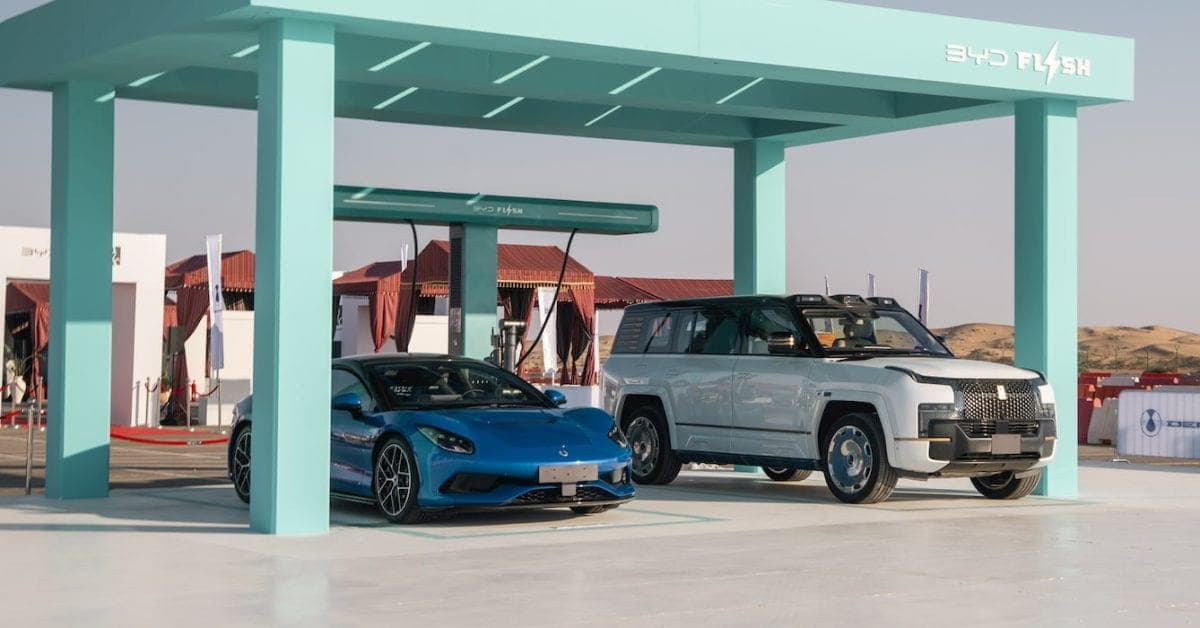
BYD showed a solar-powered charging station in Abu Dhabi where a robotic arm finds the port, plugs in and unplugs, with no driver touching the cable.

Tide
Ripple
Sci-fi
7/10
Reality
Demo
A robot butler whose only job is your charging cable.How we rate
BYD unveiled a charging site in Abu Dhabi that combines solar power, battery storage, 5-minute Flash Charging and a robotic arm that plugs the EV in without the driver touching a cable.
Compatible cars go from 10% to 70% in five minutes. It is the first time BYD has shown the full package outside China. BYD plans 6,000 Flash Charging stations by the end of 2027, but gave no date or price for the robot arms.
What to know
- BYD showed a charging site in the Abu Dhabi desert that joins solar panels, energy storage, Flash Charging and a robotic arm.
- Flash Charging takes a battery from 10% to 70% in 5 minutes and from 10% to 97% in 9 minutes, on compatible BYD cars.
- The arm uses visual guidance and force feedback to find the port, open the cover and plug in, then unplug when the session ends.
- BYD targets 6,000 Flash Charging stations worldwide by the end of 2027, but has not said how many will have robot arms.
BYD just showed a charging station where a robot plugs in your car for you. Now the fun part: how close is this to your driveway?
The site stands in the Abu Dhabi desert. It mixes four ideas in one place: solar panels, a battery that stores power, very fast charging and a robotic arm.
What did BYD actually show?
BYD calls it the world's first system to combine solar power, energy storage, Flash Charging and robotic charging. It came right after the Chinese carmaker showed its new flagship sedan, the Yangwang Altior, in the United Arab Emirates.
The idea is simple. You park. The arm does the rest. You never touch the cable.
In real life Think of a gas station where an attendant fills the tank while you stay in your seat. Here the attendant is a robot arm, and the fuel is sunshine.
How does the robotic arm work?
The arm has to solve a small puzzle every time. It must find the charging port, open its cover, line up the plug and push it in.
BYD says the arm uses "visual guidance and force feedback." In plain words, it uses cameras to see the port and a sense of touch to feel when the plug is seated. That helps it avoid pushing too hard.
Here is what happens in order:
- Park: the driver parks, or presses a button on the car's screen.
- Plug in: the arm finds the port, opens the cover and connects.
- Charge: the car fills up with Flash Charging.
- Unplug: when the session ends, the arm removes the plug.
Some BYD cars can also drive themselves into a parking space. In that case the driver can step out and walk away, and the car goes to a charging space on its own.
What is Flash Charging?
Flash Charging is BYD's name for its very fast charging. On compatible BYD group cars, the battery goes from 10% to 70% in five minutes. From 10% to 97% takes nine minutes.
That is about the time you spend at a gas pump and the coffee line next to it. BYD's own boss has made the same comparison for years: Wang Chuanfu, the company's chairman, has said the ultimate answer is to make charging as quick as filling a gas car.
The tech behind it was introduced in March 2025 as the Super e-Platform. It runs the whole car at 1,000 volts, with a charging current of up to 1,000 amps. Together that makes a power of one megawatt, or 1,000 kilowatts. That is far above most home and public chargers.
The company said the matching chargers can output up to 1,360 kilowatts and use liquid cooling, so the cables and parts do not overheat.
Why add solar panels and batteries?
The station uses BYD's Solar-Storage-Charging system, called SSC. Solar panels turn sunlight into electricity. A big battery stores that power. The charger then hands it out when cars arrive.
Why bother? Fast chargers pull a huge amount of power at once. A grid that is weak or far away may struggle with that. A local battery acts like a water tank: it fills slowly, then empties quickly when needed.
BYD says the system can also run independently of the grid. In a place with limited or unreliable power, that could be a useful way to add chargers without waiting for new power lines.
The big picture: The package follows an old plan. In 2006, BYD's chief executive, Wang Chuanfu, laid out his "Three Green Dreams": use solar power to make clean energy, store it in batteries, and replace gas cars with electric ones that run on that energy. This station puts all three in one place.
BYD also has a long history with solar. It has more than 16 years of experience, and its solar division sells cells, modules and systems in more than 100 countries and regions.
Why show it in Abu Dhabi?
BYD is pushing hard in the Middle East right now. Showing the Altior and the charger in the same week sends a clear message about its high-end plans.
Executive vice president Stella Li said this is the first time BYD has brought its combined solar, storage and Flash Charging technology outside its home market. She said the company hopes the future charging experience will be smarter, simpler and more seamless for drivers around the world.
The desert is also a handy test bench. It has plenty of sun, plenty of heat, and long drives between cities. If a robot arm and a solar battery can work there, they can probably work in many places.
How many stations are coming?
BYD wants 6,000 Flash Charging stations worldwide by the end of 2027. It has said more than 4,000 megawatt chargers are planned in China, and the company already runs thousands of fast chargers there.
The catch: nobody has said how many of the new stations will have a robot arm. There is also no public date for the arm to reach customers, and BYD has not shared prices.
The catch: Only compatible BYD group cars get the full five-minute speed. A car from another brand can plug in, but it may charge more slowly. The arm also works best with a car that can park itself, so older or cheaper models may miss part of the experience.
Is a robot arm really better than a cable?
For most of us, plugging in is not hard. It takes a few seconds. So why build a robot for it?
The answer is fleets and convenience. Taxis, rental cars and delivery vans spend hours at chargers, and a driver who must get out and handle a cable costs time. A robot can serve many cars in a row, at any hour, in rain or heat.
It also fits cars that park themselves. If the car can drive to a charging bay alone, then a robot that connects the plug closes the loop. Nobody needs to be there at all.
Other companies have shown similar ideas before. Tesla once showed a snake-like robot charger. What makes BYD's version stand out is that it joins the arm with ultra-fast charging, solar power and automatic parking in one site, and it ran in a real desert setting.
What's next?
BYD says it will keep spreading Flash Charging across Europe, the Middle East and other regions. Watch for three things: the first public site with a robot arm that drivers can really use, the price per session, and the list of cars that can use the full speed.
Until then, this is a demo of a very neat idea. It works on the stage. The test is whether it works the same on a busy Tuesday evening with 20 cars waiting.
What it means for you
- Charging may get easier: if you drive a compatible BYD car, you could one day park and walk away while the arm connects the plug.
- Waiting should shrink: 10% to 70% in five minutes is close to a gas stop, though only on compatible cars.
- Do not expect it tomorrow: there is no date, no price and no list of cities for the robot arm yet.
- Solar stations could reach new places: a site that can run off the grid can be built where power lines are thin.
The bottom line
BYD showed that a car can charge fast, from the sun, with no human hand on the cable. That is a real step toward charging that feels as easy as filling a tank.
It is still a demo. The numbers that matter next are price, availability and how many stations get the arm.
Key facts
- Location
- Abu Dhabi desert, United Arab Emirates
- Charging speed
- 10% to 70% in 5 minutes, 10% to 97% in 9 minutes
- Robot arm
- Visual guidance and force feedback
- Power source
- Solar panels with battery storage, can run off the grid
- Station goal
- 6,000 Flash Charging stations by the end of 2027
Got questions?
Quick answers, plain wordsWhat did BYD unveil in Abu Dhabi?
BYD showed a charging site that joins solar power, energy storage, Flash Charging and a robotic charging arm in one system. BYD calls it the world's first integrated solution of its kind.
How fast is BYD Flash Charging?
On compatible BYD group cars, the battery goes from 10% to 70% in five minutes and from 10% to 97% in nine minutes.
How does the robotic arm work?
BYD says the arm uses visual guidance and force feedback. It finds the charging port, opens the cover, plugs in the connector and removes it when charging ends.
Does the driver have to do anything?
Very little. The driver parks, or presses a button so the car parks itself, and the arm connects the cable. The driver never touches it.
Can the station run without the power grid?
BYD says its Solar-Storage-Charging system can work independently of the grid. That could help in places with weak or hard-to-reach electricity supply.
Can any electric car use it?
Only compatible BYD group cars get the full five-minute speed. Other cars may charge more slowly, and the robot arm also depends on the car's own features.
When will it come to my city?
There is no date for the robot arm. BYD has said it wants 6,000 Flash Charging stations worldwide by the end of 2027, but it has not said how many will have arms.
How much does it cost?
BYD has not shared prices for the robotic arm or for charging sessions at the Abu Dhabi site.
Why does BYD use solar power at the station?
Solar panels make electricity during the day and batteries store it. That lowers the load on the local grid and fits the company's long-held plan to link sun, batteries and electric cars.
SourcesBYD
Topics and tagsbyd, ev charging, robotics
Related stories
NVIDIA unveils GR00T 2 and Isaac Lab 3.0 to teach robots delicate work
At the Conference on Robot Learning, NVIDIA introduced an open robot model, a faster simulator and new benchmarks. The goal is robots that can handle gears, cables and small parts.
AWS releases open-source toolchain to train and deploy robot AI
Amazon Web Services launched the Physical AI Toolchain, an open-source kit that connects synthetic data, training, simulation and edge deployment for robots, built on NVIDIA's robotics software.
Runway's Praxis-1 wants to teach robots from video instead of demos
The AI video company announced Praxis-1, an open-weight model that turns its video pretraining into robot control, and is testing it with early partners before a public release.
More in brief
- Tesla opens Cybercab orders at $29,990, plus $299 a month to drive itNov 14
- Apple Sports adds UFC with live stats for every fight on the cardNov 13
- LangChain raises $300 million at a $3 billion valuation for AI agentsNov 13
- SignDrop, a new Windows zero-day, gives attackers full System rightsNov 13
- Microsoft's AI Frontiers research group is over, says co-founder John LangfordNov 13
- BYD apologizes after wrong wheels ship on its Great Tang SUVNov 13