
AI·News & analysis
Marvell to buy Lumentum in a $115 billion all-stock deal for AI optics
Marvell and Lumentum agreed to combine, betting that AI data centers will soon move data with light instead of copper. The deal should close in the first half of 2028.
Tide
Ripple
Sci-fi
5/10
Reality
Shipping
Data centers swapping copper wires for beams of light.How we rate
Marvell agreed to acquire Lumentum in an all-stock deal valued at $115 billion, giving Lumentum holders 4.5 Marvell shares per share at a 23.9% premium.
The pairing joins Marvell's chips with Lumentum's lasers and optical switches for AI data centers. Lumentum owners will hold about 33% of the result. The deal is expected to close in the first half of 2028, pending approvals.
What to know
- Marvell agreed to acquire Lumentum in an all-stock deal with an implied enterprise value of $115 billion, about $1,132 per Lumentum share.
- Lumentum holders get 4.5 Marvell shares for each share they own, and will hold about 33% of the combined company.
- The companies say the deal brings more than $1 billion a year in cost savings and fits the move from copper to optical links in AI data centers.
- It is expected to close in the first half of 2028, after shareholder and regulatory approvals.
Marvell and Lumentum announced on Monday that they will combine in a deal valued at $115 billion. So why would a chip company pay that much for a laser company?
What did the two companies agree to?
Marvell will buy Lumentum, and it will pay in its own stock. Lumentum holders get a fixed 4.5 Marvell shares for each Lumentum share they own.
That works out to about $1,132 per Lumentum share. It is a premium of roughly 23.9% over the October 28 closing prices, the last trading day before rumors of a deal began.
The deal values Lumentum at an implied enterprise value of $115 billion. Enterprise value is the price of the whole business, counting its debt and cash.
Who owns what afterward?
Because nobody pays cash, the two sets of owners simply merge. Current Marvell owners will hold about 67% of the combined company. Lumentum owners will hold about 33%.
Here are the other terms the companies listed:
- Leadership: Matt Murphy stays Chairman and CEO of the combined company.
- Board: Three Lumentum directors, including CEO Michael Hurlston, join Marvell's board, which has seven seats today.
- Approvals: Both boards approved the deal unanimously. Shareholders of both companies and regulators still have to say yes.
- Timing: The companies expect to close in the first half of 2028.
Why it matters: The deal is closer to a merger than a classic buyout. Marvell's own shareholders are giving up a third of their company.
First, what does Lumentum actually make?
Lumentum makes the parts that create and handle light. That means high-power lasers, optical transceivers and optical circuit switches.
A transceiver is a small module that plugs into a switch. It turns electrical signals into light, sends them down a glass fiber, and turns them back at the other end.
Lumentum also works with indium phosphide, a material used to make lasers that fast communication links need. Few factories can make these parts at volume. The company says its optical circuit switch uses tiny moving mirrors to point a beam of light straight at its target, with no need to convert the signal along the way.
And what is Marvell's side?
Marvell designs chips that move data. Its customers include big cloud companies, and it helps some of them build their own custom AI chips.
It also sells electrical and optical links, network switches and the packaging that ties chips together. Earlier this year it bought a photonics company called Celestial AI, so optics were already on its shopping list.
Marvell is also already a Lumentum customer. It buys Lumentum lasers, so this deal turns a supplier into part of the family.
In real life Think of a pizza chain buying the farm that grows its tomatoes. The pizza chain already knew what it needed, and now it can plan the crop with the cooks in the same room.
Why light, and why now?
AI data centers link thousands of chips so they can work like one giant brain. Those chips talk to each other all day, and the wires between them are the bottleneck.
Copper wires lose the signal over distance, and the faster the signal, the shorter the distance. Engineers call this the copper wall. Light travels farther and uses less power.
Marvell's Murphy called it "an opportunity that comes along once in a generation." Lumentum's Hurlston said surging AI data traffic demands fast hardware innovation.
The companies describe four kinds of links they want to cover, from long runs between distant data centers down to connections inside a single chip package. The press release puts the combined market at about $550 billion.
How does optical switching work?
Today most network switches read each packet of data, decide where it goes, and send it on. Between each hop, the signal changes from light to electricity and back to light again.
Lumentum's R300 optical circuit switch skips that. It uses micro-electro-mechanical mirrors, which are microscopic mirrors that tilt, to open a direct beam of light between two endpoints. Lumentum says this gives much lower delay, a cleaner signal and a big cut in network power for large GPU clusters. A GPU is the kind of chip that does most of the work in AI.
The catch: a mirror path is a fixed road, not a traffic cop. It suits big, steady flows of data between racks of chips.
And what is co-packaged optics?
Co-packaged optics, or CPO, means putting the light engine right next to the switch chip instead of at the edge of the box. The electrical signal then only has to travel a few millimeters.
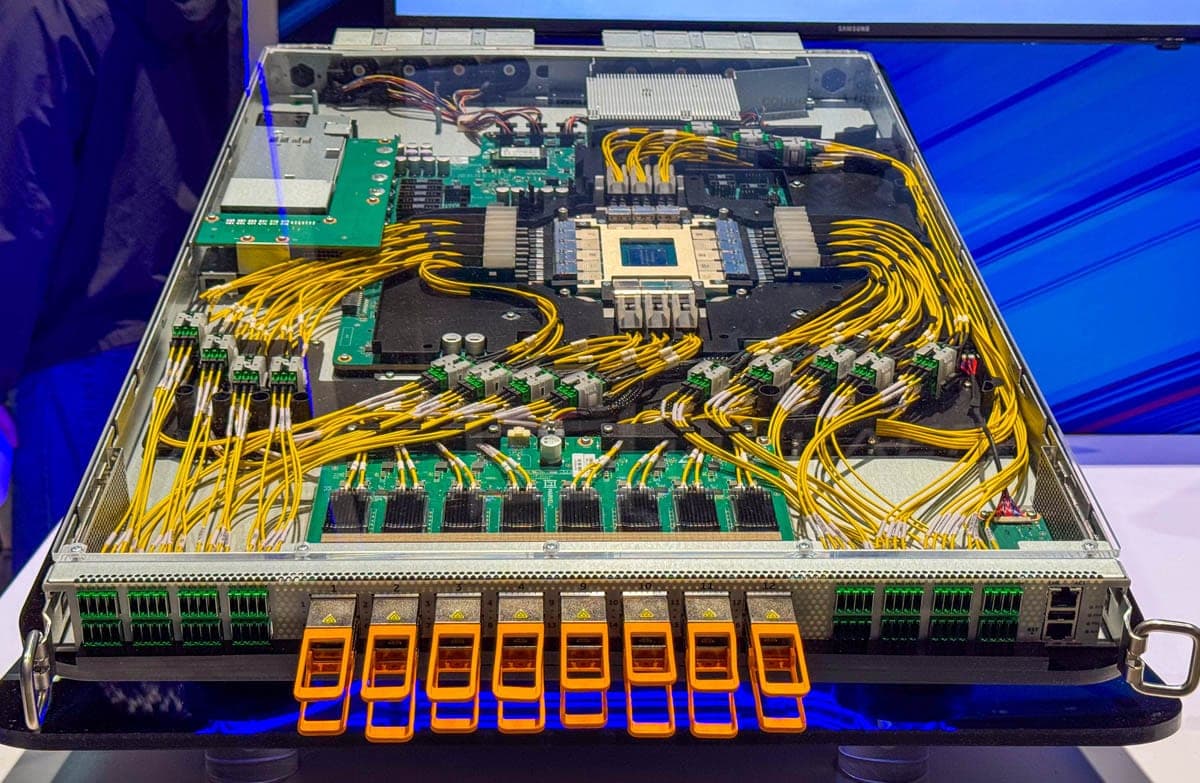
Marvell showed a switch built this way, the TX9190, at an industry show in 2025. The photo on this page shows it: yellow fibers run to the front, where orange plug-in light sources sit. Short copper paths mean less loss and less wasted power.
This is where the deal gets practical. Making a CPO product work takes chip designers and laser makers talking daily, which is the whole point of putting them under one roof.
The big picture: Marvell has been moving that way for a while. Its Murphy has said that chip speed is growing faster than the links between chips, so connections are the next bottleneck.
What do the companies say the deal will save?
The companies expect more than $1 billion a year in cost savings once the deal is fully running. That is called a run-rate synergy, which means yearly savings from combining the two businesses.
They also expect the deal to add to Marvell's profit per share, on an adjusted basis, in the first year after closing. They say the pairing should help them ship tested optical products to customers faster.
Along with the deal, Marvell shared early numbers for its fiscal third quarter. Revenue is in line with its earlier guidance, and Marvell tightened its forecast range to plus or minus 2%, down from plus or minus 5%.
What worries analysts?
Marvell's stock dropped more than 13% on October 29, after news of the talks leaked. Several analysts raised the same worries.
- Cash: Marvell held about $3.92 billion in cash in its latest quarter, so a stock deal was the only realistic route.
- Dilution: Issuing that many new shares can shrink each existing owner's slice of future profit.
- A high price: Analysts expected a big premium, which on its own can weigh on the buyer's shares.
- Regulators: The review could take a long time, including in China.
An analyst at Evercore ISI also said customers wondered why Lumentum would sell, given that it has said its output is sold out through fiscal 2029.
The Nvidia link adds another wrinkle. Nvidia invested $2 billion in Lumentum in March, which shows how much the AI chip world wants a steady supply of lasers.
What it means for you
- Not an overnight change: The deal closes in 2028, so your apps will not feel it soon.
- Faster, cooler AI later: If light links work as promised, AI services could get more speed for less power in the long run.
- Competition: The deal gives Marvell a bigger optical lineup to compete with its rival Broadcom.
- If you own either stock: Both companies' shareholders vote, so watch the filings the companies said they will submit to the SEC.
The bottom line
Marvell is paying $115 billion in stock to own more of the path a signal takes between AI chips. The idea is simple: copper is running out of room, and light has plenty.
The deal still needs approvals and almost two years to close, so the plan is still a plan.
Key facts
- Implied deal value
- $115 billion (enterprise value)
- Exchange ratio
- 4.5 Marvell shares per Lumentum share
- Premium
- About 23.9% over the October 28 unaffected prices
- Ownership after closing
- About 67% Marvell, 33% Lumentum
- Expected close
- First half of 2028
Got questions?
Quick answers, plain wordsWhat did Marvell announce?
On November 2, 2026, Marvell and Lumentum said they signed a definitive agreement for Marvell to acquire Lumentum in an all-stock deal. The implied enterprise value is $115 billion.
How much will Lumentum shareholders get?
A fixed 4.5 shares of Marvell stock for each Lumentum share. That works out to about $1,132 per Lumentum share, a premium of roughly 23.9% over the October 28 prices, the last day before deal talk began.
Is any cash involved?
No. It is an all-stock deal, so Marvell pays with its own new shares instead of cash. Marvell held about $3.92 billion in cash in its latest quarter, far too little to pay for a deal this size in cash.
What does Lumentum make?
Lumentum builds lasers, optical transceivers (modules that turn electrical signals into light and back), optical circuit switches and the specialized chips behind them. It is based in San Jose, California.
What does Marvell make?
Marvell designs chips that move, store and process data, including custom AI chips for large cloud companies, network switches and electrical and optical interconnects. It is based in Santa Clara, California.
Who will run the combined company?
Matt Murphy stays Chairman and CEO. Three Lumentum board members, including Lumentum CEO Michael Hurlston, join Marvell's board, which has seven directors today.
When will the deal close?
The companies expect it to close in the first half of calendar 2028. Marvell and Lumentum stockholders must approve it, and regulators must clear it.
Will this change anything for me as a user?
Not directly and not soon. The companies make parts inside data centers, so any effect shows up later, in how fast and how efficiently AI services run.
Why did Marvell's stock fall before the announcement?
Marvell shares fell more than 13% on October 29, after news of the talks leaked. Analysts worried about a high premium, new shares that dilute current owners, and a long regulatory review.
What is the copper wall?
It is the point where copper wires can no longer carry a fast signal far enough without it breaking down. As AI chips get faster, that point moves closer, which pushes data centers toward light.
SourcesMarvell and Lumentum (SEC filing)
Topics and tagsAI chips, Data centers, Funding & deals, marvell
Go deeper
- ExplainerWhat is a GPU, and why does AI need them?A GPU (graphics processing unit) is a chip that does huge numbers of simple calculations at the same time. Built to...
- ExplainerWhat is an AI data center?An AI data center is a huge building full of specialized computers, mostly GPUs, that train AI models and answer...
Related stories
 Techlantis
Anthropic confirms Claude Code now steers away from cloning existing games
Anthropic says it added two sentences to Claude Code on Opus 5.5 so it will not recreate someone else's specific game. Users also report reverse engineering refusals.

Linux 7.4 has the biggest merge window ever, and AI is behind much of it
The next Linux kernel took in nearly 20,000 commits before its first test build, the most ever. Phoronix ties the surge to AI tools, while Linus Torvalds says it is not the only reason.
Darkbloom warns Mac owners their AI earnings are falling as token prices drop
The network that pays people to rent out idle Macs for AI work told its members to expect less money, because the price of AI tokens keeps sliding.
More in brief
- Google cuts off a botnet of 1.3 million Android TV boxes built in at the factoryNov 2
- The 16GB Raspberry Pi 5 now costs $385, triple its launch priceNov 2
- Canada stopped changing clocks, and Microsoft's calendars are catching upNov 2
- Affinity for iPad launches, and it is free for individualsNov 2
- Supermarket freezer hacks spread to Belgium, Sweden and beyondNov 2
- UK landlines switch off on January 31, and Openreach says no extensionNov 1