
Technology·News & analysis
Tinder is done betting everything on the swipe, now it wants you to bring friends
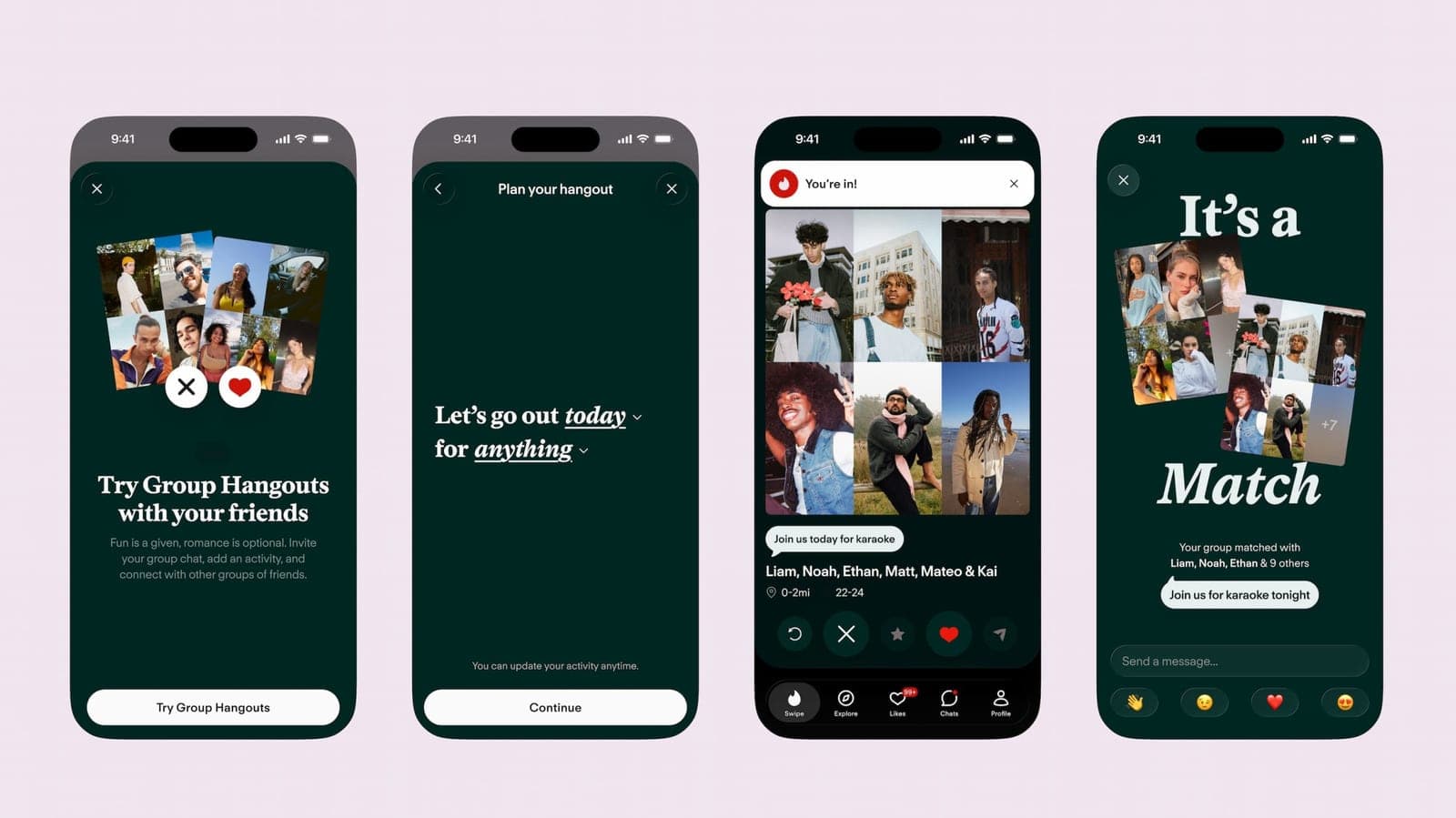
Tinder launched Group Hangouts, letting friend groups of 3 to 15 match with other groups for real-world activities instead of one-on-one swiping, as its user numbers keep falling.
Tide
Ripple
Sci-fi
2/10
Reality
Shipping
Swipe right on a whole friend group at once.How we rate
Tinder launched Group Hangouts, letting friend groups of 3 to 15 match with other groups around shared activities instead of one-on-one swiping.
It's a direct response to years of declining engagement: Tinder's monthly active users fell 7% in the most recent quarter, part of a broader industry-wide slide in dating app downloads and revenue since 2019. For an app that basically invented modern swipe-based dating, rebuilding around group, real-world connection is a genuinely significant shift in direction.
What to know
- Tinder launched Group Hangouts, letting groups of 3 to 15 friends create a shared profile around an activity and match with other friend groups instead of individuals.
- Once two groups match, members land in a shared chat to coordinate plans, with options to leave the conversation individually and block or report other groups.
- The feature responds to years of declining engagement: Tinder's monthly active users fell 7% in Q2 2026, following an 8% decline the prior quarter, with direct revenue down 1% to $457.5 million.
- Tinder VP of product Claire Watanabe said the idea was partly inspired by a college volleyball team that made a Tinder profile while traveling to explore new towns and meet locals.
- This follows Tinder's Events tab launched in March 2026 and its expansion to dozens more cities in August, while rival Bumble has built a similar group-oriented feature called Plans.
Tinder built its entire identity around swiping on one person at a time. Its newest feature asks you to bring your whole friend group instead, and matches you with someone else's.
How does Group Hangouts actually work?
A user picks an activity and invites at least two friends to form a group of 3 to 15 people. That group then shows up in Tinder's main discovery feed, the same card stack normally used for individual profiles, where other friend groups can browse it and "like" it.
When two groups both show interest, everyone involved lands in a shared group chat to coordinate actual plans. Members can leave that conversation individually without pulling the whole group out, and Tinder built in the same blocking and reporting tools used for one-on-one matches.
Why it matters: this isn't a bolt-on feature buried in a settings menu, it runs through Tinder's core swiping mechanic, the same interaction that's defined the app since it launched. Putting group matching directly into that main feed signals Tinder sees this as central to its future, not a side experiment tucked away for users who happen to stumble across it.
Why is Tinder making a change this significant right now?
The catch: Tinder's user numbers have been sliding for a while. Monthly active users fell 7% in the second quarter of 2026, following an 8% decline the quarter before, while direct revenue dipped 1% to $457.5 million. Paying users across Match Group's apps fell 6% year over year to 13.3 million.
Why it matters: those aren't small blips, they're a multi-quarter pattern stretching back well over a year that made some kind of structural change necessary rather than optional. Group Hangouts is Tinder's clearest bet yet that the fix isn't a better matching algorithm, it's rethinking what the app is actually for at a more fundamental level than past updates attempted.
Where did this idea actually come from?
Tinder VP of product management Claire Watanabe shared the spark behind it: "One inspiration was seeing a college women's volleyball team make a Tinder profile while traveling for away games, so they could explore a new town and meet locals."
In real life it's the difference between an app built for "find one person to date" and one being reshaped for "find people to do something fun with tonight," romance optional rather than the entire point.
Is this Tinder's first attempt at moving beyond swiping?
Background: no. Tinder launched an Events tab in March 2026, focused on organized in-person gatherings, then expanded it to dozens more cities by August 2026. Group Hangouts extends that same real-world, social-first direction, rather than representing a brand-new strategic pivot.
Rival Bumble has been making a near-identical bet, building its own group-oriented feature called Plans, aimed at the same shift away from pure one-on-one matching that younger users have been pushing dating apps toward.
Is this just a Tinder problem, or is the whole industry struggling?
By the numbers: it's industry-wide. Global dating app downloads have fallen for six consecutive years since peaking in 2019, and category-wide revenue declined for the first time last year, landing around $6.07 billion.
Notably, the struggle isn't universal even within Match Group. Hinge, the company's other major dating app, grew direct revenue 22% to $203.5 million in the same quarter Tinder declined, with paying users up 17% and monthly active users up 13%.
Why it matters: Hinge's growth shows the issue isn't that younger users have abandoned dating apps entirely, it's that Tinder's specific swipe-heavy, volume-focused format has fallen out of favor in a way Hinge's slower, more relationship-focused approach clearly hasn't. That comparison puts real pressure on Group Hangouts to work, since the format problem appears fixable, not an industry-wide dead end.
Hinge built its entire pitch around being "designed to be deleted," emphasizing fewer, more intentional matches over Tinder's high-volume swiping model. That positioning turned out to resonate strongly with exactly the demographic Tinder is now trying to win back, suggesting the fix Tinder needs isn't necessarily more features, but a genuinely different relationship to how much effort and intention each match requires.
How did Tinder become the app defined by swiping in the first place?
Background: Tinder launched in September 2012 out of IAC's Hatch Labs, built specifically around solving one behavioral problem: the fear of rejection in dating. Its swipe mechanic, simple, fast, low-stakes, caught on explosively, reaching a million matches by December 2012 and roughly a billion swipes a day by early 2014.
Why it matters: that history is exactly what makes Group Hangouts such a notable shift. Tinder didn't just popularize swiping, it built the entire category around the idea that fast, low-commitment, one-on-one judgment was the better way to date. Walking that back toward slower, group-based, activity-first connection is Tinder questioning its own founding premise, not just adding a feature.
What's actually driving Gen Z away from swiping specifically?
By the numbers: surveys have found that roughly 79% of Gen Z daters report real burnout from traditional swipe-based apps. The average user reportedly spends more than 50 minutes a day swiping, and specific bad experiences pile up fast: 41% say they've ghosted someone, 38% report being catfished, and 27% say they've experienced "love bombing."
Dating coach Rae Weiss summed up the core complaint simply: swiping "often feels transactional, laborious and scripted," a description that captures why so many younger users describe the process as exhausting rather than exciting. On top of the emotional fatigue, many younger users are also weighing the actual cost, premium subscriptions and paid features add up for a generation that's broadly more financially cautious than previous cohorts.
Why it matters: that combination, time cost, emotional exhaustion, financial burden, and a format that feels mechanical rather than genuine, is precisely the set of problems a group-based, activity-first feature like Group Hangouts is specifically designed to sidestep entirely. Matching around "let's do karaoke tonight" carries a lot less personal risk and scripted pressure than matching around "is this person interested in me specifically."
What it means for you
- If you're tired of one-on-one swiping, Group Hangouts gives you a lower-pressure way to use Tinder, centered on an activity rather than a direct romantic pitch.
- It's rolling out in phases across the US and select markets, so check your app's home screen to see if you have access yet.
- The safety tools carry over from one-on-one matching, individual exit, blocking, and reporting, so you're not more exposed just because you're in a group.
- This reflects a broader shift across dating apps, not just Tinder. If group or event-based features show up on other apps you use, this is the industry trend driving it.
The bottom line
Tinder built the modern dating app category around the swipe, and Group Hangouts is the company openly betting that the swipe alone isn't enough to keep the next generation of users engaged with its product long-term.
Whether it actually reverses years of declining users will depend on something harder to measure than a feature launch: whether people genuinely want to meet new friend groups through an app best known for one-on-one romantic matching, or whether this ends up being a smart pivot that arrived a little too late to change the broader trend.
Key facts
- Group size
- 3 to 15 friends
- Tinder MAU decline
- -7% (Q2 2026), -8% prior quarter
- Tinder direct revenue
- $457.5 million (-1%)
- Hinge direct revenue
- $203.5 million (+22%)
- Dating app downloads
- Down 6 straight years since 2019
Got questions?
Quick answers, plain wordsWhat is Tinder's new Group Hangouts feature?
A feature letting groups of 3 to 15 friends form a shared profile around a chosen activity, then browse and match with other friend groups in Tinder's main discovery feed, instead of matching one person with another person.
How does matching actually work with Group Hangouts?
A user picks an activity and invites at least two friends to form a group. The group then appears in the discovery feed, where other groups can view it and 'like' it. When both groups show interest, members are connected in a shared group chat to coordinate plans.
What safety features does it include?
Members can leave a group conversation independently without leaving the whole group, and Tinder includes blocking and reporting tools for dealing with other groups, similar to protections on one-on-one matches.
Why is Tinder launching this now?
Tinder's monthly active users fell 7% in the second quarter of 2026, following an 8% decline the quarter before, with direct revenue down 1% to $457.5 million. Group Hangouts is part of a broader effort to reverse that decline by appealing to younger users who increasingly prefer social, in-person experiences over one-on-one swiping.
Where did the idea for Group Hangouts come from?
Tinder VP of product management Claire Watanabe said one inspiration was seeing a college women's volleyball team create a Tinder profile while traveling for away games, using it to explore new towns and meet locals rather than to find one-on-one dates.
Is this Tinder's first move away from one-on-one swiping?
No. Tinder launched an Events tab in March 2026 focused on in-person gatherings, then expanded it to dozens more cities in August 2026. Group Hangouts extends that same push toward group and real-world connection further.
Are other dating apps doing something similar?
Yes. Bumble has built a comparable group-oriented feature called Plans, aimed at the same shift toward in-person, less one-on-one-focused connection that Gen Z users have been pushing dating apps toward.
Is Tinder's whole business struggling, or just Tinder specifically?
The decline appears specific to Tinder rather than its parent company overall. Match Group's other major app, Hinge, grew direct revenue 22% to $203.5 million in the same quarter, with paying users up 17% and monthly active users up 13%.
Is this decline unique to Tinder and Match Group, or an industry-wide trend?
It's industry-wide. Global dating app downloads have fallen for six consecutive years since peaking in 2019, and category-wide revenue declined for the first time last year, to roughly $6.07 billion.
When and where is Group Hangouts available?
It's rolling out in phases across the US and select other markets, accessible directly from Tinder's home screen.
SourcesTechCrunch
Topics and tagstinder, match group, dating apps, gen z
Related stories

Apple's smart home hub reportedly launches October 13, with a camera that never records video
Bloomberg's Mark Gurman says Apple will announce its long-rumored smart home display on October 13. He also describes a companion home camera that sends text descriptions instead of video.

GrayKey maker reportedly found a way around the iPhone's Inactivity Reboot
A leaked training video seen by 404 Media says Magnet Forensics' new tools keep a seized iPhone in an easier-to-search state, even after the reboot Apple added in iOS 18.1.

Fervo's Cape Station becomes the first enhanced geothermal plant to sell power commercially
Fervo Energy's first 33-megawatt block at Cape Station in Utah reached commercial operation a day ahead of schedule, after 23 months of construction. Two more blocks follow by January 2027.
More in brief
- arXiv limits researchers to two papers a month as AI drives submissions to a recordOct 2
- California will fine robotaxi companies that block first responders for over 30 minutesOct 2
- Microsoft launches real-time transcription and new voice models for AI voice agentsOct 1
- Cloudflare releases Clef, open-weight AI models that make yes-or-no decisions fastOct 1
- Cloudflare renames its data platform Basin and makes it generally availableOct 1
- ChatGPT can now show you wearing clothes before you buy themOct 1