
AI·News & analysis
Pat Gelsinger-backed PicoJool raises $27.5M for AI data center lasers
PicoJool's Series A, led by Socratic Partners, funds a laser-based alternative to copper wiring meant to solve a growing bandwidth and energy bottleneck in AI data centers.
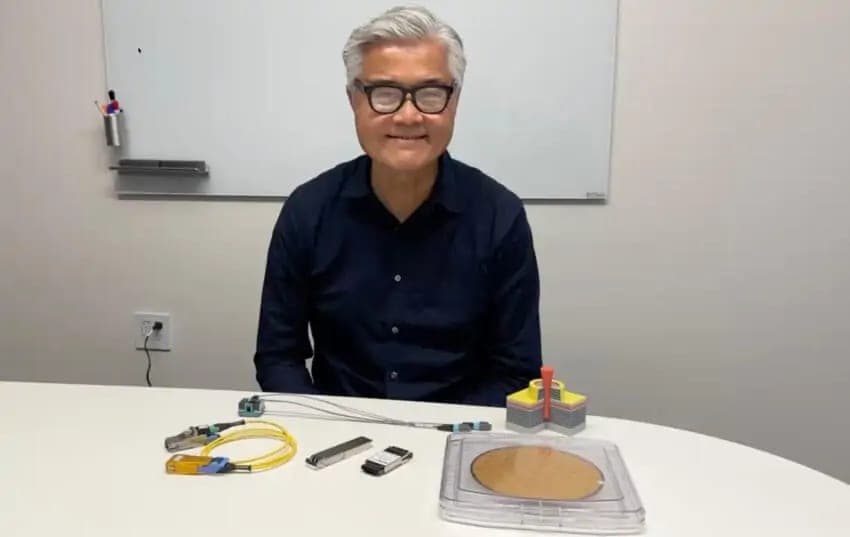
PicoJool raised a $27.5 million Series A led by Socratic Partners, with Hudson River Trading also investing, bringing its total funding to $39.5 million.
The startup, backed by former Intel CEO Pat Gelsinger, makes VCSEL lasers that move data with light instead of copper wire, reaching 200G per lane. AI clusters generate more data than copper wiring can handle without high energy costs. PicoJool will use the funding to expand in the U.S. and Taiwan and qualify products with customers.
What to know
- PicoJool raised a $27.5 million Series A led by Socratic Partners, with Hudson River Trading also participating, bringing its total funding to $39.5 million.
- The startup, seeded by former Intel CEO Pat Gelsinger's Playground Global, makes VCSEL lasers that move data with light instead of copper wire.
- PicoJool's technology reaches 200G per lane and offers a path to 3.2 terabits per second of bandwidth for AI clusters.
- It enters a market where rivals dwarf its funding: Ayar Labs raised $650 million in 2026 alone, and Marvell bought Celestial AI for $3.25 billion.
AI data centers are drowning in their own data, and PicoJool thinks light can fix what copper wire can't. The startup raised a $27.5 million Series A to scale up its laser-based alternative to traditional data center wiring.
What PicoJool raised
Socratic Partners led the round, with participation from Hudson River Trading, a quantitative trading firm. It follows a $12 million seed round from November 2025, bringing PicoJool's total funding to $39.5 million.
- Series A: $27.5 million, led by Socratic Partners.
- Total raised: $39.5 million across two rounds.
- Seed backer: Playground Global, the venture firm run by former Intel CEO Pat Gelsinger.
By the numbers: $39.5 million total is a fraction of what bigger rivals in this space have raised this year, a gap that says as much about investor appetite for the category as it does about PicoJool itself.
The bandwidth problem
AI clusters now run hundreds or even thousands of chips at once, constantly trading data so they can work together on a single task. Copper wiring, the traditional way to connect them, struggles to keep up.
In real life Think of copper wiring like a garden hose trying to fill a swimming pool. VCSEL lasers are closer to a fire hose, moving far more data through light instead of electrical signals.
Copper interconnects also burn significant energy just moving data between chips, on top of not being fast enough. That combination, more data and higher energy costs, is what PicoJool is targeting.
This isn't just a PicoJool talking point. Industry supply-chain trackers say fiber optic transceivers, connectors, and optical modules have moved into the most-extended lead time categories available, as AI training clusters demand terabit-per-second communication between thousands of GPUs at once. Data center power budgets are under similar strain: interconnection requests to one major U.S. power market alone reached 31 gigawatts this year.
PicoJool's fix
PicoJool builds VCSEL, or Vertical Cavity Surface Emitting Laser, chips: a type of semiconductor laser diode that sends data as light through optical cables instead of electrical signals through copper.
PicoJool CEO Al Yuen says the company has already reached 200G per lane, with a path to connectivity of up to 3.2 terabits per second of bandwidth for AI clusters.
"Reaching 200G per lane proved that the performance is there," Yuen said. "Our focus is now execution." The company offers both high-speed 100G and 200G VCSEL products and lower-power MicroVCSEL configurations for different parts of a data center's connectivity needs.
The MicroVCSEL line uses a massively parallel design: instead of one fast laser doing all the work, many smaller, lower-power lasers work together to add up to more total bandwidth while using less energy per bit of data moved. That mirrors a tradeoff already common across AI hardware, using more small components instead of fewer big ones to save power.
Who's behind it
Yuen isn't new to this problem. He holds more than 50 patents and helped invent Active Optical Cables and the QSFP transceiver, two pieces of hardware now standard across the internet's connectivity infrastructure. He built the world's first 10 gigabit Ethernet at a company he founded around 1999, then held technical and executive roles at Coherent and Lumentum before starting PicoJool in 2024.
PicoJool emerged from stealth mode in November 2025 alongside its $12 million seed round. The company is headquartered in Palo Alto, California, with research, development and operations split between the U.S. and Taiwan, the same footprint this new funding will expand.
How far this scales
PicoJool isn't stopping at 200G. The company says its optical connectivity products are designed to scale from today's 800G modules up through 1.6T, 3.2T and beyond, following the same doubling pattern that data center networking speeds have followed for years.
That roadmap matters because AI clusters aren't done growing. Each new generation of chips packs in more processors talking to each other more often, so an interconnect that tops out today becomes a bottleneck again within a few product cycles unless it already has headroom built in.
The standards Yuen helped create decades ago are still in wide use today. Active Optical Cables and the QSFP transceiver format became common building blocks across telecom and data center networking long before AI clusters existed, which is part of why PicoJool frames VCSEL technology as proven rather than experimental: the underlying laser approach already has a multi-decade track record in production networks, just not yet at the scale AI clusters now demand.
Small player, hot category
The catch: PicoJool is entering a field where competitors are raising vastly more money, which could make it harder to compete for customers and manufacturing capacity.
| Company | 2026 funding |
|---|---|
| PicoJool | $27.5M Series A ($39.5M total) |
| Ayar Labs | $650M raised across 2026, backed by Nvidia and AMD |
| Celestial AI | Acquired by Marvell for $3.25B, after raising $589M |
Ayar Labs builds co-packaged optics, a related approach to replacing copper with light, and has attracted direct investment from chipmakers Nvidia and AMD. Celestial AI took a different technical approach, delivering optical data to any point on a chip rather than just its edge, before Marvell bought the company outright.
The underlying materials differ too. PicoJool's VCSEL chips are built on gallium arsenide, a material already used in more than 100 million shipped VCSEL channels across the industry, with a reliability track record spanning more than two decades. Silicon photonics, the approach behind co-packaged optics, is newer and requires more new manufacturing infrastructure to scale, though it can support longer-distance, higher-bandwidth links.
Industry estimates put VCSEL-based links at roughly 1 picojoule per bit of energy used, compared with 5 to 10 picojoules per bit for silicon photonics, though the two approaches aren't strictly interchangeable: VCSEL suits rapid deployment inside a rack, while silicon photonics is generally positioned for longer, higher-bandwidth connections across a data center.
What's next
PicoJool plans to use the new funding to expand its teams in the U.S. and Taiwan, qualify its products with customers, and move its chip-level VCSEL and MicroVCSEL technology into cable and module products data centers can actually install.
That qualification step is where a lot of hardware startups stall: a chip that works in a lab still has to survive the manufacturing, testing, and reliability requirements that hyperscale data center operators demand before they'll deploy it at scale. PicoJool hasn't named specific customers yet, and its funding announcement doesn't include a timeline for when its products will ship in commercial data centers.
Growing the Taiwan operation specifically points to manufacturing, since Taiwan is home to much of the world's semiconductor and optical component supply chain. A startup building custom laser chips needs reliable access to fabrication capacity, and being close to that supply chain is often the difference between a working prototype and a product that can actually be manufactured at the volumes hyperscalers require.
The bottom line
PicoJool raised $27.5 million to prove its laser-based chips can replace copper wiring in AI data centers, and says it has already hit 200G per lane. It's a small round next to Ayar Labs' $650 million or Marvell's $3.25 billion Celestial AI deal, but it shows how much money is chasing the same basic problem: AI clusters generate more data than copper wire can move.
Key facts
- Series A
- $27.5 million, led by Socratic Partners
- Total funding
- $39.5 million
- Technology
- VCSEL (Vertical Cavity Surface Emitting Laser)
- Performance
- 200G per lane; path to 3.2 Tbps
- Seed backer
- Pat Gelsinger's Playground Global
Got questions?
Quick answers, plain wordsWhat is PicoJool?
PicoJool is a startup building VCSEL lasers, a type of optical chip that moves data using light instead of copper wire, aimed at easing bandwidth and energy bottlenecks inside AI data centers.
How much did PicoJool raise?
PicoJool raised a $27.5 million Series A led by Socratic Partners, with participation from Hudson River Trading, bringing its total funding to $39.5 million.
What is VCSEL technology?
VCSEL stands for Vertical Cavity Surface Emitting Laser, a type of semiconductor laser diode that sends data as light through optical cables instead of electrical signals through copper wire.
Why does this matter for AI data centers?
AI clusters with hundreds or thousands of chips constantly exchange data, and traditional copper interconnects can't keep up with that bandwidth without consuming large amounts of energy.
Who is Pat Gelsinger and what's his connection to PicoJool?
Pat Gelsinger is the former CEO of Intel. His venture capital firm, Playground Global, led PicoJool's earlier $12 million seed round in November 2025.
How fast is PicoJool's technology?
PicoJool says it has reached 200G per lane and offers a path to connectivity of up to 3.2 terabits per second of bandwidth for AI clusters.
Who led PicoJool's Series A round?
Socratic Partners led the round, with participation from Hudson River Trading, a quantitative trading firm.
How does PicoJool compare to Ayar Labs?
Ayar Labs, a bigger rival in optical AI interconnects, raised $650 million across 2026 alone, backed by Nvidia and AMD, dwarfing PicoJool's $39.5 million total.
What will PicoJool do with the funding?
PicoJool plans to expand its teams in the U.S. and Taiwan, qualify its products with customers, and move its VCSEL and MicroVCSEL chips into cable and module products.
What problem does optical interconnect technology solve?
It replaces copper wiring, which struggles to handle the bandwidth demands of large AI chip clusters and consumes significant energy moving data between chips.
SourcesSiliconANGLE
Topics and tagsData centers, Funding & deals, picojool, ai data centers
Related stories
arXiv limits researchers to two papers a month as AI drives submissions to a record
The preprint server got 40,363 submissions in September, double two years ago, and its volunteer moderators can't keep up. Starting October 1, every submitter gets two submissions a month.
Microsoft launches real-time transcription and new voice models for AI voice agents
MAI-Transcribe-2-Streaming turns speech into text as people talk, and MAI-Voice-2.1 and its Flash version talk back. Together, Microsoft pitches them as the building blocks for voice agents with fewer awkward pauses.
Cloudflare releases Clef, open-weight AI models that make yes-or-no decisions fast
Clef and Clef-flash answer bounded questions for AI agents in milliseconds instead of writing text. Cloudflare hosts them and also gives away the weights, a direct challenge to TypeSafe's Jev.
More in brief
- California will fine robotaxi companies that block first responders for over 30 minutesOct 2
- Apple's smart home hub reportedly launches October 13, with a camera that never records videoOct 1
- GrayKey maker reportedly found a way around the iPhone's Inactivity RebootOct 1
- Fervo's Cape Station becomes the first enhanced geothermal plant to sell power commerciallyOct 1
- Cloudflare renames its data platform Basin and makes it generally availableOct 1
- ChatGPT can now show you wearing clothes before you buy themOct 1