
Technology·News & analysis
Bolt Graphics powers on its first Zeus GPU test chip
The startup says its tiny 12nm test chip ran with no functional issues in 24 hours, but the full Zeus GPU is not due until 2028.
Tide
Ripple
Sci-fi
6/10
Reality
Lab
A graphics card that simulates radar before anyone builds it.How we rate
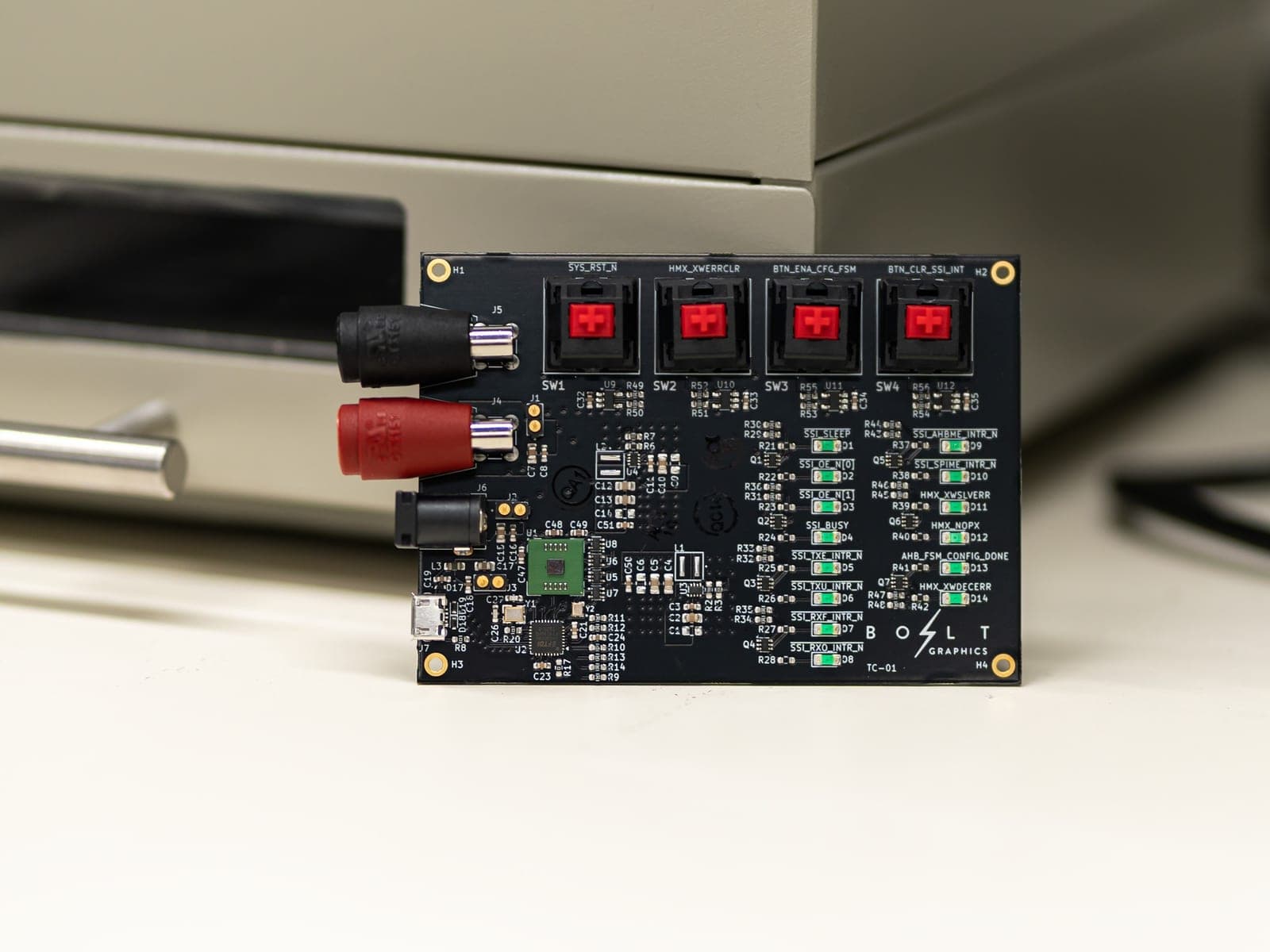
Bolt Graphics said it powered on the first test chip for its Zeus GPU and found no functional issues.
The 6 square millimeter chip draws 1.4 watts and is built to speed up electromagnetic simulation. It proves the design works at small scale, not that a full GPU will match Bolt's big claims, which no one has tested. Bolt plans developer access in Q1 2027 and volume production in 2028.
What to know
- Bolt Graphics said it powered on its Zeus test chip, a 6 square millimeter chip made by TSMC, and found no functional issues.
- The chip drew 1.4 watts, compared with 35 watts for the prototype board Bolt used before.
- The full Zeus GPU now has a later timeline, with developer access in Q1 2027 and volume production in 2028.
- Reuters reported that Bolt is trying to raise about $100 million at a valuation near $700 million.
Bolt Graphics announced on October 13 that its first Zeus test chip powered on and passed its first tests. So what does a chip the size of a fingernail tell us about a graphics card that is still two years away?
What is Bolt Graphics building?
Bolt is a startup from Sunnyvale, California. It designs a GPU, which is the kind of chip that draws 3D graphics and does lots of math at the same time. Its project is called Zeus.
Zeus is not a gaming card, at least not yet. Engadget reports that Bolt plans to sell to studios, engineers and scientists first, and expand into gaming and AI later.
Bolt first announced Zeus in March 2025. It made big claims then: up to 10 times the rendering speed of existing GPUs, and up to 10 times the path tracing speed of Nvidia's RTX 5090, according to Engadget.
Why it matters: those claims have never been independently tested. A working chip is the first real evidence that the design is more than slides.
What exactly was powered on?
Not the full GPU. Bolt built a small test chip, a prototype made only to check that the core ideas work in real silicon.
Here is what Bolt and the outlets that covered it say about it:
- Size: 6 square millimeters, roughly the area of a small pea.
- Factory: TSMC, the Taiwanese chipmaker, on its 12 nanometer process (a measure of how fine the chip's tiny parts are).
- Power: 1.4 watts.
- Bring-up: done in 24 hours, with no functional issues, Bolt says.
- Temperature tests: from -40 degrees C to 85 degrees C.
Bolt finished the design, called a tape-out, in April. Bringing up a chip means switching it on for the first time and checking that it behaves. Getting a clean result in a day is a good sign.
Why does 1.4 watts matter?
Before the chip existed, Bolt tested its design on an FPGA. That is a reprogrammable chip that engineers use to mimic a design before they make the real thing.
The FPGA setup drew 35 watts. The real silicon draws 1.4 watts, Bolt says. That is about 25 times less power for the same test job.
Think of it like testing a recipe in a giant restaurant kitchen, then finding the same dish cooks fine on a camping stove. It is a great result. It also says nothing yet about cooking for a thousand guests.
What does the chip actually do?
The test chip's headline feature is dedicated hardware for electromagnetic simulation. That is software that predicts how radio waves, light and other fields move through a product. Engineers use it to design radar sensors, antennas and camera lenses.
Bolt says it can run Maxwell's equations, the math behind those fields, directly in hardware. In its words, that lets engineers simulate a whole product instead of one part at a time.
Bolt CEO Darwesh Singh told HPCwire it shows the company can run a "highly complex physics algorithm, accelerated in hardware, which no one's done before." Bolt's press release adds that it wants to speed up two more kinds of simulation: fluid flow and molecules.
In real life An engineer designing a car's radar sensor normally builds a prototype to see how it behaves. With fast simulation, she could test dozens of versions on a computer first and build only the best one.
What will the real Zeus GPU look like?
The real Zeus is a different chip. Bolt says it will use TSMC's N5P process, a 2020-era design. It picked it on purpose, to avoid competing with other chipmakers for scarce wafers, the thin discs of silicon that chips are cut from.
Engadget and Notebookcheck describe the plan:
- Cores: built around RISC-V, an open-standard design that anyone can use without paying a license fee.
- Graphics: Bolt's own path-tracing hardware, which models how light rays bounce.
- Memory: soldered LPDDR5X memory, plus slots for ordinary laptop-style DDR5 memory sticks.
- Entry card: a 120 watt model with 32 GB of LPDDR5X, expandable.
- Capacity: up to 384 GB on PCIe cards, according to Engadget, and up to 2.25 TB on server versions, according to Notebookcheck.
The catch: Notebookcheck notes that a small test chip does not show whether a full-size Zeus can reach the speeds Bolt has advertised.
When can you get one?
The schedule has moved. Notebookcheck says Bolt used to expect production in the fourth quarter of 2027. Bolt's new timeline is:
- Q1 2027: developer access opens.
- Late 2027: early access customers get the first Zeus hardware.
- 2028: volume production of PCIe cards and servers.
Bolt said in April that more than 14,000 businesses, developers and individuals had joined its early access program. It also claimed a product pipeline above $500 million and compute costs up to 17 times lower than current hardware, Engadget reports. It did not name any customers, and those figures are the company's own.
Who could use this first?
Bolt's press release names several uses for the physics hardware. It says the approach is "essential" for work on silicon photonics, which means chips that move data with light. It also points to research on new materials, optics and stealth shapes, the designs that make an object hard to spot on radar.
The release adds one more: training robots and world models. A world model is an AI system that learns how the physical world behaves, so a robot can practice inside a simulation before it touches anything real.
These are Bolt's own descriptions. The company has not named a customer who uses the chip for any of them.
What came before Zeus?
Zeus is not Bolt's first design. Notebookcheck says the company showed a GPU called Thunder in 2024, then moved its attention to Zeus.
Zeus also promised some unusual extras. Notebookcheck lists expandable memory and built-in 400 GbE networking, a very fast network connection, right on the card. Most graphics cards have neither.
By the numbers: the test chip is about 6 square millimeters. The FPGA it replaced needed 35 watts. Zeus, at 120 watts for the entry model, is meant for a much bigger job than this small prototype.
What about the money?
Two days after Bolt's announcement, Reuters reported that the company was trying to raise about $100 million at a valuation of around $700 million. Reuters cited three people familiar with the matter, according to Engadget. Bolt has not confirmed the report.
Reuters also pointed out a hurdle for any new gaming chip. It needs deep software support to run the thousands of games already on sale. That is one reason Bolt starts with professional users, whose software is more specialized.
What it means for you
- Gamers: nothing changes. Zeus is not a gaming product now, and volume production is not planned before 2028.
- Engineers and studios: developer access is scheduled for Q1 2027. That is the first real chance to test the claims.
- GPU watchers: treat the 17x and 10x figures as Bolt's own estimates until independent tests appear.
- Investors: Reuters reports a fundraising effort. Bolt has not confirmed it.
The bottom line
Bolt Graphics showed that its first piece of silicon turns on and works. That is a real step for a young chip company, and it deserves credit.
The test chip proves the design at tiny scale, not that Zeus will match its big promises. The first honest answers come when developers get hardware in 2027.
Key facts
- Test chip size
- 6 square millimeters, TSMC 12nm
- Power draw
- 1.4 watts (35 watts on the earlier FPGA)
- Bring-up time
- 24 hours, no functional issues
- Developer access
- Q1 2027
- Volume production
- 2028
Got questions?
Quick answers, plain wordsWhat did Bolt Graphics announce?
Bolt said on October 13, 2026 that it powered on the first test chip for its Zeus GPU and opened an office in Taipei. The company says the chip ran with no functional issues.
What is Zeus?
Zeus is a graphics chip, or GPU, that Bolt Graphics is designing. It is aimed first at engineers, film studios and scientists who need simulation and path tracing, and later at gaming and AI.
Is the test chip the real Zeus GPU?
No. The test chip is a small 6 square millimeter chip made to prove the design works. The Zeus GPU Bolt plans to sell is a separate chip, built on TSMC's N5P process.
When will Zeus be available?
Bolt expects to open developer access in the first quarter of 2027 and give early access customers hardware late in 2027. Volume production of cards and servers is planned for 2028.
Can you buy a Zeus card for gaming?
Not now, and not soon. Engadget reports Bolt is selling to studios, engineers and scientists first, with gaming and AI planned for later.
Has anyone tested Bolt's performance claims?
No independent tests have been published. Bolt has not released performance figures for the test chip and says only that it beat its own internal estimates.
What is electromagnetic simulation?
It is a way to predict how radio waves, light and other electromagnetic fields behave inside a product, such as a radar sensor or a camera lens. Engineers use it before building a physical prototype.
What did the Reuters report say?
Engadget reports that Reuters said Bolt was trying to raise about $100 million at a valuation of around $700 million, citing three people familiar with the matter.
Why did Bolt open an office in Taipei?
Bolt says it wants its team close to its manufacturing partners and suppliers as it prepares Zeus for volume production. The office already has staff, and Bolt plans to grow it quickly.
SourcesBolt Graphics press release
Topics and tagsAI chips, bolt graphics, gpu, semiconductors
Go deeper
- ExplainerWhat is a semiconductor chip?A semiconductor is a material, usually silicon, that can either conduct or block electricity. Chips pack billions of...
- ExplainerWhat is a GPU, and why does AI need them?A GPU (graphics processing unit) is a chip that does huge numbers of simple calculations at the same time. Built to...
Related stories

TSMC posts a sixth straight record profit as AI chip demand keeps climbing
The company that makes most of the world's advanced chips earned NT$763 billion in three months, and its CEO says he sees no sign of AI demand slowing down.

Samsung will build Nvidia's custom memory base dies at TSMC, report says
Nvidia asked all three of its memory suppliers to make the bottom layer of its new NVHBM chips on TSMC's 3nm process, and Samsung said yes.

Qualcomm wins its breach case against Arm, and the jury awards $2
A Delaware jury found Arm broke its architecture license with Qualcomm and interfered with a Meta deal, then awarded $1 per claim. The bigger fight, over five years of royalties, is now up to a judge.
More in brief
- Darkbloom warns Mac owners their AI earnings are falling as token prices dropOct 31
- Percepto launches Axion, AI that reads inspection data from any droneOct 31
- Apple Intelligence is coming to China in December with iOS 27.3Oct 30
- Intel stock falls about 28% after a weak PC outlook and rising memory pricesOct 30
- GM to pay $220 million over selling drivers' dataOct 30
- Fujifilm will boost magnetic tape output 5x as AI piles up dataOct 30