
AI·News & analysis
Meta launches a $35 billion stock sale and plans $60 billion more for AI
Meta filed for $35 billion of new stock offerings and plans a $60 billion at-the-market program, with Nvidia, AMD and Broadcom signaling interest in up to $5 billion of shares.
Tide
Ripple
Sci-fi
2/10
Reality
Shipping
Superintelligence, financed with a stock prospectus.How we rate
Meta launched about $35 billion of stock offerings on October 26, 2026, split between $22.5 billion of common stock and $12.5 billion of convertible preferred shares.
It also plans a $60 billion at-the-market program in early 2027, and Nvidia, AMD and Broadcom signaled interest in up to $5 billion of the common stock. Meta expects $135 to $145 billion of capital spending this year.
What to know
- Meta launched about $35 billion of underwritten offerings: $22.5 billion of Class A stock and about $12.5 billion of mandatory convertible preferred stock.
- A separate $60 billion at-the-market program is planned for the first quarter of 2027, once Meta's new Class C stock starts trading.
- Nvidia, AMD and Broadcom indicated interest in buying up to $5 billion of the common stock, though none of it is binding.
- Meta expects $135 to $145 billion of capital expenditures in 2026 and says it had about $82 billion in cash and securities at the end of the third quarter.
Meta wants a lot more money for AI, and this time it is asking stock buyers rather than bond buyers.
On October 26, 2026, Meta announced the launch of about $35 billion of public stock offerings. The Financial Times reported the plan as a raise of roughly $95 billion once a second, larger piece is counted.
What is Meta actually selling?
The $35 billion comes in two separate deals, and neither depends on the other finishing.
- Common stock: $22.5 billion of Class A shares, sold through forward sale agreements.
- Preferred stock: 250 million depositary shares, about $12.5 billion, each representing a 1/20th interest in a share of Series A mandatory convertible preferred stock.
Underwriters also get a 30-day option, meant only to cover over-allotments, to buy more: up to 37.5 million extra depositary shares, and up to $3.375 billion of extra common stock.
And where does the $95 billion come from?
By the numbers: the rest is a planned at-the-market program, called an ATM, of up to $60 billion. Add it to the $35 billion and you get the figure the Financial Times reported.
Meta stresses that this part is not a done deal. It has not signed an agreement for the program, and its timing, size and terms are not set.
The program is not expected to start until the first quarter of 2027, after Meta's previously announced Class C common stock begins trading.
What do these financing terms mean?
Three pieces of jargon carry most of this story, so here they are in plain words.
- Forward sale agreement: banks sell shares to investors now, and Meta hands the shares to the banks later. Meta can settle on dates it picks, on or before November 19, 2027, and gets its cash at that point.
- Mandatory convertible preferred: a share that pays a dividend and then turns into common stock automatically. Meta expects the conversion on or about August 15, 2029. The dividend rate and conversion terms are set when the deal prices.
- At-the-market program: Meta sells shares in small pieces over time through a bank, at market prices, instead of one big launch.
In real life think of it as the difference between selling your car in one weekend and listing a few things online every week. Same goal, very different pace.
Why are Nvidia, AMD and Broadcom in the deal?
The big picture: the filing names three cornerstone investors: Nvidia, AMD and Broadcom. Each, separately, said it is interested in buying shares in the common stock offering, up to $5 billion in total.
There is a catch. These are indications of interest, not commitments. Any of them can buy more, less or nothing, and the underwriters can allocate them more, less or nothing.
If they buy, they pay the same price and terms as every other buyer, and the underwriters earn the same discount on those shares.
Where will the money go?
Why it matters: Meta says it will use the proceeds for general corporate purposes. The wider context in its announcement is AI infrastructure.
- Spending outlook: Meta expects $135 to $145 billion of capital expenditures in 2026.
- Data centers: it says it owns data centers in 23 U.S. states and is building four superclusters, each with more than one gigawatt of capacity.
- Growth target: it expects to nearly double total infrastructure capacity in 2026 compared with 2025.
Meta also points to custom silicon and other efficiency work, which it says are aimed at lowering the cost of compute.
How healthy is Meta's own balance sheet?
Meta is not raising money because it is short of it. The announcement says it generated $97 billion of operating cash flow in the first three quarters of 2026 and held about $82 billion in cash and marketable securities at the end of the third quarter.
Third-quarter revenue reached $64.6 billion, up 26% year over year. Meta says it has delivered six straight quarters of more than 20% revenue growth, and that 3.64 billion people used at least one of its apps daily as of September 2026.
Its credit ratings are Aa3 and AA-, which Meta says let it raise long-term debt efficiently. It describes stock as a complementary source that diversifies its funding.
Its stated plan is a mix of operating cash flow, investment-grade debt, strategic partnerships and equity.
How does this fit the bigger funding picture?
This is a notable change of tool. Much of the AI spending boom has been paid for with bonds. We covered how borrowing by hyperscalers, the giant companies that build most of the world's AI infrastructure, has surged this year, with Goldman Sachs tracking nearly $500 billion in AI-related debt.
Selling stock is a different bargain. Debt is repaid on a schedule. New shares mean existing shareholders own a slightly smaller slice of the company, so investors tend to watch these deals closely.
Meta also uses the announcement to describe its AI products, which we cover further down in this story.
What is Meta telling investors about its AI business?
The announcement doubles as a sales pitch, and it lists where Meta sees returns on all that computing power.
- Muse: Meta says more than 10 million people in the U.S. and Canada joined within the early weeks of launch, and over 25% of weekly users use it for shopping. It also delivered Muse Wonder, which it calls its first frontier model.
- Business agents: Meta estimates at least 500 million small businesses use its apps. More than 2 million use its Business Agent each week, with over 30 million conversations a week.
- Enterprise: Meta plans a Meta Enterprise Platform to serve what it calls high-margin inference demand (inference, which means running a trained AI model to answer real requests), including its API (the way other companies' software plugs into its models) and a coding product, Muse Code.
- Glasses: it has expanded its glasses lineup to include Muse.
These are Meta's own claims, taken from its filing. Nobody outside the company has audited the numbers in it.
What's next: the offerings still need to price. Meta says the preferred stock's dividend rate and conversion terms will be set at that moment, and it intends to apply to list the depositary shares on the Nasdaq Global Select Market. There is no public market for them yet.
What it means for you
- Your Facebook or Instagram will not change tomorrow. This is a financing move, not a product launch.
- If you own Meta stock, the new shares and the forward sale agreements are worth reading about in the prospectus, since they affect how many shares exist.
- If you follow AI, it is one more sign that the bills for AI computing now reach into every part of the financial system.
- Watch for pricing. The final price, the preferred dividend rate and any cornerstone purchases come after launch.
The bottom line
Meta has opened a new way to pay for AI: selling about $35 billion of stock now, with up to $60 billion more planned for 2027. Three chip companies have said they may buy in.
It is a company with plenty of cash choosing to spread the cost of its buildout across more kinds of investors. Whether that works depends on the price, which has not been set yet.
Key facts
- Underwritten offerings
- About $35 billion
- Planned ATM program
- Up to $60 billion
- Cornerstone interest
- Up to $5 billion
- 2026 capex outlook
- $135 to $145 billion
Got questions?
Quick answers, plain wordsHow much money is Meta trying to raise?
About $95 billion in total. That is roughly $35 billion in underwritten offerings launched on October 26, 2026, plus a planned $60 billion at-the-market program that has not been agreed yet.
What is Meta selling?
Two things in the underwritten offerings: $22.5 billion of Class A common stock, and 250 million depositary shares that represent Series A mandatory convertible preferred stock, about $12.5 billion in all.
What is a mandatory convertible preferred stock?
It is a preferred share that pays a dividend and then automatically turns into common stock on a set date. For Meta's, the conversion is expected on or about August 15, 2029, at a rate set when the deal prices.
Which companies are cornerstone investors?
Nvidia, AMD and Broadcom. Each indicated an interest in buying shares, up to $5 billion combined, in the common stock offering. These indications are not binding.
What is a forward sale agreement?
Banks borrow and sell the shares to investors now, and Meta delivers the shares to them later, on dates Meta chooses on or before November 19, 2027. Meta gets the cash when it settles, not on day one.
What is an at-the-market program?
It lets a company sell new shares gradually through a bank at market prices, instead of in one big deal. Meta's planned program would be up to $60 billion in Class C stock and is not expected to start before the first quarter of 2027.
Who is running the offerings?
Morgan Stanley and Goldman Sachs are the lead joint bookrunning managers, and they are also the forward purchasers in the common stock deal.
What will Meta do with the money?
Meta says it will use the proceeds for general corporate purposes, and describes the raise as supporting its investment in AI infrastructure and personal superintelligence.
Does this change anything for people who use Facebook or Instagram?
Not directly. It is a financing move, not a product change. It does show how much money Meta expects to spend on the computing power behind its AI features.
SourcesMeta (SEC filing)
Go deeper
Related guide
Guide, 8 minHow to choose an AI assistant: ChatGPT, Claude, Gemini and moreA plain-English way to pick between ChatGPT, Claude, Gemini, Copilot, Perplexity and Meta AI: start free, match the tool to your main...Related stories
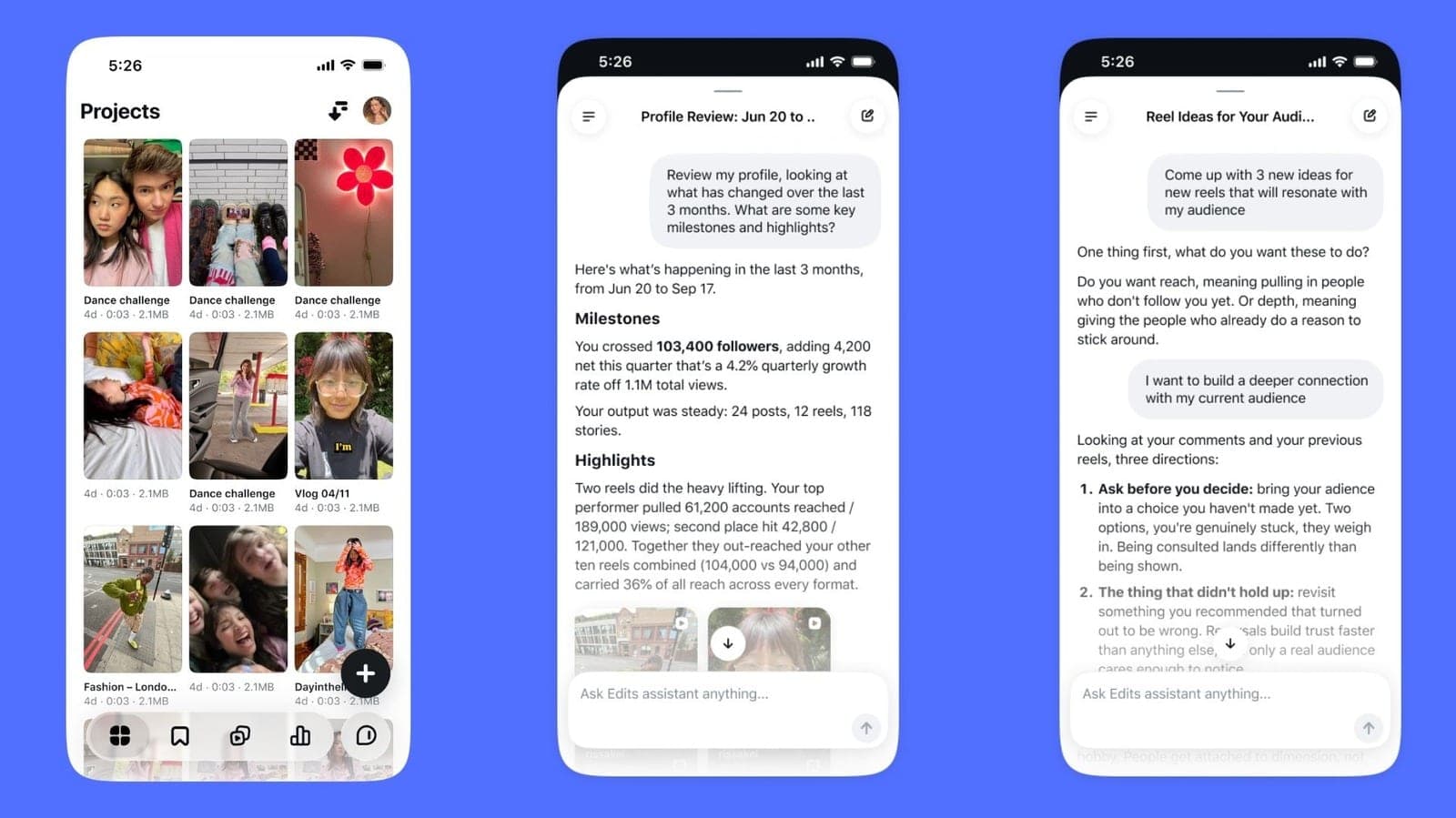
Instagram's new AI tool won't edit your videos, it'll just tell you why they flopped
Instagram rolled out a conversational AI assistant inside Edits, its CapCut competitor, that analyzes your account's performance instead of doing the actual editing for you.

Meta's tax bill dropped 71% while it spent $72 billion on AI
Meta is telling the IRS its AI data centers are experimental, a classification that let its federal tax expense drop from $9.6 billion to $2.8 billion in a single year.
AI's funding problem just moved from the stock market to the bond market
Goldman Sachs tracks nearly $500 billion in AI-related debt issued in 2026 so far, with hyperscalers borrowing at 14 times 2024 levels to fund the AI buildout.
More in brief
- iFixit tears down the iPhone Duo: best foldable repair score, but a screen problemOct 26
- Teradyne Robotics and Sereact team up to put AI-driven robot arms in warehousesOct 25
- Eka Robotics raises $150M for robot hands that feel what they gripOct 24
- Spotify's Family plan now asks some members to scan a QR codeOct 22
- Dream Labs raises $90M and opens a public API for one robot brainOct 22
- Agile Robots launches Agile ONE SN, a small humanoid for research labsOct 22