
Technology·News & analysis
Google shows it can grow quantum computing's rarest ingredient on its Willow chip
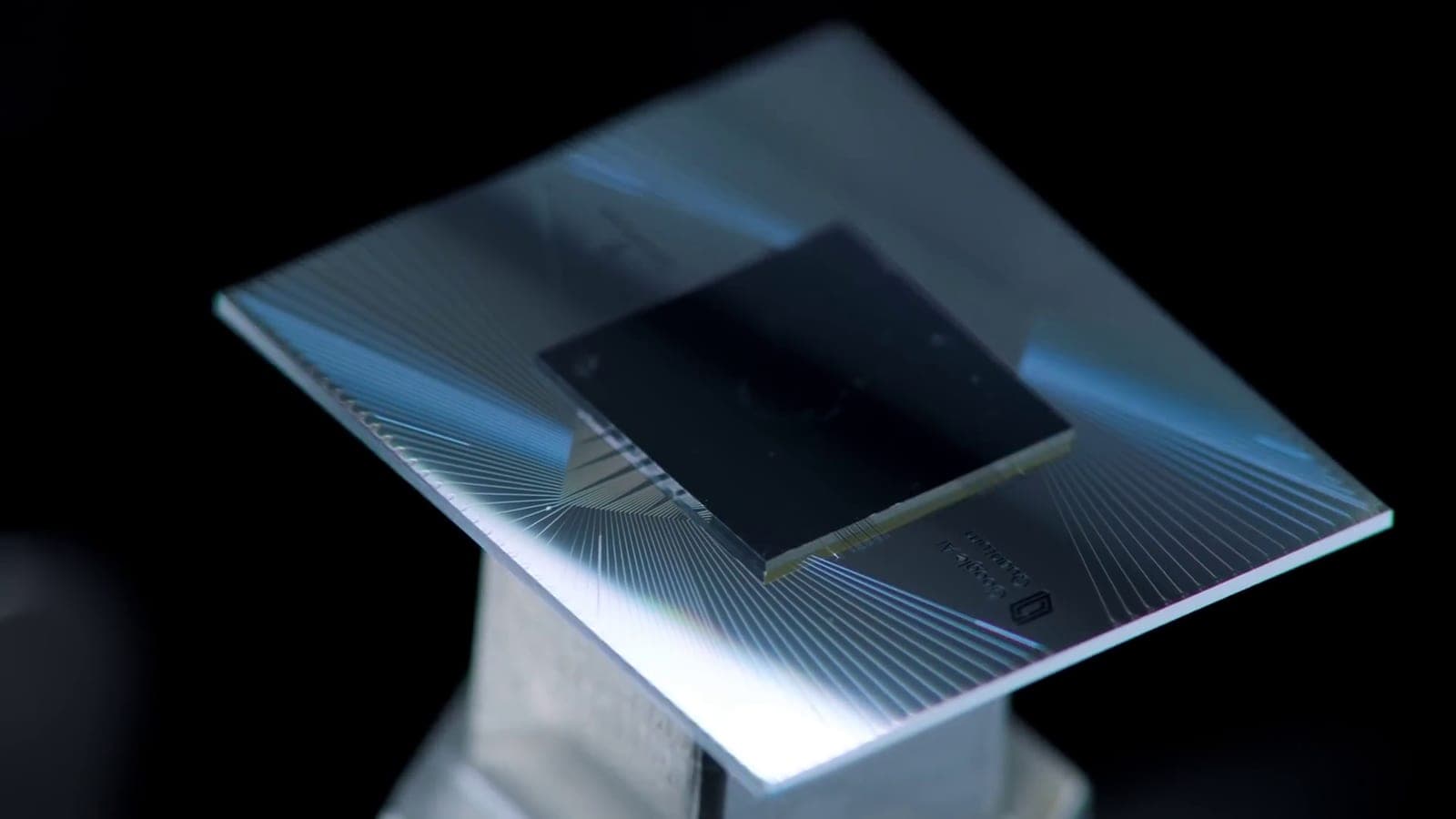
Google Quantum AI says a technique called magic state cultivation cut errors about 40 times on its Willow processor, tackling a bottleneck researchers have worried about since 2004.
Tide
Ripple
Sci-fi
7/10
Reality
Lab
A chip that gardens perfect quantum states, one seedling at a time.How we rate
Google Quantum AI says magic state cultivation, a way to grow very clean quantum states, works on its Willow processor and cuts errors about 40 times.
The resulting states reached a record 99.99% logical fidelity, in a study published in Science. Magic states could eat up to 95% of a future quantum computer's capacity, so cheaper ones mean smaller machines. Google still has to show the method at a much larger scale.
What to know
- Google Quantum AI showed that magic state cultivation works on real hardware, its Willow processor, in a study published in Science.
- The technique cut errors about 40 times compared with states made without it, reaching a record logical fidelity of 99.99%.
- The experiment used 54 of Willow's 105 physical qubits and threw away 92% of attempts in a quality check.
- Practical uses still need far cleaner states: about one error in a million for simulating molecules, versus about one in 10,000 today.
Google Quantum AI announced that a technique called magic state cultivation works on its Willow quantum processor, cutting errors about 40 times. The study is published today in Science. So what is a magic state, and why have physicists been worried about them for 20 years?
Why do quantum computers need help?
Quantum computers promise huge computing power by working through many possibilities at once, Scientific American explains. The machines we have today are still far from that ideal.
The main reason is errors. Qubits, the quantum version of bits, make mistakes often. That keeps today's quantum computers limited, and it's why so much research goes into error correction: ways to spot and fix mistakes while a program runs.
Google says that to reach "universal" quantum computing, where a machine can run any useful program, you need to run and error-correct one specific set of operations. Magic states are the hard part of that set.
First, what's a magic state?
Regular computers build every calculation from a few simple logic gates, like AND, OR and NOT. Quantum computers have their own basic set, called Clifford gates.
Here's the twist. A normal computer can imitate Clifford gates. So on their own, they don't give a quantum computer any special power.
"But there is one particular gate that unlocks the quantum computer's power," Emma Rosenfeld, the study's lead author at Google Quantum AI, told Scientific American. Physicists call it a non-Clifford gate, most often a T gate.
To run a T gate, you need a magic state. That is a qubit set up in a very specific blend of 0 and 1. It gets fed into a calculation and used up.
- Single use: once a magic state is used, it's gone.
- No room for flaws: any error in the state becomes an error in the gate.
- Precision: "It has to be made very, very precisely," Rosenfeld said.
Google's blog puts it simply: you need magic states to go beyond what classical computers can do.
Why are they such a problem?
Making clean magic states is expensive. Researchers saw this coming back in 2004, long before quantum computers were a real engineering project.
By the numbers: some estimates say up to 95% of a quantum computer's capacity could go into making magic states, Google says. That would leave very little room for actual computing.
The standard recipe is called distillation. It takes many imperfect states and boils them down into fewer, more accurate ones. It works, but it's hungry.
Think of it like making maple syrup. You boil a huge pot of sap to end up with a small jar. Distillation is the sap-boiling approach: most of the effort goes into the pot.
For two decades, researchers have been chipping away at that cost.
So how does cultivation work?
In 2024, Google researchers Craig Gidney, Noah Shutty and Cody Jones refined an idea from earlier research into what they named magic state cultivation. It works on a single state instead of many.
Google describes it as a filter:
- Plant: inject a noisy magic state into a small region of the chip.
- Check: run a series of tightly coordinated measurements to look for errors.
- Weed: throw away any attempt that fails a check.
- Grow: spread the states that pass across more qubits for stronger protection.
There's a clever trick in the checking step. Measuring a quantum state usually collapses it, forcing it to pick 0 or 1. So instead of asking "Are you 0 or 1?", Scientific American explains, the team asked: "Are you the right magic state: yes or no?"
That's where the gardening name comes from. The state starts small, gets checked, then grows.
In real life Picture a bakery that only sells perfect croissants. Every batch gets inspected, and anything slightly off goes in the bin. You waste dough, but every croissant on the shelf is flawless. Cultivation makes the same trade.
What did Google actually show?
On paper, cultivation looked great. Making it work on real hardware took a lot more.
The catch: when Rosenfeld first tested the protocol, her data seemed to defy the laws of physics. Eventually she traced it to a wrong assumption in the team's go-to measurement method. Noise from drifting electrical equipment and temperature changes in the lab was skewing the benchmark.
It took months of simulations, discussions with colleagues and consistency checks to find it. Google says the fix required a pivot in both its theory and its engineering.
The fix had two parts. The team added extra control to reduce that noise. Then it invented a new benchmark that uses cultivation to measure itself.
The results, according to Google and Scientific American:
- Errors: about 40 times lower than magic states made without cultivation.
- Fidelity: T-states with a record logical fidelity of 99.99%.
- Before and after: about four faulty states in 1,000 without cultivation, roughly one in 10,000 with it.
- Hardware: 54 of Willow's 105 physical qubits.
Google calls it the first demonstration of a practical solution to one of quantum computing's most severe resource bottlenecks.
The team also showed it could move a purified state between two kinds of error correction. It grafted a state from a distance-3 "color code" (a newer method that suits cultivation) onto a distance-5 "surface code" (the more established one). The state survived the transfer, which suggests the theory fits Google's hardware design.
What do outside experts say?
"The Google experiment shows that cultivation works in practice," Kenneth Brown, director of the Duke Quantum Center at Duke University, told Scientific American. He was not involved in the study.
Brown also pointed out the cost. The quality check rejects low-quality states, and it discards 92% of attempts. That's a lot of croissants in the bin.
How far is this from something useful?
Still a long way. Scientific American lays out the targets:
| Goal | Error rate needed |
|---|---|
| Breaking RSA-2048 encryption | 1 in 10 billion |
| Simulating molecules | 1 in a million to 1 in 100 million |
| Google today | About 1 in 10,000 |
RSA-2048 is the encryption used in website security, banking and electronic ID cards. So no, your bank account is not in danger this week.
Rosenfeld says molecule simulation is the more reachable goal. Google's blog adds that it still needs to show cultivation at a larger scale, and plenty of technical challenges remain.
What's next: the team wants to push toward "near-term scientific applications." In Rosenfeld's words: "We're more galvanized than ever."
For Google, the stated goal is a useful, error-corrected quantum computer that solves problems ordinary machines can't. This result is one step on that road.
What it means for you
- Nothing changes today: this is lab research, not a product. No quantum computer is running your apps.
- Smaller machines, sooner: cheaper magic states could shrink the quantum computer needed for practical tasks, Google says.
- Encryption is safe for now: today's error rates are about a million times too high to break RSA-2048.
- Watch for chemistry: molecule simulation is the first goal researchers call realistic.
The bottom line
Google took a 2024 idea on paper and showed it working on a real chip, with errors cut about 40 times. It's a clear step past a bottleneck physicists have discussed since 2004. The gap to useful machines is still large, but the most expensive ingredient just got a lot cheaper to grow.
Key facts
- Error reduction
- About 40x vs. no cultivation
- Logical fidelity
- 99.99%, a record for T-states
- Qubits used
- 54 of Willow's 105
- Attempts discarded
- 92%
- Published in
- Science, October 15, 2026
Got questions?
Quick answers, plain wordsWhat did Google announce?
Google Quantum AI said it demonstrated magic state cultivation on its Willow quantum processor. The technique reduced errors about 40 times compared with magic states made without it, and the work was published in the journal Science on October 15, 2026.
What is a magic state in quantum computing?
A magic state is a qubit prepared in a very precise blend of 0 and 1. It is used up to perform a special operation, usually called a T gate, that ordinary computers cannot imitate. Without these states, a quantum computer cannot run the full range of useful programs.
What is magic state cultivation?
It is a method proposed by Google researchers in 2024. A rough magic state is placed on a few qubits, checked again and again, and flawed attempts are thrown away. States that pass are spread across more qubits for stronger protection, so the state starts small and grows.
Why are magic states a bottleneck?
Making high-quality magic states takes a lot of resources. Some estimates say up to 95% of a quantum computer's capacity could go into making them, and each one can be used only once.
How much better is cultivation than before?
Scientific American reports that without cultivation about four attempts in 1,000 produced a faulty state. With it, errors fell about 40-fold, to roughly one error in 10,000 attempts. Google says the T-states reached a record logical fidelity of 99.99%.
Which Google chip was used?
The experiment ran on Google's Willow processor. According to Scientific American, it used 54 of the chip's 105 physical qubits.
Can this break encryption now?
No. Scientific American reports that breaking RSA-2048 encryption would need magic states that fail only once in 10 billion tries. The current result is about one error in 10,000.
What is the downside of the technique?
Kenneth Brown of Duke University, who was not involved, notes that the method relies on a quality check that discards 92% of attempts. Google also says it still needs to show cultivation at a much larger scale.
Who led the research?
Emma Rosenfeld, a researcher at Google Quantum AI, is the study's lead author. The cultivation idea came from a 2024 paper by Google researchers Craig Gidney, Noah Shutty and Cody Jones.
Does this affect me today?
Not directly. It is lab research. Its value is that cheaper magic states could make useful quantum computers smaller, which matters for future work like simulating molecules.
SourcesGoogle
Topics and tagsGoogle, AI chips, google, quantum computing
Related stories

Google's Fitbit Edge brings back the screen and a replaceable battery
Google announced the Fitbit Edge, a $179.99 tracker with a bright display, GPS and a battery you can swap. It reaches stores on October 27.
Hackers hijacked three country domains to get fake Google certificates
Attackers took over the .gh, .sl and .as registries, rewrote DNS records and got real certificate authorities to issue HTTPS certificates for Google and other big brands. Chrome has blocked the ones Google found.
Google signs a deal to squeeze 890 MW more out of Constellation's nuclear plants
Google will be the anchor customer for upgrades at six existing nuclear plants in Illinois, Pennsylvania and New Jersey, adding power to the grid by 2032. Constellation will also use Google's Gemini Enterprise to run the work.
More in brief
- Anthropic gives six METR researchers employee-like access to check its AIOct 15
- FTC subpoenas OpenAI and Anthropic over AI safety incidentsOct 15
- E Ink's Kaleido 4 brings richer color and video to future e-readersOct 15
- Volvo picks Nvidia to bring hands-free, door-to-door driving by 2030Oct 15
- Bank of America hired 1,000 contractors to patch bugs that AI models foundOct 15
- Microsoft takes down a phishing marketplace behind 1 billion scam messagesOct 15