
Robots·News & analysis
Figure retired its BMW factory robots by having them jump into molten steel
Figure decommissioned its F.02 humanoid robots after 11 months building BMW X3s, sending them off with a Terminator 2-style melt into a foundry furnace, an idea Arnold Schwarzenegger suggested.
Tide
Ripple
Sci-fi
9/10
Reality
Shipping
Robots trained to walk into molten steel, on purpose.How we rate
Figure retired its F.02 humanoid robots after 11 months building BMW X3s at a South Carolina plant.
It sent them off by training them to autonomously walk into a 75-ton furnace at a Finnish foundry, an idea Arnold Schwarzenegger suggested as a nod to Terminator 2. Behind the theatrics is a real commercial robotics milestone: more than 30,000 vehicles built, 90,000 parts loaded, and 99% placement accuracy. Figure's next robot, F.03, now takes over that same real factory work with a redesigned wrist.
What to know
- Figure retired its F.02 humanoid robots after an 11-month deployment at BMW's Spartanburg, South Carolina plant, where they helped build more than 30,000 BMW X3 vehicles.
- The F.02 fleet logged over 1,250 hours of runtime, loaded more than 90,000 sheet-metal parts, and walked roughly 1.2 million steps, about 200 miles, on the job.
- Instead of disassembling the robots, Figure trained F.02 units to autonomously walk off a platform into a 75-ton electric arc furnace at a foundry in Imatra, Finland.
- Arnold Schwarzenegger suggested the melting sendoff in response to CEO Brett Adcock's public request for ideas, referencing the ending of Terminator 2.
- Metal from the melted robots is being turned into limited-edition commemorative artifacts, while F.03, Figure's next-generation robot with a redesigned wrist, takes over active deployment.
Figure just retired its first commercially deployed humanoid robot fleet the same way Arnold Schwarzenegger's most famous character met his end: walking calmly into a vat of molten steel.
What did F.02 actually accomplish at BMW?
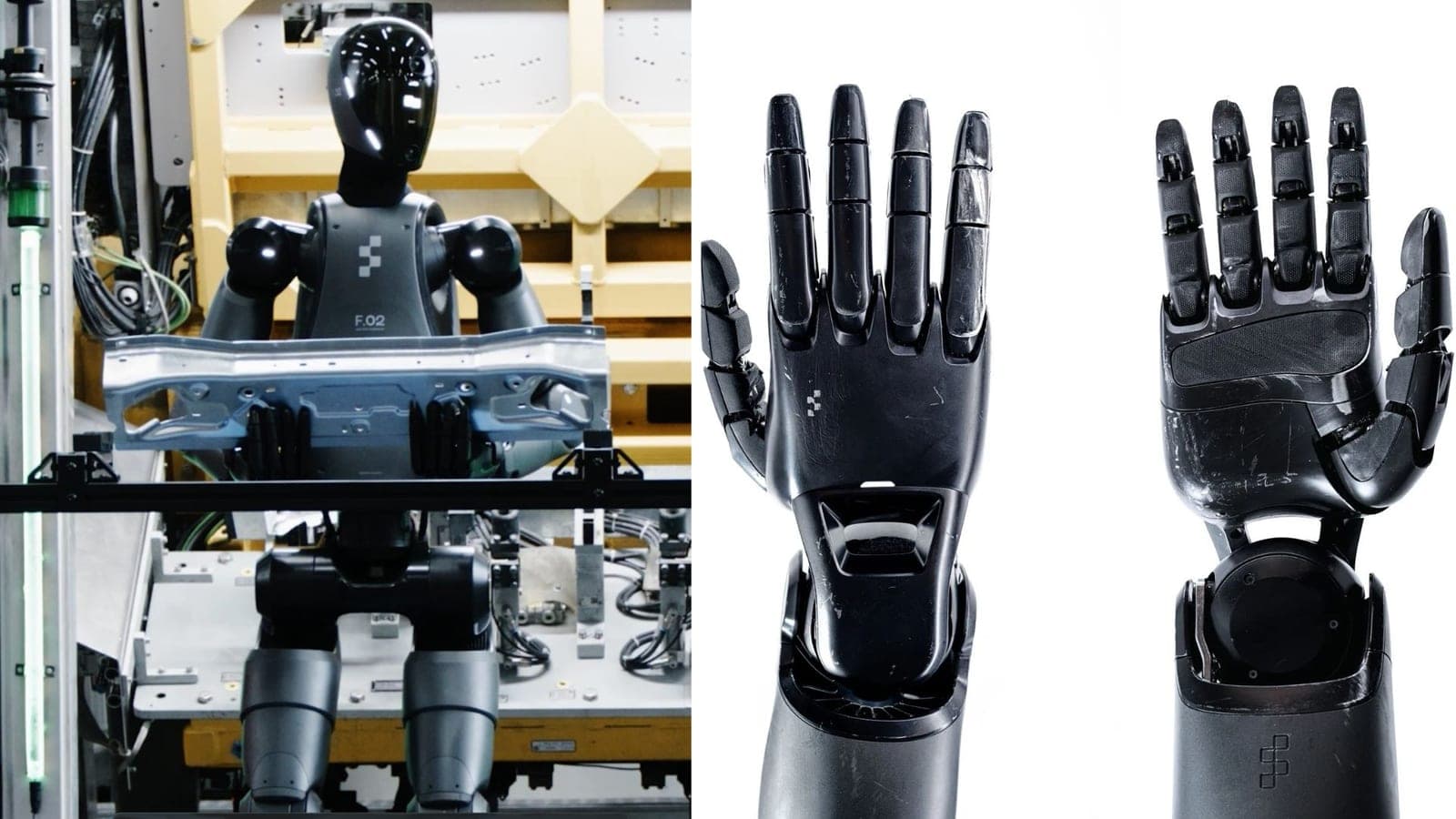
Figure's F.02 humanoid robot spent 11 months working at BMW Manufacturing's plant in Spartanburg, South Carolina, performing sheet-metal loading. The job: pick parts from bins and place them onto welding fixtures with 5-millimeter tolerance accuracy, before traditional industrial robotic arms handled the actual welding.
By the numbers, that deployment was genuinely substantial:
- 1,250+ hours of accumulated runtime.
- 30,000+ BMW X3 vehicles built.
- 90,000+ sheet-metal parts loaded.
- ~1.2 million steps, roughly 200 miles, walked on the job.
- 99%+ placement accuracy, with an 84-second work cycle (37 seconds dedicated to loading).
Why it matters: those aren't demo numbers or a curated highlight reel. Eventually running 10-hour shifts, Monday through Friday, F.02 was doing real, sustained, measurable factory work on an actual production line, exactly the kind of evidence the humanoid robotics industry has struggled to produce at scale until fairly recently.
Why retire F.02 now?
The catch: Figure said that as its next-generation F.03 fleet expands, continuing to maintain the older F.02 units simply "no longer makes sense." That's a practical, unsentimental reason, not a claim that F.02 failed.
Figure identified F.02's forearm as its top hardware failure point, the result of packing three degrees of freedom, thermal constraints, and dynamic cabling into a tight mechanical space. F.03 addresses that directly with a full wrist re-architecture, eliminating the distribution board and dynamic cabling so motor controllers communicate straight to the main computer instead.
How did Figure actually decommission the robots?
Rather than disassembling the robots to protect proprietary actuators and other intellectual property, Figure trained F.02 units to autonomously walk off a platform into a 75-ton electric arc furnace at a foundry in Imatra, Finland. The AI models guiding that walk were informed by actual stunt artist movement data, and the whole process ran across six melts within a 24-hour window.
In real life it's the corporate-robotics equivalent of a company shredding old hard drives instead of just deleting the files, except here the "shredder" is a foundry furnace and the whole thing doubles as the best sendoff video a robotics team could ask for.
Whose idea was this, exactly?
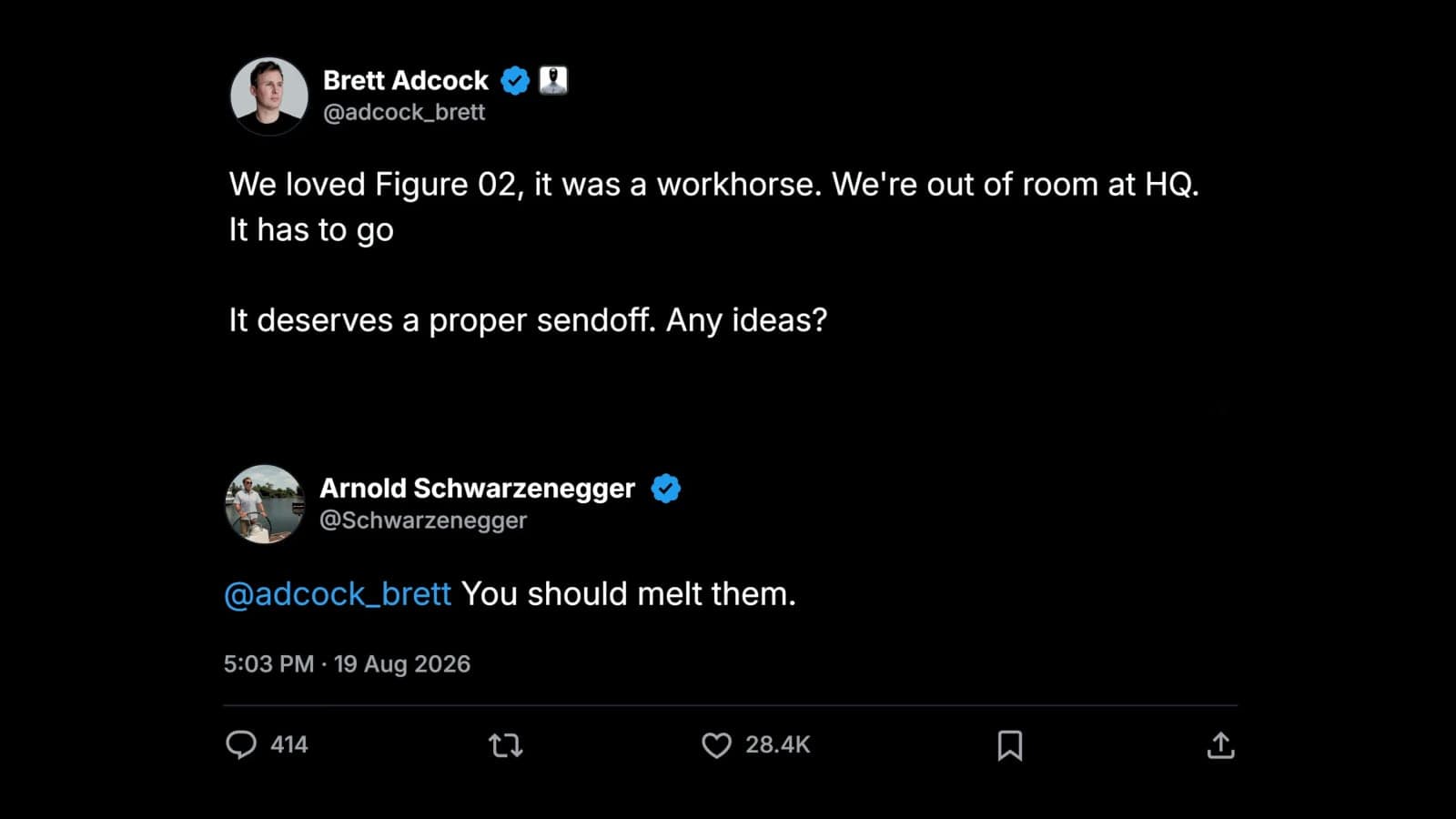
Background: Figure CEO Brett Adcock posted publicly asking for sendoff ideas for the retiring fleet, writing: "We loved Figure 02, it was a workhorse. We're out of room at HQ. It has to go. It deserves a proper sendoff. Any ideas?"
Arnold Schwarzenegger replied directly: "You should melt them." The reference is unmistakable, both the T-1000 and Schwarzenegger's own T-800 character meet identical fates at the end of Terminator 2: Judgment Day, sinking into molten steel at a foundry.
What happens to the melted robots now?
Figure is having the metal from the melted F.02 units machined into limited-edition commemorative artifacts, which will be made available for purchase. A small number of F.02 units were spared entirely and remain in storage at Figure's headquarters rather than going through the melt.
Is F.03 actually different, or just newer?
Why it matters: the forearm and wrist redesign isn't a cosmetic update, it's a direct response to F.02's most common real-world hardware failure. Figure described F.03 as "ready for the world at scale," positioning it as the robot that inherits everything F.02 proved was possible, sustained factory work with high accuracy, while fixing the specific mechanical weak point that limited F.02's long-term reliability.
Background: F.02's run wasn't just about BMW either. Figure credits the F.02 era with several company firsts: the original BMW deployment itself, the creation of its Helix AI model, early household chore capabilities, and Figure's first logistics deployment, making F.02 the fleet that established humanoid robotics as viable commercial infrastructure rather than a lab curiosity.
How big of a company is Figure, and why does that matter here?
Background: Figure was founded in 2022 by Brett Adcock, who previously co-founded the recruiting company Vettery and the electric aircraft maker Archer Aviation. The company's valuation has climbed sharply as its commercial deployments have grown, from $2.6 billion in February 2024 to $39 billion in its most recent Series C round, a roughly fifteenfold increase backed by investors including NVIDIA, Brookfield Asset Management, Salesforce, and Qualcomm Ventures.
That funding has translated into real manufacturing capacity. By April 2026, Figure's own BotQ factory was reportedly producing a new robot roughly every 90 minutes, scale that matters directly for this story: it's part of why maintaining an aging F.02 fleet stopped making sense once F.03 production could realistically replace it.
Why it matters: a company burning through billions in funding to prove humanoid robots can do real factory work has a lot riding on deployments like BMW actually working. F.02's retirement, framed around genuinely strong performance numbers rather than failure, is exactly the kind of result Figure needs investors and future customers to see, especially heading into whatever comes next for the company's funding and growth plans.
Is Figure the only company racing to prove humanoid robots work in factories?
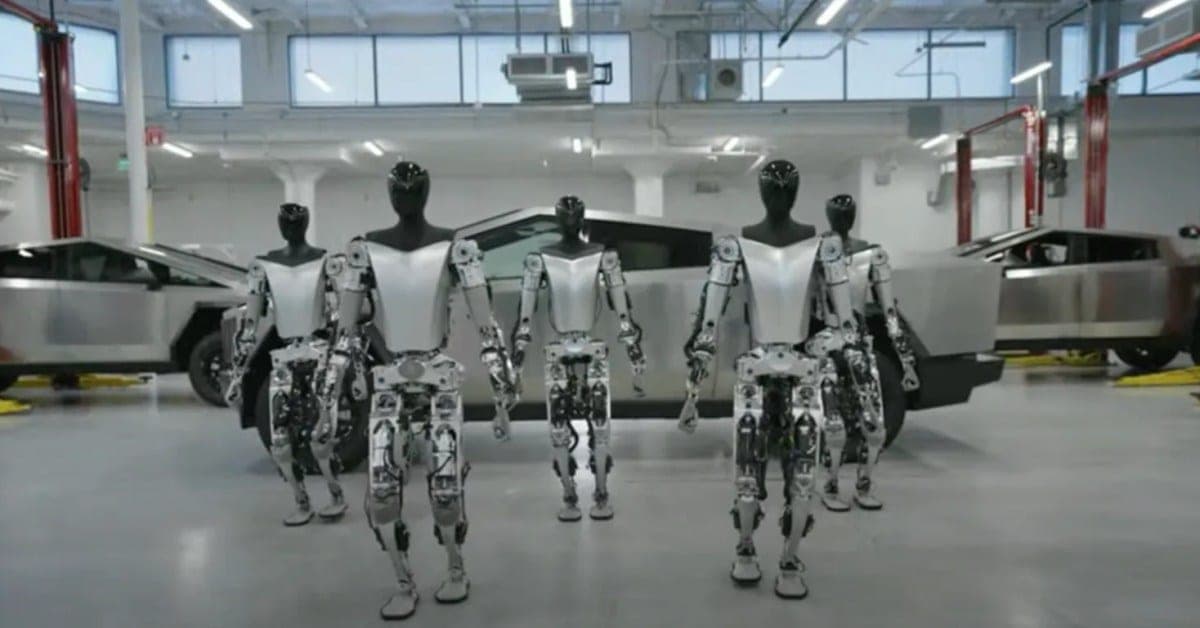
Background: absolutely not. Tesla has been developing its own humanoid robot, Optimus, with its own ambitious production and deployment claims, and multiple Chinese robotics companies have also been racing hard to bring humanoid robots to market at competitive speed and cost. The humanoid robotics field broadly has shifted from research demos toward this kind of head-to-head competition over actual commercial deployments in the past couple of years.
Why it matters: in that context, F.02's real, measurable BMW results, tens of thousands of vehicles, sustained shift work, accuracy north of 99%, function as concrete evidence in a market still full of promises and prototypes. A viral Terminator-themed sendoff draws attention, but the underlying numbers are what actually separates Figure's claims from competitors still working mostly in controlled demos rather than real, unscripted factory floors.
What it means for you
- This isn't a story about a robot failing. F.02's retirement is a planned hardware transition after a genuinely successful commercial run, not a sign the technology didn't work.
- The molten steel sendoff is real, not an AI-generated stunt or a hoax. It's an official announcement from Figure's own site, deliberately leaning into the theatrical presentation around a real hardware milestone.
- Watch F.03 for the next round of real deployment numbers. If Figure's wrist redesign holds up, expect F.03 to extend F.02's factory results with fewer hardware failures over time.
- The commemorative artifacts are a genuine collectible, if you're interested in robotics history, this is a rare case of a piece of a real, working humanoid robot fleet becoming a purchasable object.
The bottom line
Underneath the Terminator theatrics is a real, well-documented humanoid robotics success story: a fleet of robots that worked real 10-hour shifts on a real BMW assembly line for nearly a year, building tens of thousands of actual cars with accuracy north of 99%.
Figure clearly understood that milestone deserved more than a quiet spec-sheet retirement, and turning it into a viral, Schwarzenegger-approved sendoff is a reminder that even serious industrial robotics companies know exactly how to make people pay attention when they've actually got something to show for it.
Key facts
- Deployment length
- 11 months at BMW Spartanburg, SC
- Vehicles built
- 30,000+ BMW X3s
- Parts loaded
- 90,000+ sheet-metal parts
- Placement accuracy
- 99%+
- Sendoff
- Melted in a 75-ton furnace, Imatra, Finland
Got questions?
Quick answers, plain wordsWhat was Figure's F.02 robot, and what did it actually do?
F.02 was Figure's humanoid robot deployed at BMW's Spartanburg, South Carolina manufacturing plant, where it performed sheet-metal loading, picking parts from bins and placing them onto welding fixtures with 5-millimeter tolerance accuracy, before traditional industrial robotic arms handled the welding.
How long was F.02 actually working at BMW, and how well did it perform?
F.02 worked for 11 months, eventually running 10-hour shifts Monday through Friday. It logged over 1,250 hours of runtime, helped build more than 30,000 BMW X3 vehicles, loaded over 90,000 sheet-metal parts, and achieved over 99% placement accuracy with an 84-second work cycle.
Why did Figure retire F.02 instead of continuing to use it?
Figure said that as its next-generation F.03 fleet expands, continuing to maintain the older F.02 units no longer made sense, given F.03's redesigned hardware addresses reliability issues F.02 had, particularly around its forearm and wrist.
How did Figure actually decommission the robots?
Rather than disassembling the robots to protect proprietary components, Figure trained F.02 units to autonomously walk off a platform, using AI models informed by stunt artist movements, into a 75-ton electric arc furnace at a foundry in Imatra, Finland, melting them down across six melts within a 24-hour window.
Whose idea was the molten steel sendoff?
Arnold Schwarzenegger suggested it. Figure CEO Brett Adcock publicly asked for sendoff ideas for the retiring F.02 fleet, and Schwarzenegger replied suggesting they be melted, a direct reference to the ending of Terminator 2: Judgment Day, where both the T-1000 and Schwarzenegger's own T-800 character are destroyed in molten steel.
What happens to the melted robot metal?
Figure is having the metal from the melted F.02 units machined into limited-edition commemorative artifacts, which will be available for purchase. A small number of F.02 units remain in storage at Figure's headquarters rather than being melted.
What was wrong with F.02's hardware that F.03 fixes?
Figure identified the forearm as F.02's top hardware failure point, caused by the complexity of integrating three degrees of freedom, thermal constraints, and dynamic cabling in a small space. F.03 addresses this with a complete wrist re-architecture, eliminating the distribution board and dynamic cabling so motor controllers communicate directly with the main computer.
Is F.03 already deployed?
Figure has positioned F.03 as its production-ready robot for wider deployment, describing it as ready for the world at scale, taking over the kind of commercial work F.02 pioneered at BMW.
Is this Figure's first commercial humanoid robot deployment?
The F.02 deployment at BMW represented major milestones for Figure, including the company's first BMW deployment, the creation of its Helix AI model, early household chore capabilities, and its first logistics deployment.
Is this a real, official announcement, or a marketing stunt someone made up?
It's a genuine, official announcement published directly on Figure's own website, though the company clearly leaned into the theatrical, Terminator-referencing presentation deliberately, treating a real hardware retirement as an opportunity for a memorable sendoff.
SourcesFigure
Topics and tagsHumanoid robots, Industrial robots, figure, humanoid robots
Related stories
Tesla ramps Optimus to hundreds a week, but its hands are the bottleneck
Tesla has scaled Optimus production roughly tenfold since Q2, but the robot's hands still need hand assembly and its touch sensors aren't holding up, The Information reports.
A data company just built a lab whose only job is teaching robots to move like us
Innodata opened a motion-capture lab in New Jersey, built with Vicon, that captures sub-millimeter 3D movement data to train humanoid and industrial robots how to move more naturally.
Flourish One is a $3,555 home robot you teach chores with your phone
Startup Flourish is selling its first 50 Flourish One robots for $3,555 each, a Raspberry Pi-powered home helper you train by moving your phone to demonstrate a task.
More in brief
- California will fine robotaxi companies that block first responders for over 30 minutesOct 2
- Microsoft launches real-time transcription and new voice models for AI voice agentsOct 1
- Apple's smart home hub reportedly launches October 13, with a camera that never records videoOct 1
- Cloudflare releases Clef, open-weight AI models that make yes-or-no decisions fastOct 1
- GrayKey maker reportedly found a way around the iPhone's Inactivity RebootOct 1
- Fervo's Cape Station becomes the first enhanced geothermal plant to sell power commerciallyOct 1