
Technology·News & analysis
Enough Phone brings a 5.3-inch Android phone to Kickstarter
A new company says people still want small phones. Its Enough Phone has a 5.3-inch screen, a battery you can swap, and a choice between regular Android and a stripped-down mode.

Tide
Ripple
Sci-fi
3/10
Reality
Demo
A phone that fits in a hand, which feels almost retro.How we rate
Enough Phone opened a Kickstarter campaign on November 4 for a compact Android phone with a 5.3-inch screen, a removable battery and a mid-range MediaTek chip.
Early backers pay from $399, with a planned final price of $599. Buyers can pick standard Android 17 or OdysseyOS, a limited version that blocks social media. Shipping is planned for May 2027, and crowdfunded hardware can slip or fail to arrive.
What to know
- Enough Phone opened a Kickstarter campaign on November 4 for a 5.3-inch Android phone, with shipping planned for May 2027.
- Early backer prices start at $399 and rise through the campaign, and the final price is planned at $599.
- Buyers pick Android 17 or OdysseyOS, a limited version of Android that blocks social media, games and browsers.
- The battery is removable, and the company promises software updates through 2032.
Enough Phone just put a very small phone on Kickstarter. The pitch is simple: lots of people say they want a compact phone, so will they pay for one?
That is the fun question here, because the big phone makers decided the answer was no a few years ago.
What is the Enough Phone?
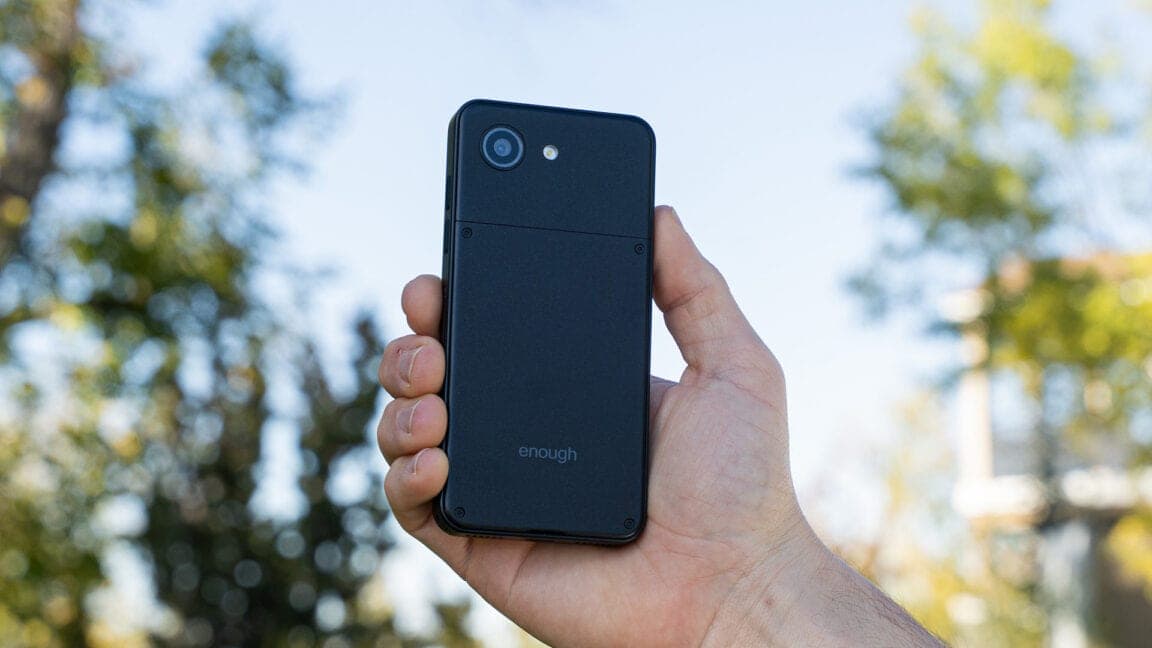
The Enough Phone is an Android phone with a 5.3-inch screen. Most phones today have screens around 6.3 inches, so this one is noticeably smaller.
It is built for people who liked the old compact phones. The footprint is almost the same as the iPhone 13 mini, which Apple stopped making years ago.
The campaign went live on November 4, and shipping is planned for May 2027.
What is inside it?
This is a mid-range phone, and the company does not hide that. It is not trying to win a spec race. Here is what it has:
- Chip: a MediaTek Dimensity 7500, a mid-range processor.
- Memory: 8 GB of RAM and 128 GB of storage, plus a microSD slot that shares space with the second SIM tray.
- Screen: a 5.3-inch display at 1,520 by 720 pixels, which works out to about 317 pixels per inch.
- Cameras: one 50 MP Sony camera on the back and a 32 MP camera on the front.
- Connectivity: 5G, Wi-Fi 6, Bluetooth, NFC for tap-to-pay, and eSIM support.
- Body: polycarbonate, which is a tough plastic. The fingerprint sensor sits in the power button.
There is only one rear camera, so do not expect a flagship photo kit. The phone is also about 12 millimeters thick, while the iPhone 17 is 7.8 millimeters. That thickness has a purpose.
Why is it so thick?
Because the battery is built to come out. Four Torx screws hold the back on, so you can open it with a small screwdriver, much like on a Fairphone, a Dutch phone known for repairability.
The company is aiming for a battery of 3,500 to 4,000 mAh. That is a big battery for a phone this small, and it should help with all-day use. The final size is not locked in yet.
A swappable battery also fits the direction of upcoming European Union rules, which push phone makers toward batteries that people can replace.
In real life Think of a phone you keep for five years. In year three, the battery gets tired. On this phone, you buy a new one, undo four screws and carry on.
Which software does it run?
You get a choice when you order. The first option is regular, Google-certified Android 17, with all the usual apps. Most people will probably pick this one.
The second is OdysseyOS, made by a company called Sleke. It is a spin on Android, which is the system most phones run, built to behave like an old-fashioned dumb phone.
OdysseyOS keeps the useful apps, such as Uber, Spotify, WhatsApp, banking, smart home and two-factor codes. It blocks browsers, news apps, social media, games and video apps. Sleke curates its own app store, and you can ask for an app to be added, but Sleke makes the final call.
For messages, you can use Beeper, an app that gathers your chats in one place. For searching, there is a text-only search bar powered by Perplexity, an AI search service. It also scans QR codes.
The team behind the phone expects most buyers to pick OdysseyOS. Switching between the two later might be possible, but that is not confirmed.
Who is behind it?
The Enough Phone comes from a trio: Austin Boer, Brennan Jordan and William Stults. Boer and Jordan run Sleke, founded in 2024, which sells refurbished Google Pixel phones with OdysseyOS on them. Stults helps run Dumbwireless, a shop that sells dumb phones with a phone plan.
They say they have no direct background in the phone industry, though some of Sleke's engineers do. The team also says it has designed and shipped hardware for other well-known companies, working as an original design manufacturer, which means building a product that another brand sells.
This is, however, the first phone the group is making under its own name.
What does it cost?
Kickstarter prices work in tiers. Early backers get the best deal, and it rises as the campaign goes on.
- First tier: $399 for a limited time.
- Later tiers: $449, then $499.
- Planned final price: $599.
The team says the price is shaped by what it could fit. That is why there is no headphone jack: space inside is tight, and the team wanted to stay under $600.
The big picture: component costs have been rising across the industry, so a new phone at these prices is not a bargain-bin product. It is a niche device priced as one.
What are the risks?
You are backing an idea, not buying a finished phone. Several details are still open:
- Water and drop ratings: not decided yet.
- Battery size: could still change, though the team hopes it goes up, not down.
- Carrier support: it is expected to work on T-Mobile, and the company plans to get it certified on AT&T. Verizon support is unclear.
- Camera quality and battery life: both unknown until real units exist.
The catch: plenty of Kickstarter projects ship late, and some never ship at all. A May 2027 date is six months away, and the Enough Phone team has not shipped a phone under its own brand before.
On updates, the company plans to support the phone through 2032. That is a long time for a small company. Some big Android makers promise seven years, so the pledge is solid on paper, but a promise from a new brand is harder to count on than one from Samsung or Google.
Is there a market for small phones?
The team thinks so. Apple stopped selling its Mini model in 2023 because of poor sales. Sony dropped its compact Xperia line in 2023. Asus, one of the few makers of small Android phones, paused its mobile business early this year.
Smaller companies are filling the gap. Unihertz makes tiny phones with keyboards. Clicks is launching the Communicator in December, a 4-inch Android phone with a keyboard. Light Phone III, Minimal Phone and Mudita Kompakt aim at people who want fewer distractions.
The Enough Phone sits between those worlds. It runs normal apps if you want them, or a calmer version if you do not.
The founders are open about their target. They are not chasing the huge phone market. They point to the loyal fans who kept using the iPhone Mini.
"What's not a success for Apple could be a home run for us," Jordan says.
Stults adds that the goal is a phone people keep. "We're really hoping this could be a five-year phone for people," he says.
What it means for you
- If you want a small phone: this is one of the few new options, with the usual crowdfunding risk attached.
- If you back it: pay only what you can afford to wait on, because delivery is planned for May 2027.
- If you want fewer distractions: OdysseyOS is built for that, and you can still keep rides, banking and chat.
- If you need a specific carrier: check the support list before you pledge.
The bottom line
The Enough Phone is a small bet on a simple idea: some people just want a phone that fits in one hand. It is mid-range, repairable and a little unusual.
Whether enough people want it is the question the campaign will answer.
Key facts
- Screen
- 5.3 inches, 1,520 x 720
- Price
- From $399, final $599
- Software
- Android 17 or OdysseyOS
- Shipping
- May 2027 (planned)
Got questions?
Quick answers, plain wordsWhat is the Enough Phone?
It is a small Android phone with a 5.3-inch screen from a new company called Enough Phone. It is built for people who find modern phones too big.
How much does the Enough Phone cost?
Early backers on Kickstarter pay from $399, and the price rises to $449 and then $499 as the campaign goes on. The planned final price is $599.
When will the Enough Phone ship?
Shipping is planned for May 2027. That date is a target, not a promise, because the phone is not built yet.
How big is the screen?
The screen is 5.3 inches, with a resolution of 1,520 by 720 pixels. Most phones today sit at around 6.3 inches.
Can you replace the battery?
Yes. Four small Torx screws hold the back cover on. Remove them and you can swap the battery, which is expected to hold 3,500 to 4,000 mAh.
What is OdysseyOS?
It is a version of Android from a company called Sleke. It keeps useful apps such as banking and maps, and blocks social media, games, browsers and news apps.
Does the Enough Phone have a headphone jack?
No. The team says there was not enough room inside, and it wanted to keep the price under $600.
How long will it get software updates?
The company plans to support the phone through 2032. That is long, though many big Android makers now promise seven years.
Will it work on my carrier?
It is an unlocked 5G phone. It is expected to work on T-Mobile, and the company plans to certify it on AT&T. Support on Verizon is unclear.
SourcesEnough Phone
Topics and tagsSmartphones, smartphones, android, kickstarter
Related stories

Suspected Russian hackers used old iPhone and Android bugs on fake sites
Security firm Sekoia says a group linked to Russia's foreign intelligence service used already-patched flaws to hit phones that visited booby-trapped sites.
iPhone Duo pre-orders open Friday at 5 a.m. PT, starting at $1,999
Apple's first foldable iPhone goes up for pre-order on October 16, with new cases, trade-in credits and a $57.99 monthly lease to soften the price.
Amazon's Alexa Tablets start shipping today with full Android and Google Play
The new 12 Pro, 11 and 8 replace the Fire tablets after about 15 years. They run Android 16 with the Play Store built in, start at $229.99, and put Alexa+ on every screen.
More in brief
- Tencent's Hy4 can now see images and operate a computerNov 5
- SpaceX picks Qualcomm chips for Starlink Mobile's US 5G networkNov 4
- VMware brings back a low-cost server product called vSphere ExpressNov 4
- Microsoft says Windows 11 now runs up to 40% faster on 8 GB PCsNov 4
- Google will switch off AI and Search for school accounts until schools opt inNov 3
- Peak Design, the backpack maker, now sells a $100 wireless charger and $25 cablesNov 3