
Robots·News & analysis
A Caltech robot built part of a structure in orbit, on its own
A small robot named ASTRA has assembled a new section of a truss in orbit with no astronauts. It is the first time a structure was built that way, DARPA says.

Tide
Ripple
Sci-fi
8/10
Reality
Demo
Flat-pack furniture, but the delivery goes to orbit.How we rate
DARPA and Caltech say a robot named ASTRA has made the first automated assembly of a structure in space, building a third truss section in orbit without astronauts.
The robot flew with two sections already built and will not finish its planned 11-section antenna before the mission ends in December. Still, the test shows a path to antennas and telescopes far bigger than any rocket can carry. DARPA's next test, a composite-making experiment, flies to the space station later this year.
What to know
- DARPA and Caltech say ASTRA is the first automated assembly of a structure in space, with no astronauts involved.
- The robot launched on March 30, 2026, with two truss sections already built, and then assembled a third section on its own.
- It will not finish the full 11-section antenna before the mission ends in December, but the team says the method is proven.
- Engineers could talk to the robot only about 15 minutes at a time, seven or eight times a day.
DARPA announced that a robot built by Caltech has put together part of a structure in orbit with no astronauts. DARPA calls it the first automated assembly of a structure in space.
That is the news. Now the fun part: how do you build something in orbit when your only helper is a robot you can phone for 15 minutes at a time?
What did the robot actually build?
The robot is called ASTRA, short for Autonomous In-Space Tensioned Reflector Assembly. Caltech built it, and DARPA, the research arm of the US Department of Defense, paid for it.
It was meant to build a reflector antenna, a dish-shaped surface that collects or sends radio signals, 1.4 meters wide. The frame of that dish is a truss. A truss is a light frame made of straight tubes joined at points, like a crane arm or a bridge.
Each repeating piece of the truss is called a bay. ASTRA flew with two bays already built. Then it assembled a third bay by itself, in orbit.
DARPA says this is the first time a structure has been built in space by an automated system, with no astronauts connecting the pieces.
How does the robot work?
It is simpler than you might think. DARPA describes a relatively simple gantry robot, a machine that slides along three straight lines, like a crane over a workbench.
It picks up composite tubes (strong, light tubes made of fibers) and aluminum connectors from storage dispensers. It joins them into a new bay. Then it pushes the finished bay outward and starts the next one.
DARPA's program manager, Andrew Detor, says the plan is to build things the way you build with toys. "You can think of the Caltech approach as similar to Tinkertoys or K'nex construction toys," he said.
In real life Think of a flat-pack bookshelf. The box is small and easy to ship. You build the shelf where you want it. ASTRA does the same, except the shelf is a space antenna and the living room is orbit.
Why build in orbit at all?
Today there are two ways to make a big space structure. Both have limits, and DARPA says so plainly.
- Build it on Earth: the whole thing must fold up to fit inside the rocket's nose cone, called the fairing. That caps its size.
- Build it by hand in space: astronauts join big pieces that were sent up over several launches. That is slow and costly.
A third way is to ship a box of parts and let a robot put them together. Caltech's Sergio Pellegrino, who leads the ASTRA demonstration, puts it simply: "Once you get to the size limit where structures cannot be prebuilt on the ground and unfolded, you have to think about how to build them in space."
Why it matters: DARPA wants structures hundreds of meters or even kilometers across. "Nothing approaching that scale can be achieved today," Detor said.
How did the robot get to space?
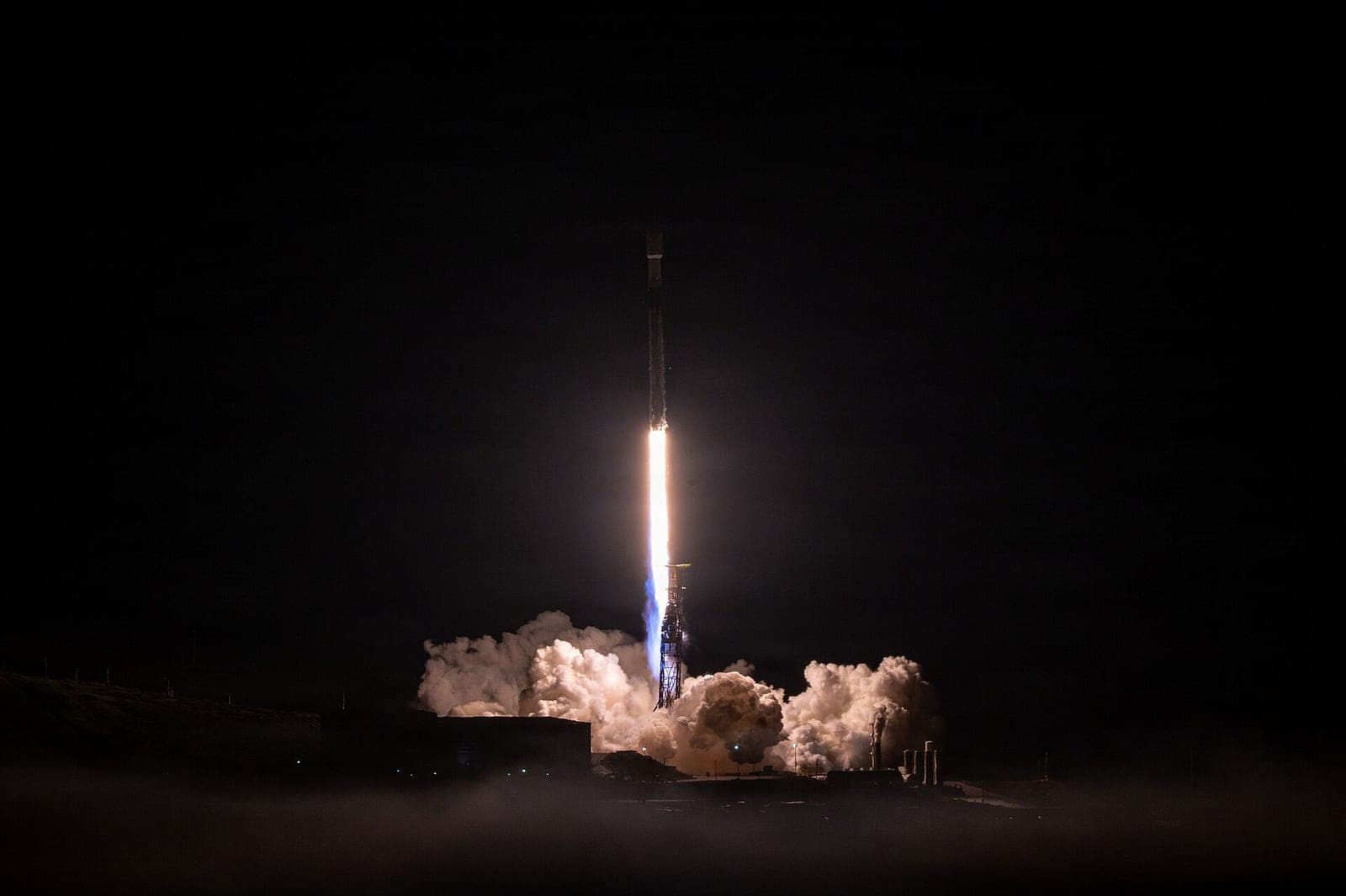
ASTRA launched on March 30, 2026, on SpaceX's Transporter-16 mission from Vandenberg Space Force Base in California. Transporter missions are shared rides, where many small customers split one rocket.
It rode on Momentus's Vigoride 7 vehicle, which carried 10 payloads, meaning 10 separate experiments, into low Earth orbit. That is the zone a few hundred miles above the ground where most satellites fly.
ASTRA filled about one cubic meter. In that small box were the two pre-built bays, a robotic arm and the dispensers loaded with parts for the rest.
Momentus hosted the payload and provided communications, power and imaging during the test. Another SpaceX story from this week shows how busy that company's schedule has become.
How fast was this done?
Very fast for space hardware. DARPA says the program was not first planned around a flight at all.
When good results came in during the second phase of the program, Detor decided to pivot the last phase to a real space test. "We went from the idea of an on-orbit demo to launching a working prototype into space in 15 months," he said.
The Caltech team had even less time for the hardware itself. They had under 12 months to build, test and deliver it to Momentus. Pellegrino called it "an enormous undertaking for our small team."
- Phases 1 and 2: the team worked out the idea and the design, and tested it in labs on Earth.
- Phase 3: the space test, launched in March 2026.
What went wrong, and how was it fixed?
Space is not forgiving. Some things went wrong, and the team had to solve them from the ground.
The engineers could contact ASTRA only about seven or eight times a day, and each window lasted about 15 minutes. Three people sent the commands: Charles Sommer, Alan Truong and graduate student Tara Venkatadri.
The robot did the assembly automatically. But the team watched photos sent from orbit. When a step failed, they studied the pictures and tried again.
To find fixes, they used a twin. A spare copy of ASTRA sits in Pellegrino's lab at Caltech. "Every time we confirm there is an issue in space, we come to the laboratory and try to mimic the problem on the ground," Sommer said.
The catch: because of these problems and limited time, ASTRA built only one bay, not the whole antenna.
Jaden Suh, a former Caltech postdoctoral scholar who is now a professor at the University of Texas at Austin, said the setbacks are the point of a test like this. "There are a lot of differences in the space environment compared to down on Earth," he said. "There are always lots of little surprises."
What is the special reflective film?
The full design is more than a frame. After building a bay, ASTRA is meant to attach a thin film full of tiny holes. It forms two nets that are pulled against each other by springs, which keeps the surface in shape.
Caltech and the University of Pennsylvania invented the film together. Professor Igor Bargatin led the Penn team. The film is lighter than the knitted metal mesh used on many folding antennas. It needs less tension, so the frame holding it can be lighter too.
Light matters because every extra kilogram makes a rocket's job harder. The full ASTRA design has 11 connected bays, each attached to the nets and pushed outward.
What is still unfinished?
The mission ends in December. The team does not expect ASTRA to finish all 11 bays by then.
Even so, Caltech says the test taught the team ways to simplify the robot and the building steps. The team believes it has enough evidence that the method works.
DARPA stresses that this is not the end. "The NOM4D Caltech demonstration is not an endpoint; it's a beginning," Detor said.
There is one more NOM4D milestone ahead. Later this year, a team from the University of Illinois Urbana-Champaign will send a project to the International Space Station. It will not assemble anything. It will test a special resin, a liquid plastic that hardens, to make a strong composite part in space with little energy.
What could this lead to?
Detor lists some ideas: large space depots or habitats, big solar arrays and huge radio antennas. Each needs size, which a rocket's fairing does not allow.
Caltech adds big telescopes, which gather more light and can see farther. Pellegrino also co-directs Caltech's Space Solar Power Project, which wants to collect sunlight in space and send the power to Earth without wires.
Building in orbit has a history. The robotic arm Canadarm2 helped assemble the International Space Station, but it moved large parts that were already made on Earth. In 2014, a 3D printer on the station printed a part for itself. NASA's Archinaut One planned to make beams and a solar array in orbit, but the project ended in 2023.
ASTRA is different because it builds a bigger object out of a handful of small pieces.
What it means for you
- No new gadget yet: this is a proof of concept. You will not use anything from it this year.
- Bigger tools later: larger telescopes and antennas could one day see farther and carry more data.
- Rockets matter less: if robots assemble parts in orbit, the size of the rocket stops being the main limit.
- Watch the next tests: the space station composite experiment is the next step in the program.
The bottom line
A small robot built one section of a space antenna frame on its own. It did not finish the job, but it showed that the idea works.
For now it is a first step, not a product. The big dishes and telescopes are still years away.
Key facts
- Robot
- ASTRA, built by Caltech for DARPA's NOM4D program
- Launch
- March 30, 2026, on SpaceX Transporter-16
- Built in orbit
- A third truss section (bay), after two pre-built ones
- Planned antenna
- 1.4 meters wide, 11 bays
- Mission ends
- December 2026
Got questions?
Quick answers, plain wordsWhat did the Caltech robot do in space?
A robot called ASTRA assembled a third section of a truss, a lightweight frame made of tubes and joints, while orbiting Earth. DARPA and Caltech call it the first automated assembly of a structure in space.
Did astronauts help build it?
No. The robot did the assembly by itself. Engineers on the ground watched photos, fixed problems and sent new instructions, but nobody was in orbit to help.
Did ASTRA finish the antenna?
No. The full design has 11 sections, and the team does not expect the robot to finish them all before the mission ends in December. The team says it proved the method anyway.
What is a truss?
A truss is a frame built from straight tubes joined at points, like the metal frame of a bridge or a crane. It is strong for its weight, which matters in space.
Who paid for it?
DARPA, the research agency of the US Department of Defense, funded it through its NOM4D program. Caltech built the robot.
How did the robot get to space?
It launched on March 30, 2026, on a SpaceX Transporter-16 rocket from Vandenberg Space Force Base in California. It rode on a Momentus Vigoride 7 vehicle that carried 10 payloads in all.
Why not just build big things on Earth and launch them?
Everything must fit inside the rocket's nose cone, called the fairing. Folding a structure into that space limits how big it can be, so very large antennas cannot be launched whole.
How big could future structures get?
DARPA's goal is structures hundreds of meters or even kilometers across. Its program manager says nothing close to that scale can be built today.
What happens next for NOM4D?
A team from the University of Illinois Urbana-Champaign will send an experiment to the International Space Station later this year. It will test a new way to make strong composite parts in space.
Can I use this technology soon?
Not yet. This was a proof of concept in a small box. It shows the idea can work, but large space structures built this way are still a future goal.
SourcesDARPA, caltech.edu
Topics and tagsSpace tech, caltech, darpa, space robotics
Related stories
Tesla opens Cybercab orders at $29,990, plus $299 a month to drive it
Tesla is inviting select customers to buy a Cybercab for personal use. It costs $29,990, but needs a $299 monthly subscription and only works in Robotaxi areas.
GXO plans up to 1,000 Apptronik Apollo humanoids, if trials pass
GXO signed a letter of intent with Apptronik to expand warehouse trials of the Apollo humanoid in 2027. Up to 1,000 robots could follow over four years.

BYD's robot arm plugs in your EV and charges it in 5 minutes
BYD showed a solar-powered charging station in Abu Dhabi where a robotic arm finds the port, plugs in and unplugs, with no driver touching the cable.
More in brief
- Apple Sports adds UFC with live stats for every fight on the cardNov 13
- LangChain raises $300 million at a $3 billion valuation for AI agentsNov 13
- SignDrop, a new Windows zero-day, gives attackers full System rightsNov 13
- Microsoft's AI Frontiers research group is over, says co-founder John LangfordNov 13
- BYD apologizes after wrong wheels ship on its Great Tang SUVNov 13
- Microsoft 365 outage cuts off Outlook, Teams and Copilot for hoursNov 13