
Technology·News & analysis
Asahi Linux brings Apple's M3 Macs out of testing and adds Thunderbolt
The Asahi Linux project says M3 Macs no longer need a special flag to install Linux, and that Thunderbolt and a new way to play PC games are on the way.

Tide
Ripple
Sci-fi
4/10
Reality
Shipping
Teaching a Mac to speak a language it was never built for.How we rate
The Asahi Linux project says support for Apple's M3 Macs is now generally available, so installing Linux on them no longer needs the EXPERT flag.
Thunderbolt now works in a limited form, and the first code for the M4 Pro, M4 Max and M5 chips has reached the Linux kernel. The M3 graphics chip still has no driver, only a drawn triangle. The team plans to keep sending its work upstream.
What to know
- Support for Apple's M3 Macs is now generally available in Asahi Linux, with no EXPERT flag needed in the installer.
- Thunderbolt now works for USB3 devices and for linking two computers, but not yet for most docks or displays.
- Initial code for the M4 Pro, M4 Max and M5 chips has been sent to the Linux kernel, enough to boot to a text screen.
- The M3 graphics chip has no Linux driver yet, but the team has drawn its first triangle on it.
The Asahi Linux project says M3 Macs are now fully supported, with no special flag needed to install Linux on them. That is the headline of its new progress report, published after Linux 7.3 came out.
Now the fun part: how do you teach a Mac a new operating system when the maker never wrote the manual? Let's walk through it.
First, what is Asahi Linux?
Linux is a free operating system. Apple's newer Macs run on chips Apple designed itself, and those chips do not behave like normal PC chips.
Asahi Linux is the volunteer project that works out how those chips behave and writes the drivers, the small programs that let software talk to hardware. It does this in the open and says so in every report.
In real life Think of a car with a one-off engine. Anyone can learn to drive it, but a mechanic has to figure out every wire before a new kind of fuel will work.
Is my M3 Mac supported now?
Yes. Last time, the team added first support for M3 machines behind the EXPERT flag, a switch in the installer for people who accept some risk. This time it removed the flag.
The reason is simple: the team says it received almost no issues from early adopters. M3 support is now generally available.
There are other M3 upgrades too:
- Display engine: the part that sends pictures to the screen, called DCP, is now switched on.
- Sleep: it now works on M3 devices.
- The notch: the area around the screen cutout on MacBooks is now usable.
- Speed and battery: both are better than before.
The catch: the graphics chip. M3 support is mostly as complete as M1 and M2, but not the GPU, the chip that draws what you see in games and apps. Apple changed that design a lot with M3.
How close is the M3 graphics chip?
A small group of contributors has been reverse engineering it, which means studying how it behaves from outside, without Apple's plans. They gave a talk at XDC this year, a conference for graphics developers.
The team can now start the GPU and draw a triangle. A triangle sounds tiny. It is the first proof that the chip takes orders. The report says Apple made a number of "interesting choices" that will need real engineering effort to fit into Mesa, the open-source graphics software Linux uses.
What about M4 and M5?
The report says first device description files for the M4 Pro, M4 Max and M5 chips have been sent upstream. A device description file tells the kernel what parts a chip has and where to find them.
These files are barebones. They only get the chip to boot to a text screen, called a TTY. The team says work on more is moving along.
The M5 brings a new puzzle. Versions of macOS that run on it need something called Exclaves. Those are small apps that run in a sealed-off area controlled by a Secure Kernel. Apple uses them for sensitive jobs, such as drawing the "camera in use" light on screen.
The team predicts it cannot always switch Exclaves off. So it now runs three virtual machines under its tool m1n1, which lets it study macOS on both M4 and M5 machines. A virtual machine is a pretend computer running inside your real one.
Why does "upstream" matter?
Upstream means the main Linux kernel, the core of the system that everyone shares. Code that lands there is checked by many eyes and kept up to date. Code that stays in the project's own copy has to be patched by hand every time Linux changes.
The report lists two big drivers sent for review this cycle:
- macaudio: the audio driver. Apple's sound setup is unusual, so the team needed many changes to the Linux sound system and to speaker and headset amplifier drivers that already existed.
- AVD: a video driver of around 13,000 lines of code. It sat in the project's own copy for barely 3 months before going to review. The team calls that its shortest turnaround yet for a major chip part.
Why it matters: the team says this bodes well for working upstream first in the future. Some work, including changes for USB power delivery and a chip bus called SPMI, was already done that way.
So does Thunderbolt work?
Partly. The team promised Thunderbolt in January 2024 and says it will not make that kind of promise again.
Thunderbolt is the fast cable standard that carries data, video and power. Intel supplied nearly every Thunderbolt controller, so Linux grew up around Intel's design. Apple built its own controller, with one for each Thunderbolt USB-C port, and it breaks many of Linux's assumptions.
The code went upstream first, and the project now ships it to users. What works today:
- USB3 devices: plug them in and they work.
- XDomain: the link between two computers.
- Thunderbolt networking: two computers can ping each other.
The catch: PCIe and DisplayPort tunnelling, which most Thunderbolt docks need, are not supported yet. The report credits Sven, who stuck with this for nearly 5 years.
Can you play PC games on it?
On M1 and M2 Macs, a stack of tools makes it possible. FEX translates Intel code to run on Apple's Arm chips. WINE runs Windows software. A tool called muvm creates a thin virtual machine so games see a 4 KiB memory page size, which many games assume.
The trouble is muvm. The report says it costs about 20% in speed depending on the workload, and it cannot use Wayland, a modern way to draw windows on screen.
Here is the clever part. macOS can give each program its own page size. Linux cannot, because all pages must match the kernel. Google engineers Kalesh Singh and Frederick Mayle presented a fix for Android called P3S, short for Per Process Page Size.
The Asahi team tried it on its own kernel. It then ran several games without muvm:
- Star Wars Battlefront (2004): runs essentially flawlessly.
- Wolfenstein: The New Order (2014): runs flawlessly, at 144 or more frames per second on an M2 Max Mac Studio.
- Grand Theft Auto IV (2008): better than with muvm, but "not fantastic".
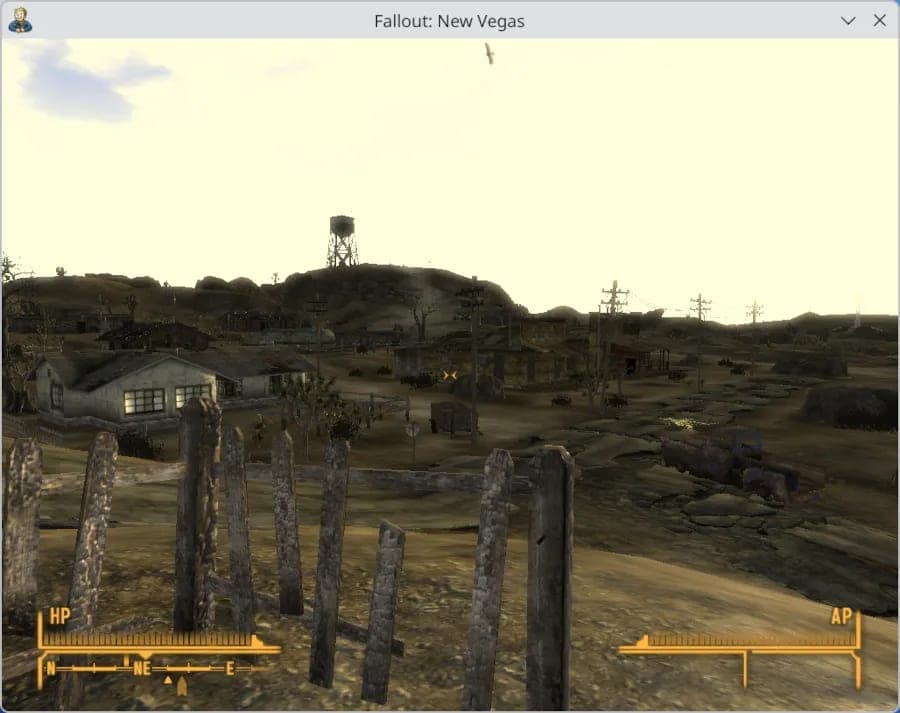
- Fallout: New Vegas (2010): runs too, as the photo above shows.
The catch: the Google patch is built only for 16 KiB hosts running 4 KiB programs, and it needs an extra helper to switch on. The team will not ship it until it knows whether Google plans to make it general. It has asked Google questions and hopes to say more soon.
What else is in the report?
A few smaller wins are worth a line each:
- Microphones: the MacBook microphone array tool, Triforce, is almost twice as fast after contributors added hand-tuned code for Arm and Intel chips.
- Fedora: Fedora Asahi Remix 45 shipped on 3 November, the same day as Fedora 45. The team says it is the first time that has happened.
- Updates: new m1n1 and kernel updates are due in the coming days.
What it means for you
- M3 owners: you can install Asahi Linux without the EXPERT flag, with working sleep.
- Gamers: M1 and M2 owners can play many PC games already, with patchy speed. Nothing new ships yet.
- M4 and M5 owners: do not expect an installer soon. The work so far only reaches a text screen.
- Thunderbolt users: USB devices work. Docks and displays over Thunderbolt do not.
The bottom line
Asahi Linux just moved its M3 support out of testing and sent big pieces of its work into the main Linux kernel. The M3 graphics chip is still the gap, and the best gaming trick depends on a decision Google has yet to make. Slow, open and steady, which is probably the only way this kind of project works.
Key facts
- M3 status
- Generally available, no EXPERT flag
- Thunderbolt
- USB3, XDomain and Thunderbolt networking only
- Big driver upstreamed
- AVD, about 13,000 lines of code
- Fedora Asahi Remix 45
- Shipped 3 November, same day as Fedora 45
Got questions?
Quick answers, plain wordsWhat is Asahi Linux?
It is a project that makes Linux run on Apple Silicon Macs, the Macs with Apple's own M-series chips. Apple does not provide help, so the team works out how the hardware behaves and writes the drivers itself.
Can I install Linux on an M3 Mac now?
Yes. The project says M3 support no longer needs the EXPERT flag in the Asahi installer. It says it received almost no issues from early adopters before making that change.
Does the M3 graphics chip work on Linux?
Not yet. The M3 GPU is very different from the M1 and M2 versions. A small team has drawn a triangle on it, which is an early milestone, but there is no usable driver.
Does Thunderbolt work?
Partly. You can plug in USB devices or connect two Thunderbolt computers and make them talk over a network. Most Thunderbolt docks need tunnelling for PCIe and DisplayPort, which is not supported yet.
What about the M4 and M5 Macs?
Early files describing the M4 Pro, M4 Max and M5 chips were sent to the Linux kernel. They are barebones and only enough to boot to a text screen, but the team says work is moving on.
Can I play PC games on Asahi Linux?
On M1 and M2 Macs, yes, with tools that translate Windows and Intel code. The project calls performance patchy. A new method that skips the virtual machine looks promising but is not shipping.
What is a virtual machine and why skip it?
It is a pretend computer running inside your real one. The current game setup uses one, which costs about 20% in speed depending on the workload. Skipping it would be faster and easier to debug.
Is the Android patch coming to Asahi Linux?
Not yet. The team says it does not want to ship it until it knows whether Google will make it work for all Linux systems or keep it Android-only. It has asked Google questions.
Do I need Fedora to use Asahi?
The project's main version is Fedora Asahi Remix. Version 45 came out on 3 November, on the same day as Fedora 45 itself, which the team says is a first.
What changed with the microphones?
The speech filter for the MacBook microphone array, called Triforce, now runs almost twice as fast and uses less processor time, thanks to hand-tuned code from contributors.
SourcesAsahi Linux
Topics and tagsApple, asahi linux, apple silicon, linux
Go deeper
Related stories
A 256-character password can unlock some Linux servers
A decade-old bug between OpenSSH and the musl library lets attackers log in to Alpine Linux accounts that should block passwords. OpenSSH 10.6p2 fixes it.
Xbox's new PC app launches up to 60% faster, and Insiders can try it today
Microsoft is giving Xbox Insiders a redesigned PC app with faster loading, a simpler library and friends built into the main menu. A matching cloud gaming refresh is coming to more players.
PlayStation profit jumps 83% even as PS5 shipments fall 35%
Sony shipped 2.6 million PS5 consoles last quarter, down from 4 million, yet games and online services pushed gaming profit sharply higher.
More in brief
- YouTube is going back on the Billboard charts in 2027Nov 9
- Apple starts selling $50 packs for extra Apple Intelligence useNov 9
- Windows 11 tests a way to switch off the Sticky Keys popup for goodNov 9
- US regulators question whether Waymo's school bus fix workedNov 9
- NVIDIA unveils GR00T 2 and Isaac Lab 3.0 to teach robots delicate workNov 9
- Tesla launches its robotaxi service in San Antonio, its eighth cityNov 9