
Technology·News & analysis
WhatsApp will now tell parents when their teen joins a group, but not what's said in it
WhatsApp launched optional parental controls for teen accounts, alerting parents when their teen joins or leaves groups while keeping actual messages end-to-end encrypted.

Tide
Wave
Sci-fi
1/10
Reality
Shipping
A notification when a group grows, not a transcript of what's inside.How we rate
WhatsApp launched optional parental controls for teen accounts, alerting parents to group activity and letting them manage privacy and Meta AI settings, while keeping actual messages end-to-end encrypted.
It arrives soon after Meta's $18 billion child-safety settlement with 52 state attorneys general, as age-verification laws for social platforms spread across more states. For millions of families already using WhatsApp as a primary messaging app, this is a real, concrete change to how much visibility parents get into a teen's account.
What to know
- WhatsApp launched optional parental controls for teen accounts, letting parents manage privacy settings, group participation, Channels, Status, and Meta AI access.
- Parents get alerts when their teen joins or leaves a group, or when a group they're in grows significantly, without being able to read the group's actual messages.
- Personal messages and calls remain end-to-end encrypted and private, even with parental controls turned on.
- Teens need a parent-set PIN to loosen any restriction once it's in place, and parents can choose a stricter 'Limited Content' Meta AI setting instead of the standard 13-and-up experience.
- The launch follows Meta's $18 billion child-safety settlement with 52 state attorneys general in August 2026, and arrives as age-verification laws for social platforms spread across more states.
WhatsApp just gave parents a real way to watch the front door of their teen's group chats, without ever being able to peek inside the room itself.
What can parents actually control now?
WhatsApp's new, optional parental controls let a parent manage several specific things about a teen's account: who can see their profile photo, who can add them to groups, how they use Channels, which Status updates they can see and who sees theirs, and whether their Meta AI experience runs in the standard mode for users 13 and up or a stricter "Limited Content" setting.
Why it matters: none of these controls touch actual message content. WhatsApp was explicit that personal messages and calls remain end-to-end encrypted, even with every parental control turned on, drawing a clear line between account-level oversight and reading someone's private conversations.
What do parents actually get notified about?
Parents receive alerts when their teen joins or leaves a group, and when a group the teen belongs to grows significantly in size. WhatsApp didn't specify the exact size thresholds that trigger a growth alert.
In real life it's like a parent getting a text that says "your kid just walked into a new room at the party," without getting to hear a word of what's actually being said once they're inside.
Why it matters: that's a meaningfully narrow kind of visibility. A parent learns their teen is now part of a new group chat, which can matter for safety, but they don't get a transcript, a participant list, or any way to monitor ongoing conversation content.
Can a teen just turn these controls off?
Not unilaterally. If a teen wants to loosen any restriction their parent set, they need approval through a PIN that only the parent controls. That's a meaningful detail: plenty of past "parental control" features have quietly relied on a child simply not bothering to disable them, rather than making removal require the parent's direct involvement.
Why is WhatsApp launching this specific feature right now?
Background: this arrives soon after Meta agreed to pay up to $18 billion over a decade to settle child-safety claims brought by 52 state attorneys general in August 2026. That settlement required changes including daily usage limits, overnight restrictions, and muted notifications during school hours for teens on Instagram and Facebook.
Why it matters: WhatsApp's announcement doesn't explicitly tie this feature to that settlement, but the timing lines up closely with Meta demonstrating broader child-safety compliance across its full app family, not just the two platforms the settlement specifically named. It also comes as more US states pass their own age-verification and parental-control requirements for social and messaging apps, adding regulatory pressure beyond the settlement alone.
How is this different from what Instagram just changed?
Background: Instagram's settlement-related updates have focused mainly on usage limits and notification timing, things like daily time caps and quieter nights and school hours. WhatsApp's new controls instead focus on group oversight, privacy settings, and AI access specifically.
Why it matters: that split reflects what each app actually is. Instagram is fundamentally a content and attention platform, so limiting time spent and notifications makes sense there. WhatsApp is fundamentally a private messaging app, so its safety features center on who a teen is communicating with and what they can see, rather than how long they're using the app.
What exactly are these new state age-verification laws requiring?
By the numbers: four states, Texas, Utah, Louisiana, and California, have each passed their own app store or social media age-verification laws, with effective dates spread across 2026 and into 2027. Texas's law, effective January 1, 2026, requires digital service providers to get parental consent before minors under 18 can create accounts at all.
Utah's Social Media Regulation Act, effective May 2026, goes further, mandating age verification and restricting social media use between 10:30 PM and 6:30 AM for users under 18 without parental consent. California's approach, effective January 2027, takes a different angle entirely, regulating algorithmic "addictive feeds" rather than account access directly, requiring verifiable parental consent before showing minors that kind of engagement-optimized content.
Why it matters: that's a genuinely fragmented legal landscape, four different states with four different approaches to the same underlying concern, each with its own effective date and specific requirements. A platform like WhatsApp, operating nationwide, has strong incentive to build parental control features broad and flexible enough to satisfy multiple overlapping state requirements at once, rather than building separate compliance systems state by state.
Has WhatsApp built family-oriented features like this before?
Background: this isn't WhatsApp's first move toward structured, age-based account management. The company has also introduced parent-managed accounts, letting parents directly set up and oversee accounts for children under 13 who wouldn't otherwise meet WhatsApp's standard age requirements to use the app at all.
Why it matters: that earlier feature and this new teen-focused one together suggest WhatsApp is building out an entire tiered system of age-appropriate account types, rather than treating child and teen safety as a single, one-size-fits-all feature. Separating "parent fully manages a young child's account" from "parent gets limited oversight into a teen's existing account" reflects a reasonable recognition that a 10-year-old and a 16-year-old need meaningfully different levels of parental involvement.
Could age verification itself be a weak point here?
The catch: reporting on Meta's broader $18 billion settlement has already flagged that age-verification technology remains imperfect industry-wide. Meta reportedly relies on facial analysis and other signals to estimate a user's age, but those methods can make real errors in both directions, wrongly restricting adults while failing to catch some teenagers who should be covered by these protections.
Why it matters: that imperfection matters directly for WhatsApp's new controls too, not just for Meta's other apps. The entire system depends on correctly identifying which accounts actually belong to teenagers in the first place. If age estimation misses a teen account entirely, misclassifying it as an adult account, none of these new parental controls would ever come into play for that user, regardless of how well-designed the controls themselves are.
What it means for you
- If you're a parent of a WhatsApp-using teen, these controls are opt-in, not automatic. You'll need to set them up together with your teen rather than expecting them to switch on by default.
- Don't expect message-content monitoring. This feature is built specifically to preserve encrypted privacy for actual conversations, group and contact oversight only.
- The PIN requirement means you stay in control of any changes, so a teen can't quietly disable restrictions without your involvement.
- If your teen uses Meta AI on WhatsApp, consider reviewing the 'Limited Content' option if you want a more restricted AI experience than the standard 13-and-up default.
The bottom line
WhatsApp's new controls thread a genuinely difficult needle: giving parents real, actionable oversight into who their teen is connecting with, without compromising the end-to-end encryption that defines the entire product.
Whether that balance satisfies regulators, parents, and privacy advocates all at once remains to be seen, but it's a notably more targeted approach than simply weakening encryption outright or demanding broad message access, the kind of tradeoff plenty of other messaging platforms have struggled to avoid entirely once child-safety pressure mounts.
Key facts
- Feature
- Optional parental controls for teens
- Messages
- Remain end-to-end encrypted
- Alerts
- Group joins/leaves, significant growth
- Control bypass
- Requires parent-set PIN
- Meta settlement
- $18B, 52 state AGs, Aug 2026
Got questions?
Quick answers, plain wordsWhat exactly can parents control with WhatsApp's new feature?
Who can see their teen's profile photo, who can add the teen to groups, how the teen uses Channels, who sees their Status updates and which Status updates they can view, and whether Meta AI runs in its standard mode or a stricter 'Limited Content' setting.
Can parents read their teen's private messages with this turned on?
No. WhatsApp says personal messages and calls remain end-to-end encrypted and private even with parental controls active. Parents only get visibility into group activity and the specific settings listed, not message content.
What alerts do parents actually receive?
Parents are notified when their teen joins or leaves a group, and when a group their teen belongs to grows significantly in size. The exact size thresholds weren't specified in WhatsApp's announcement.
Can a teen just turn these controls off themselves?
Not without parental involvement. If a teen wants to loosen any restriction, they need approval through a PIN that only the parent sets, preventing teens from silently disabling the controls on their own.
What is the 'Limited Content' Meta AI setting?
A stricter alternative to WhatsApp's standard Meta AI experience for users 13 and older, which parents can select instead for their teen's account, offering more restricted AI interaction.
Are these controls mandatory, or optional?
Entirely optional. WhatsApp describes the controls as designed for parents and teenagers to set up together, not something imposed automatically on every teen account.
Why is WhatsApp launching this now specifically?
The launch follows Meta's $18 billion child-safety settlement with 52 state attorneys general in August 2026, and comes as more US states pass age-verification and parental-control requirements for social and messaging platforms.
What was Meta's $18 billion settlement actually about?
Meta agreed to pay up to $18 billion over a decade to settle child-safety claims brought by a coalition of state attorneys general, committing to changes including daily usage limits, overnight restrictions, and muted notifications during school hours on Instagram and Facebook for teen users.
Does this settlement directly require WhatsApp's parental controls?
WhatsApp's announcement doesn't explicitly tie this feature to the settlement, but the timing lines up closely with Meta's broader push to demonstrate child-safety compliance across its apps following that agreement.
Is WhatsApp's approach different from Instagram's teen safety features?
Yes, in emphasis. Instagram's settlement-related changes focus on usage limits and notification timing, while WhatsApp's new controls focus specifically on group oversight, privacy settings, and AI access, reflecting WhatsApp's core identity as a private messaging app rather than a content-feed platform.
SourcesWhatsApp
Related stories

GrayKey maker reportedly found a way around the iPhone's Inactivity Reboot
A leaked training video seen by 404 Media says Magnet Forensics' new tools keep a seized iPhone in an easier-to-search state, even after the reboot Apple added in iOS 18.1.

Why Black Twitter found a new home on Meta's Threads
Years after Elon Musk bought Twitter, a wave of Black creators and communities have found their footing on Threads, helped by features Meta built specifically for community building.
Instagram lets partner schools post content only their own students can see
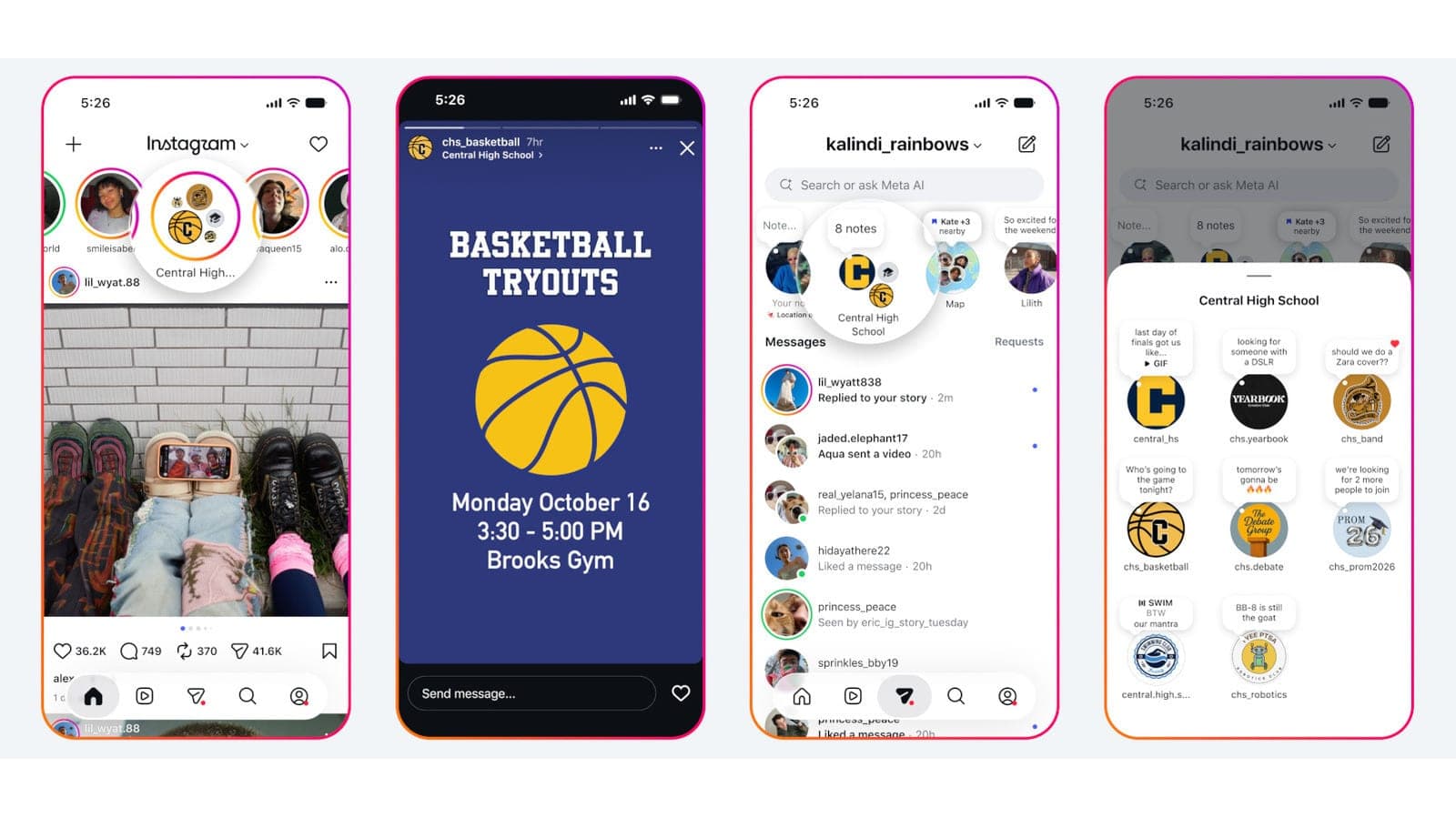
Meta is adding private Stories, Notes, Channels, and student directories to Instagram's School Partnership Program, which now covers nearly 17,000 schools.
More in brief
- California will fine robotaxi companies that block first responders for over 30 minutesOct 2
- Microsoft launches real-time transcription and new voice models for AI voice agentsOct 1
- Apple's smart home hub reportedly launches October 13, with a camera that never records videoOct 1
- Cloudflare releases Clef, open-weight AI models that make yes-or-no decisions fastOct 1
- Fervo's Cape Station becomes the first enhanced geothermal plant to sell power commerciallyOct 1
- Cloudflare renames its data platform Basin and makes it generally availableOct 1