
Robots·News & analysis
NEURA and TUM open RoboGym in Munich and show the 4NE1 Gen 4 humanoid
NEURA Robotics and the Technical University of Munich opened a 2,300 square meter robot training center near Munich Airport. NEURA also unveiled 4NE1 Gen 4, a humanoid that is 20 percent lighter than the last one.
Tide
Ripple
Sci-fi
8/10
Reality
Demo
A gym where robots go to learn their day jobs.How we rate
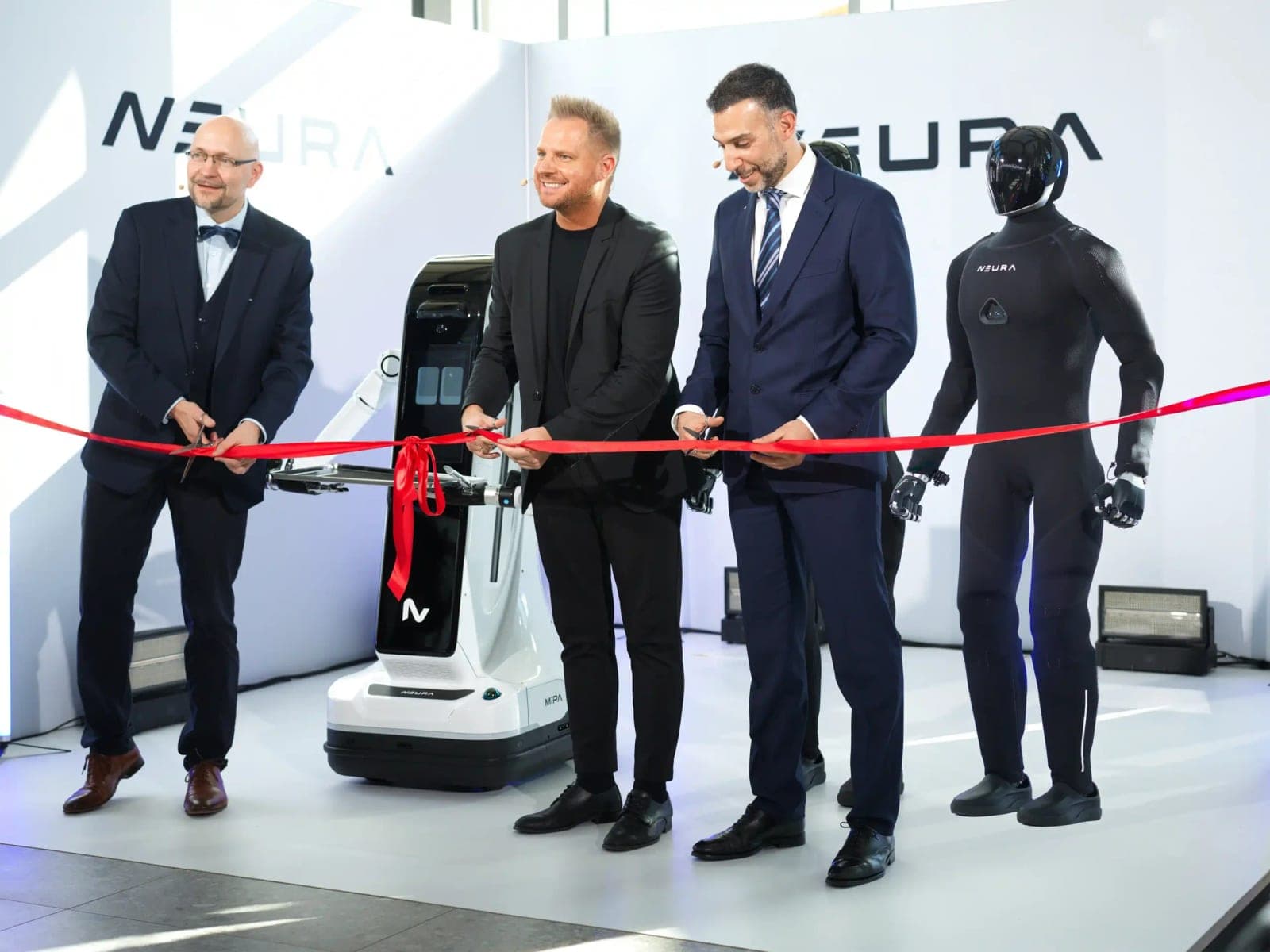
NEURA Robotics and the Technical University of Munich opened the TUM RoboGym, a 2,300 square meter center near Munich Airport where companies train robots on real tasks.
NEURA also unveiled the humanoid 4NE1 Gen 4, 20 percent lighter than its predecessor and being prepared for series production. The partners are investing about EUR 17 million over three years. More NEURA Gyms are planned in Europe, the US and China, starting with one in Aachen.
What to know
- NEURA Robotics and the Technical University of Munich opened the TUM RoboGym on October 22, 2026, a center of more than 2,300 square meters at LabCampus near Munich Airport.
- Companies from more than ten industries bring real tasks, like handling cardboard boxes or filling bottles, so robots can learn them from sensor data, human demonstrations and simulation.
- NEURA unveiled the humanoid 4NE1 Gen 4: 20 percent lighter, wrapped in a black textile skin, and run by Neuron AI, the company's own model for Physical AI.
- The partners are investing about EUR 17 million over an initial three years, with NEURA paying about EUR 11 million, and more NEURA Gyms are planned in Europe, the US and China.
NEURA Robotics announced that it opened a robot training center with the Technical University of Munich (TUM) today. It also showed off a new humanoid robot. So what does it mean to put robots in a gym?
What is the TUM RoboGym?
The TUM RoboGym is a research and training center at LabCampus, near Munich Airport. It covers more than 2,300 square meters and opened on October 22, 2026.
NEURA built it with TUM's Munich Institute of Robotics and Machine Intelligence, known as MIRMI. The idea is simple: companies bring real jobs, and robots practice them until they get good.
In real life Picture a bottling company that wants a robot to fill bottles. Instead of testing on its own production line, it sends the task to the RoboGym and lets the robot practice there first.
Why train robots in a gym at all?
Robots need to know how the physical world behaves. How does a robot grasp a delicate part? How does it notice that two pieces clicked together? What does it do when the workflow changes?
NEURA says these skills come from experience, and experience needs data about objects, materials and forces. TUM made a similar point in an earlier release: unlike chatbots, robots cannot learn from huge piles of internet text. Web videos of robot arms doing specific tasks are hard to find.
Why it matters: the data has to be made, and a gym is a place to make it.
How does the training work?
The RoboGym combines three ways of collecting data:
- Real-world robot data: different robots perform tasks while their sensors record movements, contacts and results.
- Human demonstrations: people show a workflow. Sensor-equipped data suits, motion-capture systems and teleoperation turn their movements into training data.
- Simulation: virtual practice adds to the real-world data, and the center connects the training setup with NEURA's software and AI tools.
NEURA says the joint research processes this data so it can be used to develop and study Physical AI models. The practical question at the center is how quickly a robot can learn a new task, and how reliably it can do it.
Who is already using it?
Partners have been training concrete workflows at the site since September. NEURA says companies from more than ten industries are involved, including automotive, pharmaceuticals, medical technology, packaging, logistics, agriculture and care.
The tasks sound pleasantly ordinary:
- Handling cardboard boxes.
- Filling bottles.
- Loading and unloading wooden components.
Companies can test applications, find out what training a task needs, and compare different robot systems before they bring robots to their own sites. NEURA says capacity in Munich is already in strong demand.
The robots come in several shapes: humanoids, mobile assistants such as the MiPA, and cognitive robot arms. The point is to match the robot to the task, not to push one design.
What is the 4NE1 Gen 4?
To mark the opening, NEURA launched the fourth generation of its humanoid, the 4NE1 Gen 4, nicknamed "For Anyone". The company lists these changes:
- Lighter: 20 percent lighter than the previous generation.
- Slimmer, softer look: a black textile outer skin. NEURA says the fabric makes the robot seem more approachable and leaves room for simple customization.
- Better hands: advanced hands for more accurate grips.
- Smart Limbs: reflexes built into the limbs, so each one can react on its own.
NEURA says the robot is designed for serial production and is being prepared for it. It is already working at the TUM RoboGym and the NEURA Gyms, and it also appears at the NVIDIA GTC conference in Berlin.
What is Neuron AI?
Neuron AI is the robot's brain. NEURA calls it its Perception-Language-Action model for Physical AI, which means it turns what the robot perceives directly into movement.
Vision is only one input. Touch, force, sound and the robot's own state feed in too. NEURA says that matters most in industrial work, for example when a robot must tell whether a fastener has clicked into place.
The model is trained on real-world robot data from the NEURA Gyms, human demonstrations and simulation. Through the Neuraverse, NEURA's network for sharing skills, what one robot learns becomes available to other connected robots. So every Gym teaches the whole fleet.
The big picture: NEURA is betting that the winner in robotics will not be the best metal and motors, but the best training data.
Who are the two partners?
NEURA Robotics was founded in 2019 and is headquartered in Metzingen, Germany. It describes itself as a Physical AI company that builds cognitive robots that can see, hear, feel and learn, plus the software and data setup to deploy them.
TUM MIRMI is the university's robotics and AI institute. It links nearly 80 TUM chairs and works on robotic and AI solutions for the environment, health, mobility, labor, and security and defense. Prof. Lorenzo Masia leads it and heads the RoboGym, and his deputy is Prof. Achim Lilienthal.
Back in March, when the partnership was first announced, TUM said the center would develop and train hundreds of robot systems, many of them humanoids. Lilienthal explained the trade: NEURA pays for robots and hardware upkeep, and in return it takes part in the research.
The big picture: a university gets robots it could not easily buy, and a company gets scientists who ask hard questions about how robots learn.
How does NEURA pitch the Gym to companies?
On its NEURA Gym page, the company says Physical AI needs real-world training data such as vision, sound, touch, force and spatial awareness, and that this cannot be sourced online or generated by simulation alone. It also claims robots have seen 120,000 times less training data than large language models. That is NEURA's own figure, not an independent one.
The pitch is that each facility is built around a partner's specific use cases. NEURA says the work done there belongs to the partner, and that European infrastructure keeps the data under the partner's control. For firms worried that a robot vendor might keep what their experts know, that is the selling point.
How much does it cost, and what comes next?
The partners are investing around EUR 17 million in total, according to NEURA, and TUM's earlier release says the same. NEURA pays about EUR 11 million. NEURA covers robotics, infrastructure, computing power and operating staff, while TUM brings space, scientific expertise and resources. The initiative is initially set up for three years.
The RoboGym is the first of a planned international network of NEURA Gyms, with more locations coming in Europe, the United States and China. Another German Gym is being built with RWTH Aachen.
"The TUM RoboGym robotics center is unique in Germany and Europe," said TUM President Thomas Hofmann. NEURA founder and CEO David Reger said the company wants businesses to "carry their experience into the next industrial era" and to decide for themselves where and under what conditions they share what their robots learn.
What's next: series production of the 4NE1 Gen 4, and more Gyms.
What it means for you
- If you work in manufacturing or logistics, a place now exists where your own tasks can be tested on several robot types before you buy anything.
- If you are a student or researcher, the RoboGym offers shared robot infrastructure in Munich.
- If you are just curious, don't expect a humanoid at home soon. The 4NE1 Gen 4 is being prepared for series production, and its first jobs are in industry.
- If you care about data, NEURA says companies keep control of how their know-how is shared.
The bottom line
NEURA and TUM have turned robot training into a place you can visit, with real tasks from real companies. The 4NE1 Gen 4 is the new robot that will practice there.
The robots are lighter and learn faster, but they are still in training. The gym is open, and the series production is yet to come.
Key facts
- Opened
- October 22, 2026, Munich
- Size
- More than 2,300 m²
- Investment
- About EUR 17 million (NEURA about EUR 11 million)
- New robot
- 4NE1 Gen 4, 20% lighter
- Initial term
- Three years
Got questions?
Quick answers, plain wordsWhat is the TUM RoboGym?
It is a joint research and training center run by the Technical University of Munich (TUM) and NEURA Robotics. It sits at LabCampus near Munich Airport, covers more than 2,300 square meters, and is where researchers and companies teach robots concrete tasks.
Who built it?
NEURA Robotics built it in partnership with TUM's Munich Institute of Robotics and Machine Intelligence (MIRMI). NEURA contributes robots, technical infrastructure, computing power and operating staff, while TUM provides space, scientific expertise and resources.
How much money is going into it?
The partners are investing around EUR 17 million in total, of which NEURA contributes approximately EUR 11 million. The joint initiative is initially set up for three years.
What is 4NE1 Gen 4?
It is the new generation of NEURA's humanoid robot, nicknamed 'For Anyone'. NEURA says it is 20 percent lighter than the previous generation, has a slimmer body with a black textile outer skin, advanced hands, and runs on Neuron AI.
What is Neuron AI?
NEURA describes it as its Perception-Language-Action model for Physical AI. It turns what the robot senses directly into movement, and feeds in touch, force, sound and the robot's own state alongside vision.
What are Smart Limbs?
NEURA says reflexes are built directly into the robot's limbs, so each limb can respond on its own. The company says this lets 4NE1 Gen 4 react instantly to its surroundings and move more fluidly.
Can I buy a 4NE1 Gen 4 now?
Not yet. NEURA says the robot is being prepared for series production. It is already working at the TUM RoboGym and the NEURA Gyms, where companies can train tasks with it, and it is also appearing at the NVIDIA GTC conference in Berlin.
What kinds of tasks do robots practice there?
NEURA lists handling cardboard boxes, filling bottles, and loading and unloading wooden components. Partners have been training concrete workflows at the site since September, from industries such as automotive, pharmaceuticals, medical technology, packaging, logistics, agriculture and care.
Are there more NEURA Gyms planned?
Yes. NEURA says Munich is the start of an international network, with further locations being set up in Europe, the United States and China. In Germany, another Gym is being built with RWTH Aachen.
Who can use the RoboGym?
Companies, researchers, students and startups. Companies bring tasks and process knowledge, and the center offers a shared development environment for academia, established firms and startups.
SourcesNEURA Robotics, tum.de
Topics and tagsHumanoid robots, neura robotics, humanoid robots, physical ai
Go deeper
- ExplainerWhat is a humanoid robot?A humanoid robot is a machine built in the shape of a person, with a torso, head, arms and usually legs, so it can...
- ExplainerWhat is a large language model (LLM)?A large language model is an AI system trained on huge amounts of text to predict the next word. That simple skill,...
Related stories
Agility picks Nyobolt batteries so Digit 5 can work 20 hours a day
Agility Robotics named UK battery maker Nyobolt as the supplier behind Digit 5's new pack, which runs for 90 minutes and recharges in nine.
Rivian's robot spinoff Mind Robotics hires ex-Ford EV chief Doug Field
The engineer behind Tesla's Model 3 ramp and Apple's car project will run day-to-day work at Mind, the $1 billion-plus startup teaching robots on Rivian's factory lines.
AWS releases open-source toolchain to train and deploy robot AI
Amazon Web Services launched the Physical AI Toolchain, an open-source kit that connects synthetic data, training, simulation and edge deployment for robots, built on NVIDIA's robotics software.
More in brief
- Tesla's Q3 profit fell 43% as AI and Optimus spending climbedOct 22
- Meta creates a new class of non-voting shares to fund its AI pushOct 21
- PHP patches two critical flaws that could let attackers take over serversOct 21
- Meta pauses Muse chat sharing after 6,800 links surface in DNSOct 21
- ChatGPT now lets you lock sensitive chats behind a PINOct 20
- Antigravity halves the A1 drone's entry price with watch and ring controlsOct 20