
AI·News & analysis
YouTube Music starts labeling songs made mostly with AI
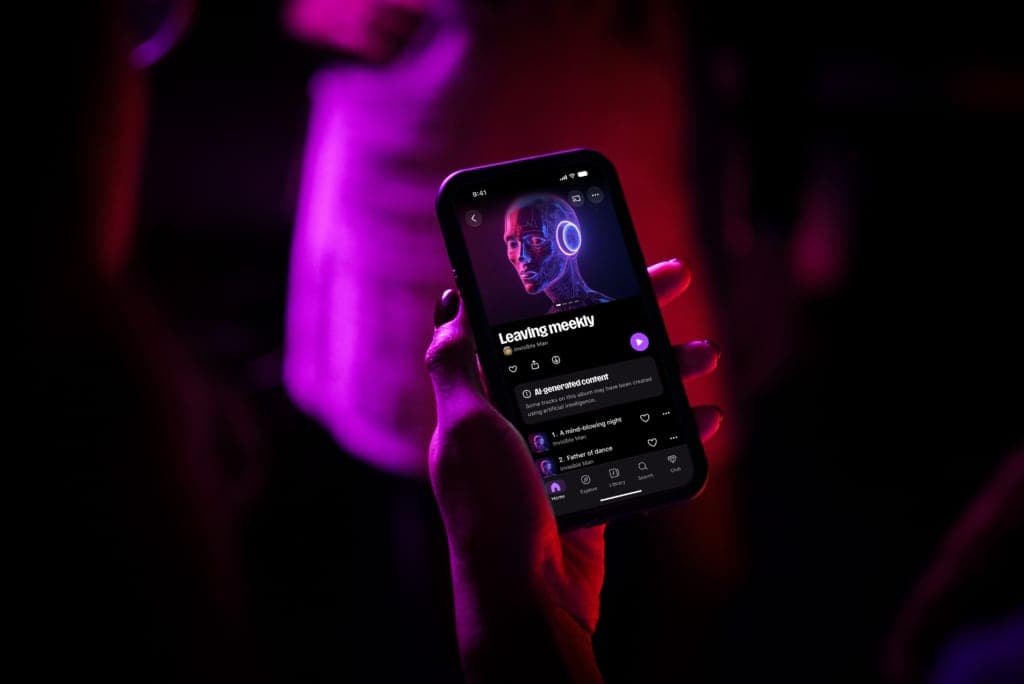
A new AI label on the YouTube Music player marks tracks where generative AI played a significant role. Tap it to see how the song was made.

Tide
Wave
Sci-fi
3/10
Reality
Shipping
Your music player now has a little tag for robot songwriters.How we rate
YouTube Music began rolling out a label on its player page for songs created primarily with generative AI, like tracks where a model wrote the composition and sang the vocals.
Tapping the label explains how AI was used. YouTube spots these songs through music partners' disclosures and its own detection tools. The labels will also reach the main YouTube app, though AI songs can still earn money.
What to know
- YouTube Music is rolling out a label on the player page for songs created primarily with generative AI, such as AI-made composition and vocals.
- Tapping the label opens a short menu that explains how AI was used in the track.
- YouTube relies on disclosures from music partners plus its own detection tools, and the labels will also come to the main YouTube app.
- The label is about disclosure: AI involvement alone doesn't stop a track from earning money on YouTube.
YouTube announced that YouTube Music is rolling out labels for songs created primarily with generative AI. So the next time a catchy track pops up in your mix, you might get a small hint about who, or what, wrote it.
What does the label look like?
It's small, and it sits right on the player page. Engadget describes it as an oblong label reading "AI", placed directly below the track name, "so it's tough to miss."
Tap it, and a short menu opens with more detail. In the example image YouTube shared, the menu is titled "How this was made" and reads: "Made with AI. This audio was altered or fully generated using AI."
What's next: the labels are rolling out on YouTube Music starting October 14, 2026. YouTube says they will also expand to the main YouTube app, which hosts a huge amount of music videos. There's no date for that yet.
In real life You're on a run, and a song you've never heard comes on. You glance at your phone, see the little AI tag, and tap it. Now you know before you add it to your workout playlist.
Which songs get labeled?
Not every song that touched an AI tool. YouTube says the label is for songs created primarily using generative AI. Its example is a track where a generative model created both the composition and the vocals.
The company says it applies when "AI played a significant role." Engadget adds that it covers fully generated tracks and also songs where a model made major parts, like the vocals.
The Verge notes this doesn't sound like it applies to every use of AI in making music. Think of it like a "contains nuts" sticker. It isn't there for a trace of something, it's there when the ingredient is a big part of the recipe.
How does YouTube know a song used AI?
Two ways. YouTube says it is teaming up with music partners and using its own detection tools to identify AI-generated tracks.
Partners are the labels and distributors that deliver songs to YouTube. According to YouTube's help page, as TechCrunch reports, they can mark each track with one of three designations:
- Fully Gen AI: the track was generated entirely by AI.
- Partly Gen AI: an artist used AI-generated parts but added their own live elements.
- No Gen AI: no generative AI. Songs edited with pitch-correction tools like Auto-Tune land here.
The guidelines give everyday examples, Unite.ai reports from YouTube's Help Center:
- Fully Gen AI: someone types a text prompt into an AI music generator and downloads the song, or an artist uses a model to generate the composition, the instruments and the vocals.
- Partly Gen AI: a tool adds a bassline or a string section under an artist's own live vocals, or helps brainstorm lyrics and melodies that are then recorded in a studio.
- No Gen AI: an engineer fixes small tuning slips with Auto-Tune, or a producer uses automated AI mastering to balance the final mix.
Partners send this information with the rest of a song's metadata, through industry delivery formats called DDEX and CSV. Uploaders who don't use those can mark it in YouTube Studio instead.
And if a partner says nothing? The Verge reports that, under YouTube's rules for music partners, YouTube may use "other signals" to decide whether a song is AI-generated. Per the Help Center, as Unite.ai reports, a song with no declaration counts as "unknown" until those signals say otherwise, and YouTube may then mark it fully or partly Gen AI on its own.
Why is YouTube doing this now?
Because AI-made music is spreading across every streaming service. YouTube says its listeners told it they want transparency when they're hearing an AI-generated track.
"Our goal is to make it as easy as possible for viewers and listeners to have the right information and clarity when it comes to the music they listen to."
The scale is easy to see at other services. Deezer says it receives nearly 90,000 fully AI-generated tracks a day, more than half of all uploads on its peak days.
YouTube says it's applying the same labeling principles it already uses across YouTube. The Verge compares it to YouTube's existing process for putting AI labels on videos, and Engadget makes the same comparison.
Where did YouTube's AI labels come from?
Music is the newest stop for a system YouTube has been building for years. Here's the short history, based on Tubefilter's reporting:
- 2023: YouTube introduces AI labels and requires creators to disclose content made with AI video generators.
- 2024: it adopts C2PA, a standard that attaches "how this was made" details to a file and keeps them as it moves between platforms.
- 2026: it makes video labels more visible, placing them right below the player on long videos and as an overlay on Shorts, and starts applying them automatically when its systems detect "significant photorealistic AI use."
Videos made with Google's own AI tools, like Veo, keep their labels, Tubefilter reports. The music label borrows the same "How this was made" idea and brings it to your headphones.
Can I block AI songs on YouTube Music?
No. YouTube is choosing disclosure, not restriction: the label tells you about AI, it doesn't hide the song.
TechCrunch points out that AI involvement alone doesn't make a track ineligible for monetization on YouTube. So a labeled song can still earn money, just like any other track.
The big picture: YouTube is also experimenting with AI music itself. TechCrunch notes its tool Dream Track lets select creators generate soundtracks using AI versions of participating artists' voices. Labels fit that approach: AI music is allowed, as long as listeners can see it.
How does this compare to other music apps?
Every service is landing in a slightly different place. Here's the lineup, based on reporting from TechCrunch, The Verge and Engadget:
| Service | What it does with AI music |
|---|---|
| YouTube Music | AI label on the player, tap for details |
| Spotify | AI labels, a music spam filter, no recommendations for "AI personas" |
| Apple Music | Planning "Made With AI" labels later this year |
| Deezer | Tags AI music, keeps it out of recommendations, filter toggle coming |
| Tidal | Labels fully AI recordings, lets you turn them off |
| Bandcamp | Banned AI music outright |
Deezer took the strictest route among the big apps. A day before YouTube's news, it announced a switch that will remove fully AI-generated music from your search results.
The catch: a label is only as good as the information behind it. YouTube depends on partners to declare AI use honestly, with its own detection tools and "other signals" as the backup. YouTube points to its Help Center for the full disclosure guidelines.
What it means for you
- Look under the song title: on YouTube Music, a small "AI" tag now marks songs made mainly with generative AI.
- Tap for details: the menu tells you how AI was used in the track.
- Nothing is hidden: labeled songs still play, show up and earn money, so the choice to skip is yours.
- Coming to YouTube too: the same labels are on the way to the main YouTube app.
The bottom line
YouTube Music now tells you when a song was made mostly by AI, using partner disclosures and its own detection. It won't block those songs, but it puts the information one tap away. For a service this big, that small tag could become the way millions of people first notice AI music.
Key facts
- Feature
- AI label on the YouTube Music player page
- Rollout
- Starting October 14, 2026, main YouTube app later
- Partner categories
- Fully Gen AI, Partly Gen AI, No Gen AI
- Detection
- Partner disclosures plus YouTube's own tools
Got questions?
Quick answers, plain wordsWhat is YouTube Music's new AI label?
It's a small label that appears on the player page when you listen to a track where generative AI played a significant role. Engadget describes it as an oblong 'AI' tag right below the track name.
Which songs get the label?
Songs created primarily with generative AI. YouTube's example is a track where a generative model created both the composition and the vocals. Engadget notes it also covers songs where a model made major parts, like the vocals.
What happens when I tap the label?
A simple menu opens with more information. In YouTube's example it is titled 'How this was made' and says the audio was altered or fully generated using AI.
Does Auto-Tune count as AI?
No. According to TechCrunch, which cites YouTube's help page, tracks edited with pitch-correction tools such as Auto-Tune fall under the 'No Gen AI' category.
How does YouTube know a song used AI?
Music partners declare it when they deliver songs, and YouTube also uses its own detection tools. The Verge reports that without a disclosure, YouTube may use 'other signals' to decide.
Is the label on the regular YouTube app too?
Not yet. YouTube says the new music labels will also expand to the main YouTube app, but it hasn't given a date.
Can I hide AI songs on YouTube Music?
No. YouTube's change is a label, not a filter. Deezer is the service building a toggle that removes fully AI-generated music from search results.
Do AI songs still make money on YouTube?
Yes. TechCrunch reports that AI involvement alone doesn't make a track ineligible for monetization on YouTube.
Is it free?
YouTube's announcement doesn't limit the labels to paid subscribers. They appear on the player page when you listen to a labeled track.
What are other music apps doing about AI songs?
Spotify tags AI tracks and artists, Apple Music is reportedly adding AI labels, Tidal lets listeners turn off fully AI recordings, Deezer is adding a filter toggle, and Bandcamp banned AI music.
SourcesYouTube
Topics and tagsyoutube music, youtube, ai music, generative ai
Go deeper
Related stories
Deezer will let you hide fully AI-generated music with one switch
Deezer is adding an on/off toggle that removes fully AI-generated tracks, albums and artists from search. It arrives worldwide before the end of 2026.

Man who streamed AI songs with bots for $8 million gets 18 months in prison
Michael Smith used AI to make hundreds of thousands of songs and bots to play them billions of times. A federal judge in Manhattan sentenced him in the first US criminal case over streaming fraud.

OpenAI engineer charged over hidden recording device in executive room
Federal prosecutors say an OpenAI engineer wrapped a tiny recorder in toilet paper and plugged it into a TV in an executive conference room in San Francisco.
More in brief
- Eight US states sue OpenAI over ChatGPT's safety for kidsOct 14
- Xbox Nano is a $50 controller small enough for your pocketOct 14
- Linux kernel developers move to drop the rule that made coders disclose AI helpOct 14
- OpenAI says an ex-employee took its device files to AppleOct 14
- Anthropic says AI worms could soon spread through cheap smart TV boxesOct 14
- Epic's new games launcher is faster, runs on Linux and was built with AIOct 14