
Technology·News & analysis
The AI boom turned Singapore into a chipmaking powerhouse, and a risk
Singapore's economy is riding the AI chip boom to record growth, but high costs, scarce land, and its role as neutral ground between the US and China all threaten how long that lasts.
Tide
Ripple
Sci-fi
2/10
Reality
Shipping
A tiny country becomes the world's neutral chip clubhouse.How we rate
Singapore's economy grew 5.7% year-on-year in Q2 2026, with manufacturing up 12.2%, driven by AI-related demand for chips and equipment.
Electronics exports rose 132% in August alone. Singapore now accounts for about 20% of global semiconductor equipment production, and has become neutral ground where AI firms set up to avoid US-China tech tensions. But high costs, scarce land and labor, and rising US scrutiny over whether restricted technology moves through Singapore all threaten how long that boom can last.
What to know
- Singapore's economy grew 5.7% year-on-year in Q2 2026, with manufacturing up 12.2%, driven by AI-related demand for chips and chipmaking equipment.
- Electronics exports rose 132% year-over-year in August, with personal computer shipments up 238% and disk drives up 214%.
- Singapore accounts for about 20% of global semiconductor equipment production and has become a hub AI companies use to stay neutral in US-China tech tensions.
- High costs, scarce land and labor, and rising US trade scrutiny over technology transfers all threaten how long Singapore's chip boom can continue.
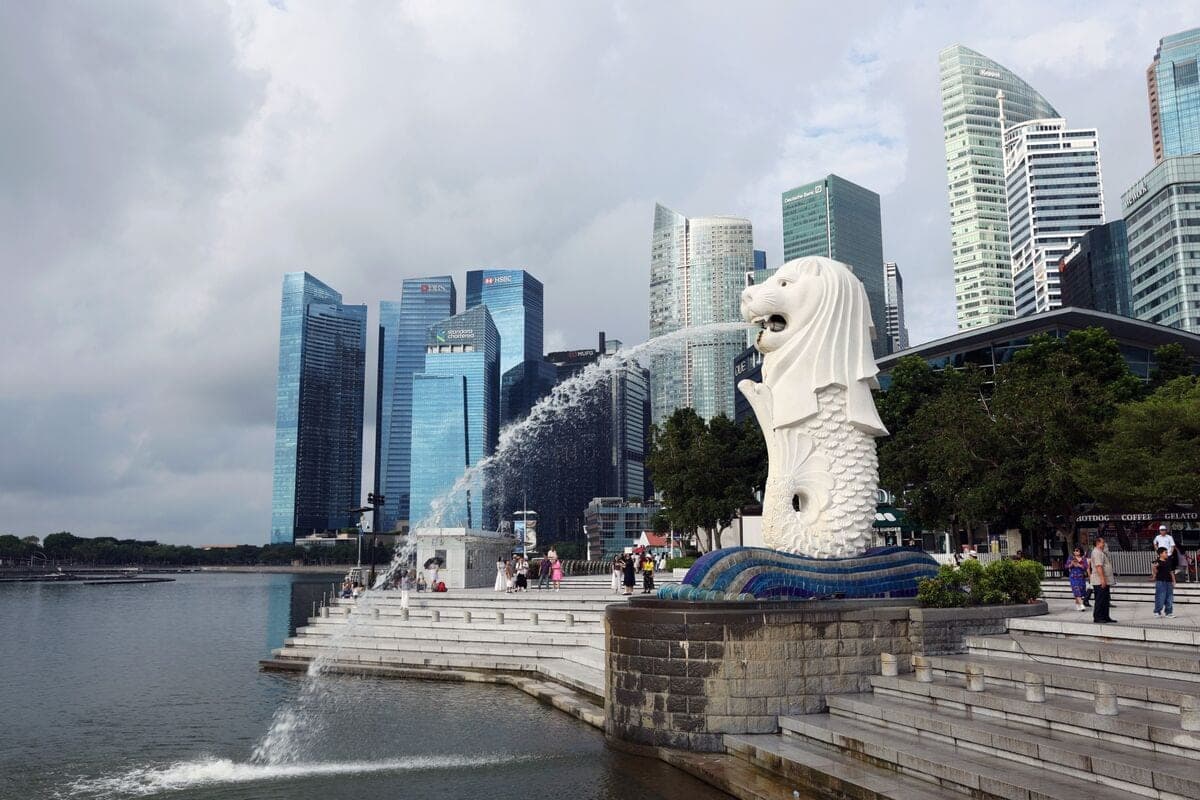
Singapore is a city-state smaller than New York City, and it's currently a fifth of the world's chip equipment production. The AI boom is why. It's also why that position might not last.
Singapore's economy grew 5.7% year-on-year in the second quarter of 2026, with manufacturing up 12.2%, driven almost entirely by AI-fueled demand for chips and the equipment used to make them.
How big is this boom, really?
By the numbers: Singapore's government raised its annual growth forecast in August from an original 2-4% range up to 4.5-5.5%, citing AI-related exports directly. Electronics exports rose 132% year-over-year that same month, with personal computer shipments up 238% and disk drive shipments up 214%.
- GDP growth (Q2 2026): 5.7% year-on-year.
- Manufacturing growth: 12.2% year-on-year.
- Electronics exports (August): up 132% year-over-year.
- Global semiconductor equipment share: about 20%.
Why it matters: those aren't small, isolated numbers. A 132% jump in electronics exports in a single month reflects a genuinely massive shift in global chip production and equipment demand flowing directly through Singapore's economy.
This industry didn't start with AI
Background: Singapore's chip industry dates back nearly six decades, not just the current AI boom. National Semiconductor opened operations there in 1968, followed the same year by Texas Instruments, which built a plant employing thousands of workers within its first years.
That early bet paid off fast. Within three years, Texas Instruments alone had created 7,000 jobs, and other American and European electronics companies, including Hewlett-Packard, Digital Equipment Corporation, and Seagate, followed once word spread about how smoothly operations ran there. By the early 1980s, Singapore had already become a major global hub for microelectronics manufacturing, well before AI chips existed as a category.
Why it matters: that decades-long head start is the actual foundation the current AI boom is building on. Singapore isn't a country that suddenly discovered chips because of AI demand. It's a country that spent nearly 60 years building the exact infrastructure, workforce, and reputation that made it the obvious place for AI-driven chip investment to land once demand exploded.
Why Singapore specifically?
Singapore built a deep bench of semiconductor talent over decades, which made it a natural regional base once global chipmakers needed to expand production fast to keep up with AI demand. That existing expertise, not luck, is what let Singapore capture such an outsized share of the current boom.
In real life think of Singapore like a well-stocked hardware store that suddenly finds itself at the center of a construction boom. It didn't build the boom, but it had exactly the tools and skilled staff on hand when demand exploded.
There's a second reason companies are flocking there
The catch: Singapore isn't just attractive for its chip talent. It's increasingly used as neutral ground by AI companies trying to stay out of the direct crossfire of US-China tech tensions.
Setting up operations in Singapore signals to international clients that a company's intellectual property isn't directly subject to controls from either government. It also offers practical perks: favorable visa processing, tax treatment for IP registration, and visa programs specifically built for AI talent.
Who's affected: reported examples of companies with a Singapore presence include Workato, Addepar, Plaud AI, and Harvey AI, alongside major US AI labs including Anthropic, OpenAI, DeepMind, and Superintelligence Labs. One venture capital executive, Kerry Goh of Kamet Capital, said the arrangement "gives a lot of comfort" to clients worried about their IP being caught up in either country's restrictions.
Is "neutral ground" actually sustainable?
What's next: that neutrality cuts both ways, and it's already drawing real consequences. China has imposed travel bans on the founders of Manus after the company relocated to Singapore, and restricted talent movement at another AI startup, MiroMind, following a similar move.
Political scientist Chong Ja Ian put the bigger risk plainly: Singapore risks being seen as a "grey space" for restricted technology transfers, a perception that could eventually trigger US restrictions targeting Singapore itself, the exact outcome its neutral positioning is meant to avoid.
Is this boom actually built to last?
The catch: not everyone is convinced Singapore's current surge represents a durable, long-term shift. Economist Danny Quah, of the Lee Kuan Yew School of Public Policy, has described Southeast Asia's broader AI-driven boom as a "short-term blip."
His argument is specific: he says the region's advantage comes from "supporting, not leading-edge, semiconductors," the less specialized, more easily replicated parts of the chip supply chain, rather than the cutting-edge chip design work that generates the biggest long-term value. That kind of capacity, he warns, is "commodifiable," meaning another country with cheaper land or labor could eventually take it over.
Who's affected: Singapore isn't competing alone for this role either. Malaysia is leaning into chip assembly, testing, and packaging, backed by a national AI plan aimed at moving into higher-value work. Thailand and Vietnam are both drawing new investment in data centers and electronics manufacturing. Every one of those countries is chasing the same AI-driven capital that's currently flowing into Singapore.
What about the practical limits?
Background: beyond geopolitics, Singapore faces straightforward physical constraints that no amount of policy cleverness can fully solve. It's a small country with genuinely scarce land, a limited labor pool, and high operating costs compared to larger manufacturing hubs elsewhere in Asia.
Those constraints matter more as chip demand keeps climbing. A semiconductor fabrication plant requires enormous physical space, reliable power, and a large skilled workforce, all things Singapore has less room to expand than countries like Taiwan, South Korea, or increasingly, parts of Southeast Asia competing for the same investment.
Grid capacity is a particularly concrete limit. Data centers and chip fabrication both require enormous, reliable amounts of electricity, and a small country without much room to build new power infrastructure faces a hard ceiling on how much more capacity it can add, regardless of how much capital wants to flow in.
By the numbers: that physical ceiling is exactly why economists like Quah frame the current boom as potentially temporary. Singapore can win the AI chip investment race for now, but land and power constraints don't expand just because demand does, which limits how much of this growth can actually be sustained locally over the coming years.
What it means for you
- This is background economic context, not a product you'll use directly. It shapes where and how the chips inside your devices get made and priced, but it isn't a launch you'll interact with.
- If Singapore's boom slows, expect ripple effects in global chip supply and pricing, given its outsized 20% share of semiconductor equipment production.
- The "neutral ground" strategy is a genuine bet with real risk attached, not a guaranteed safe harbor, as China's response to Manus and MiroMind already shows.
- Watch for US policy moves specifically targeting Singapore if American officials start viewing it as a workaround route rather than a neutral partner.
The bottom line
Singapore's chip-fueled economic boom is real, dramatic, and backed by genuinely strong export numbers. But it rests on two foundations that aren't fully within Singapore's control: physical limits on land and labor that only get tighter as demand grows, and a delicate neutral position between two superpowers that could shift from asset to liability with a single policy decision from either side.
Key facts
- Q2 2026 GDP growth
- 5.7% year-on-year
- Manufacturing growth
- 12.2% year-on-year
- Electronics export growth
- 132% year-over-year (August)
- Global chip equipment share
- About 20%
Got questions?
Quick answers, plain wordsWhy is Singapore's economy growing so fast right now?
AI-driven demand for chips and chipmaking equipment is fueling a manufacturing surge. Singapore's Q2 2026 GDP grew 5.7% year-on-year, with manufacturing up 12.2%, and the government raised its annual growth forecast to as high as 5.5%.
How big a role does Singapore play in global chip production?
Singapore accounts for about 20% of global semiconductor equipment production, and it hosts a deep bench of chip talent that makes it a regional base for global developers and cloud providers.
Why do AI companies set up in Singapore specifically?
Singapore is seen as neutral ground in US-China tech tensions. Companies there can signal that their intellectual property isn't subject to controls from either government, while also accessing favorable visas and tax treatment.
What risks does Singapore's chip boom face?
High operating costs, scarce land and labor, and increasing US trade scrutiny over whether restricted technology is moving through Singapore to China all threaten the country's long-term position.
Has China restricted any companies that moved to Singapore?
Yes. China imposed travel bans on the founders of Manus after it relocated to Singapore, and restricted talent movement at another AI startup, MiroMind, following a similar move.
Is Singapore at risk from US export controls?
A political scientist quoted in reporting on the trend warned Singapore risks being seen as a 'grey space' for restricted technology transfers, which could eventually trigger US restrictions targeting Singapore directly.
Which companies are based in Singapore because of this trend?
Reported examples include Workato, Addepar, Plaud AI and Harvey AI, alongside major US AI labs including Anthropic, OpenAI, DeepMind and Superintelligence Labs, which all maintain a presence there.
How much have electronics exports grown?
Singapore's electronics exports rose 132% year-over-year in August, with personal computer shipments up 238% and disk drive shipments up 214%.
SourcesFinancial Times
Topics and tagsAI chips, singapore, chips, ai
Related stories
Micron's CEO says the memory chip shortage squeezing your next laptop won't end until at least 2028
Micron's CEO said memory shortages will persist through 2027 and 2028, with customers paying much higher prices, as AI data centers keep pulling DRAM production away from everyday devices.

AMD's 192GB 'Gorgon Halo' chip powers a $7,099 mini-PC for local AI
The Ryzen AI Max+ Pro 495 packs 192GB of unified memory into a mini-PC, enough in theory to run models with hundreds of billions of parameters, at a price that has doubled from a year ago.

Apple's smart home hub reportedly launches October 13, with a camera that never records video
Bloomberg's Mark Gurman says Apple will announce its long-rumored smart home display on October 13. He also describes a companion home camera that sends text descriptions instead of video.
More in brief
- arXiv limits researchers to two papers a month as AI drives submissions to a recordOct 2
- California will fine robotaxi companies that block first responders for over 30 minutesOct 2
- Microsoft launches real-time transcription and new voice models for AI voice agentsOct 1
- Cloudflare releases Clef, open-weight AI models that make yes-or-no decisions fastOct 1
- GrayKey maker reportedly found a way around the iPhone's Inactivity RebootOct 1
- Fervo's Cape Station becomes the first enhanced geothermal plant to sell power commerciallyOct 1