
Technology·News & analysis
Instagram lets partner schools post content only their own students can see
Meta is adding private Stories, Notes, Channels, and student directories to Instagram's School Partnership Program, which now covers nearly 17,000 schools.
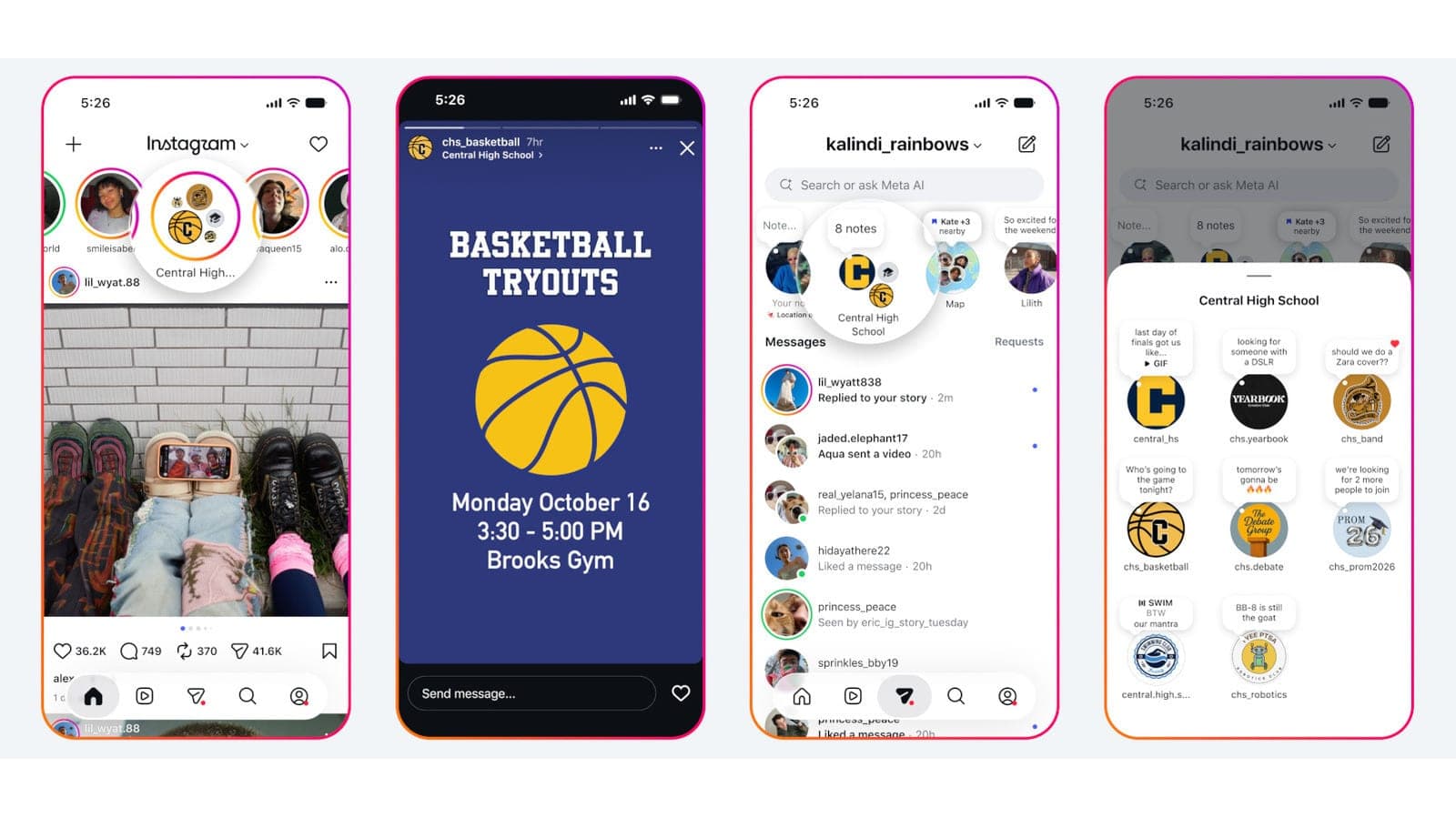
Instagram is turning individual school accounts into semi-private community hubs, with content visible only to verified students.
That's a meaningful shift from a public platform toward school-gated spaces, arriving as Meta faces sustained legal and regulatory pressure over teen safety across all its apps. Whether schools and parents see this as a genuine safety improvement or a deeper embedding of social media into school life will shape how far the program spreads beyond its current base of nearly 17,000 US schools.
What to know
- Instagram is expanding its School Partnership Program with private Stories, Notes, Channels, and a student directory visible only to verified students.
- Nearly 17,000 US schools have already joined the program, which launched in 2025 to prioritize cyberbullying reports from verified school accounts.
- Verified students get access to Clubs and Teams hubs, a student directory, and can add school banners to their profiles.
- Meta uses third-party verifier UNiDAYS, the same service Apple uses for student pricing, to confirm student identity before granting access.
- The expansion follows an August 2026 agreement between Meta and 52 state attorneys general adding further protections for younger users.
Instagram is turning verified school accounts into something closer to a private community space than a public feed, and nearly 17,000 US schools have already signed up.
What's changing
Meta is rolling out a set of new features to its School Partnership Program that let verified schools post and share content specifically walled off from the public app.
- Private Stories and Notes: school staff and students can post updates visible only to verified students at that school.
- Channels: administrators can share announcements directly with students and parents.
- Clubs and Teams: any school member can create a hub for a specific group, team, or activity.
- Student directory: verified students get access to a directory of classmates, along with the option to add a school banner to their profile.
The catch: none of this is public. Content posted through these tools stays visible only to verified members of that specific school community.
How the program got here
Meta launched the School Partnership Program in March 2025, initially focused on a narrower goal: giving verified school accounts priority review when they report bullying or harassment involving their own students, with Meta guaranteeing a response within 48 hours.
That original safety-reporting tool has now expanded into a full communication platform embedded inside Instagram itself, with private posting, directories, and school-branded community spaces.
By the numbers: nearly 17,000 US schools have joined since launch, all middle and high schools across the country have been eligible to sign up since the program moved past its initial pilot phase.
How verification works
Access to these private features isn't automatic. Meta verifies student identity through UNiDAYS, the same third-party service Apple uses to confirm student status for its own education pricing program.
Once verified, students gain access to school-specific content, the directory, and community features, while school administrators retain the ability to remove posts, Stories, and Notes that violate school or platform rules. Parents also get visibility into the process: Meta's Family Center notifies parents when a teen joins or leaves a school on the platform.
Built around the school day, not against it
Meta has specifically framed the new features as designed to avoid disrupting classroom hours, with parental controls available to manage when and how teens can use them. That framing responds directly to one of the most common criticisms of social media in schools: that it competes with instructional time rather than supporting it.
Why it matters: by positioning these tools as extracurricular and community-focused, things like club coordination, sports schedules, and school announcements, Meta is trying to make the case that deeper Instagram integration into school life is additive rather than a distraction.
The regulatory backdrop
This expansion doesn't arrive in a vacuum. In August 2026, Meta reached an agreement with 52 state attorneys general adding further restrictions specifically aimed at protecting younger users across its platforms, part of a broader wave of legal and regulatory scrutiny the company has faced over teen safety.
That agreement followed years of lawsuits and investigations into how Instagram and Facebook affect teen mental health, body image, and exposure to harmful content. Meta has consistently pointed to safety features, including Teen Accounts and now the expanded School Partnership Program, as evidence it's responding to those concerns rather than ignoring them.
The scale of the legal exposure here is significant. In October 2023, a bipartisan coalition of 42 state attorneys general sued Meta in federal and state courts, alleging the company knowingly built addictive features into Instagram and its other platforms specifically targeting children and teens.
That investigation had actually begun years earlier, with California's attorney general announcing a nationwide probe into the company's youth-targeted design choices back in November 2021. The lawsuits pointed to design choices like infinite scroll and near-constant notifications, arguing they were built with the explicit goal of hooking young users into compulsive use.
That litigation culminated in a landmark settlement: Meta agreed to pay $17 billion and commit to stronger child-safety measures across Facebook and Instagram to resolve claims brought by 47 states. The School Partnership Program's expansion arrives as part of that broader reform commitment, not as an isolated product decision made independently of the legal pressure driving it.
Teen Accounts as the foundation
The School Partnership Program doesn't operate in isolation. It sits on top of Instagram's Teen Accounts system, introduced in September 2024, which automatically places teen users into Instagram's most restrictive settings by default rather than requiring parents or teens to opt in manually.
What Teen Accounts already restrict: accounts are private by default, messaging is limited to people a teen already follows or is connected to, sensitive content settings are locked to their strictest level, and only connected accounts can tag or mention a teen in posts. Teens under 16 need a parent's permission to loosen any of those settings.
That existing restrictive foundation is what makes the School Partnership Program's new features possible without, in Meta's framing, reopening the platform to the kind of open contact and content exposure Teen Accounts were built to prevent in the first place.
The bigger picture: Meta says hundreds of millions of teens now use Teen Accounts across Instagram, Facebook, Messenger, and Threads, the restricted-by-default account type the company introduced as its primary response to youth safety criticism. The School Partnership Program expansion builds directly on that infrastructure, adding school-verified community features on top of accounts that are already more locked down by default.
What this means for schools considering it
For schools weighing whether to join, the pitch has gotten more substantial than the original bullying-reporting tool. A school that signs up now gets a semi-private communication channel to students and parents, built-in club and team coordination, and faster moderation response, features that might otherwise require separate apps or platforms schools would need to build, vet, and maintain themselves.
That convenience is also the tradeoff worth weighing. Schools adopting these tools are embedding a commercial social media platform deeper into official school communication and community life, a decision that carries its own set of questions around data, platform dependency, and whether student engagement with Instagram itself increases as a side effect of features meant to serve narrower school purposes.
Participation is voluntary, not mandated, which means adoption will likely vary widely by district and by how individual administrators weigh those tradeoffs. A school with an existing bullying problem and limited moderation resources might find the faster reporting response alone worth signing up for, independent of whether it ever uses the newer community features at all.
That variability also means the program's actual impact on student wellbeing will be hard to measure uniformly. A school that enables every feature, private Stories, Channels, the full directory, is making a very different bet than one that joins purely for the prioritized bullying-report pipeline and ignores the rest.
The bottom line
Instagram's School Partnership Program has evolved from a targeted anti-bullying reporting tool into something closer to a school-branded social layer sitting on top of the main app, and nearly 17,000 schools have already opted in.
Whether that expansion reads as genuine safety infrastructure or as social media further embedding itself into daily school life probably depends on how it's used in practice over the next school year, not just what the feature list says on paper today.
Key facts
- Schools enrolled
- Nearly 17,000 (US)
- Program launched
- March 2025
- New features
- Private Stories/Notes, Channels, student directory, Clubs and Teams
- Verification partner
- UNiDAYS
- Related agreement
- August 2026 deal with 52 state attorneys general
Got questions?
Quick answers, plain wordsWhat is Instagram's School Partnership Program?
A program Meta launched in March 2025 that lets US middle and high schools create verified accounts, giving them priority review when they report bullying or harassment involving their students, with responses guaranteed within 48 hours.
What's new in this expansion?
Schools can now post Stories and Notes visible only to verified students, create Channels to share updates with students and parents, set up Clubs and Teams as communication hubs, and give verified students access to a school directory and profile banners.
How many schools are part of the program?
Nearly 17,000 US schools have joined since the program launched in March 2025.
How does Instagram verify students?
Through UNiDAYS, a third-party identity verification service that also handles student verification for Apple's education pricing program.
Who can see the private school content?
Only verified students at that specific school, plus approved followers for certain features like the student directory. School administrators can remove posts, Stories, and Notes.
Are parents involved?
Yes. Parents receive notifications through Meta's Family Center when their teen joins or leaves a school on the platform, and the features are designed to avoid disrupting classroom hours.
How does this relate to Meta's other teen safety moves?
It follows an August 2026 agreement between Meta and 52 state attorneys general that added further restrictions protecting younger users, and builds on Meta's broader Teen Accounts initiative, which the company says now covers hundreds of millions of teens across Instagram, Facebook, Messenger, and Threads.
Is this only in the US?
Yes, currently. The program has been available to all US middle and high schools since expanding beyond its initial pilot phase.
SourcesEngadget
Topics and tagsMeta, AI safety, instagram, meta
Related stories

WhatsApp will now tell parents when their teen joins a group, but not what's said in it
WhatsApp launched optional parental controls for teen accounts, alerting parents when their teen joins or leaves groups while keeping actual messages end-to-end encrypted.

Why Black Twitter found a new home on Meta's Threads
Years after Elon Musk bought Twitter, a wave of Black creators and communities have found their footing on Threads, helped by features Meta built specifically for community building.

Apple's smart home hub reportedly launches October 13, with a camera that never records video
Bloomberg's Mark Gurman says Apple will announce its long-rumored smart home display on October 13. He also describes a companion home camera that sends text descriptions instead of video.
More in brief
- arXiv limits researchers to two papers a month as AI drives submissions to a recordOct 2
- California will fine robotaxi companies that block first responders for over 30 minutesOct 2
- Microsoft launches real-time transcription and new voice models for AI voice agentsOct 1
- Cloudflare releases Clef, open-weight AI models that make yes-or-no decisions fastOct 1
- GrayKey maker reportedly found a way around the iPhone's Inactivity RebootOct 1
- Fervo's Cape Station becomes the first enhanced geothermal plant to sell power commerciallyOct 1