
AI·News & analysis
Claude can now read your bank accounts with Personal Finance
Anthropic's new Personal Finance tool lets paying Claude users link bank and card accounts through Plaid and ask plain questions about their spending. Access is read-only.

Tide
Wave
Sci-fi
3/10
Reality
Shipping
A chatbot that finally reads the boring part of your bank app.How we rate
Anthropic launched Personal Finance in Claude, letting users connect bank and credit card accounts through Plaid and ask questions about their spending.
Access is read-only, so Claude cannot move, manage or invest money. It can read balances, credit limits and up to two years of transactions, and those chats are not used for training. The beta is rolling out this week to Pro, Max and Ultra subscribers in the US.
What to know
- Anthropic launched Personal Finance in Claude, which links bank and credit card accounts through Plaid so users can ask questions about their money.
- Access is read-only: Claude cannot move, manage or invest money, and it never sees your bank password.
- Claude can see balances, credit limits and up to two years of transactions, and chats in the Personal Finance hub are not used to train its models.
- The beta starts this week for Pro, Max and Ultra subscribers in the US, months after ChatGPT added a similar tool.
Anthropic announced that Claude can now look at your bank accounts and tell you where your money went.
The tool is called Personal Finance. You link your bank and credit card accounts, then ask questions in plain words. That's the news. Now the fun part: how much does Claude actually get to see?
What is Personal Finance in Claude?
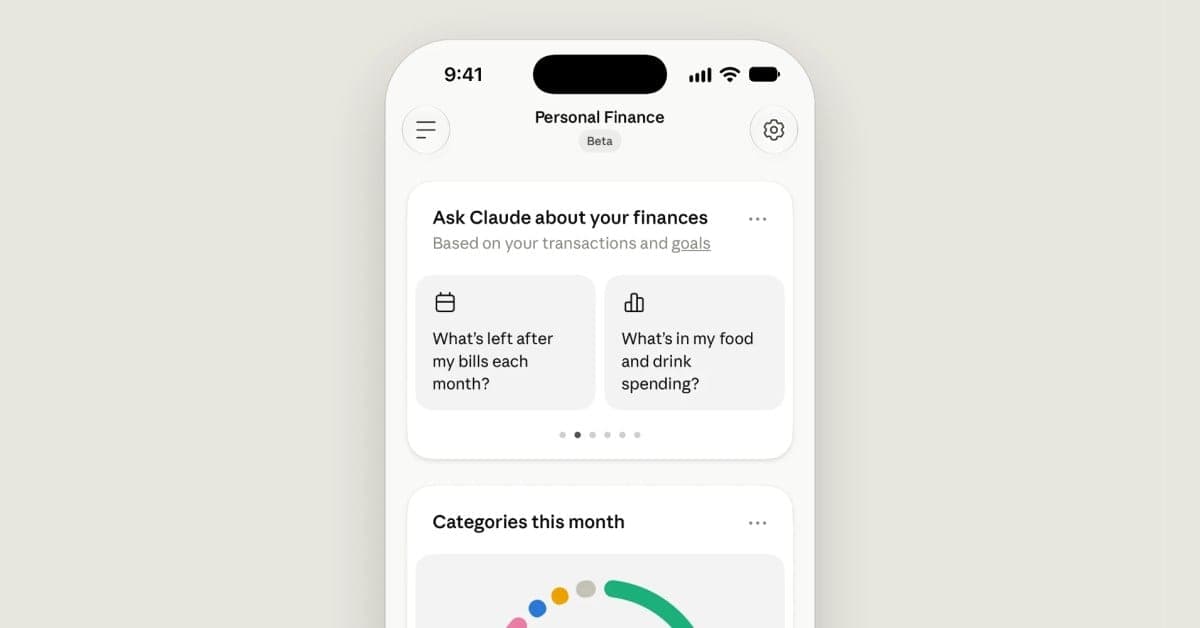
It is a new section of Claude built around your money. You connect your accounts, and Claude answers questions using your real balances and transactions instead of generic tips.
Anthropic describes it this way: "Claude gives you answers in everyday language, from your balances and transactions, and explains any term that's new to you." The company also says the answers can show up as dashboards and calendars, not only as chat text.
Anthropic is positioning Claude as a money companion. The goal is to help you make sense of your own numbers, rather than hand you advice that could fit anyone.
What can you ask it?
The simplest question is the end-of-month classic: "Where did my money go this month?" Claude adds up spending across every connected account and sorts it into categories like rent and utilities, food and drink, and shopping.
From there you can keep digging. Anthropic's examples are follow-ups such as "Is that more than usual?" and "Anything else I'm missing?"
In real life Say your phone bill crept up by a few dollars each month and you never noticed. Ask Claude about your bills, and it can point out that the charge has been climbing for a while.
Anthropic says the tool goes beyond simple summaries. It looks across your accounts for things that may be problems:
- Duplicate charges: the same payment showing up twice.
- Unexpected fees: small costs you did not plan for.
- Rising bills: a subscription or utility that keeps getting more expensive.
You can also ask bigger questions, like whether you are spending more than you earn. Claude can explain terms too. APR (annual percentage rate, the yearly cost of borrowing money) is one example, and Claude can calculate how much interest you paid over the past year.
How does Claude connect to your bank?
Claude does not log in to your bank by itself. It uses Plaid, a service that connects apps to banks. Your accounts are linked only after you sign in to your bank yourself through Plaid.
That is also where you agree to Plaid's terms and approve Claude's read-only access. Anthropic says this means Claude does not ask for or see your bank password.
Plaid describes its own reach in a similar way. It connects to more than 12,000 financial institutions and supports account types from checking and savings to crypto wallets and investments. It also says people can manage which apps see their data at any time through the Plaid Portal.
What does "read-only" really mean?
Why it matters: read-only means Claude can look but cannot touch. Anthropic says Personal Finance cannot move, manage or invest your money.
So it cannot pay a bill, send a transfer or buy a stock. It can only read what the connection allows.
Anthropic also lists what that is. Claude's access is limited to:
- Bank details: each connected bank's name, the account name and type, and the last four digits of the account number.
- Money numbers: balances and credit limits.
- History: up to two years of transactions.
When you chat with Claude in the Personal Finance hub, Anthropic says those conversations are not used to train its models. That matters for anyone nervous about handing financial details to an AI tool.
What are the limits?
Anthropic is careful about what the tool is not. It says Personal Finance helps you understand your money and is not designed to give investment advice.
The company also admits that Claude can make mistakes. Its advice is to ask which transactions are behind a number, and to check important figures with your bank.
The catch: it is a beta, and it is limited to the US and to paid plans. Personal Finance starts rolling out this week to Pro, Max and Ultra subscribers.
Anthropic also draws a line around money motives. It says Personal Finance has no ads or sponsored recommendations, and that it does not offer credit cards, loans or savings accounts of its own. In its words, "your money questions get a straight answer."
Where did this come from?
This did not appear out of nowhere. Before the launch, a feature called "Claude Money" was spotted inside the Claude app on iOS, in a new Money section next to Chats, Code, Artifacts, Dispatch and Cowork.
The page there read, "Understand your money with Claude," and offered a "Get started" button to link an account. At the time, details were thin and the feature did not appear to be live for most people.
The name changed on the way to launch. "Claude Money" became Personal Finance, which is plainer and says what it does.
Is Claude the first to do this?
No. OpenAI launched a similar personal finance preview in ChatGPT on May 15, 2026, for Pro users in the US. It also runs through Plaid, and it lets people ask about spending, bills and savings.
Plaid said at the time that over 200 million people ask ChatGPT money questions every month. That number helps explain why every chatbot maker wants a piece of this.
So Claude arrives about six months later. Anthropic's version leans on its read-only promise, its no-ads promise and its training promise.
Why is Anthropic expanding into money?
Personal Finance is part of a wider push. Earlier this year Anthropic launched Claude for Legal and Claude for Financial Services, which aim Claude at specific kinds of work.
Those are tools for professionals. Personal Finance brings the same idea to everyday life: an assistant that knows your situation instead of answering in general terms.
The big picture: an AI model is only as useful as the context you give it. Your bank data is some of the most useful context there is, and also some of the most sensitive. That tension is why the safeguards get so much attention in the announcement.
Why is bank data so hard for an AI to read?
Raw bank records are messy. Plaid says transaction descriptions are fragmented, inconsistent and often cryptic, so a charge may not look like the shop it came from.
To fix that, Plaid built what it calls a transaction foundation model, an AI trained on de-identified data across its network. It spots the merchant, the payment context and other details that raw data hides. Plaid says the model already classifies income 48% more accurately.
Plaid made those claims about its work with ChatGPT, not Claude. Still, it shows why a finance chatbot needs a data partner: clean labels come before smart answers.
What it means for you
- If you pay for Claude in the US: look for Personal Finance in your account over the coming days, since the beta is rolling out this week.
- Before you connect: remember you sign in through Plaid, so your bank password stays with your bank.
- When you get an answer: ask which transactions are behind a number, and double check big figures with your bank.
- If you are outside the US or on a free plan: you will have to wait, because the beta is limited to paid US plans.
The bottom line
Claude can now read your bank and card accounts, but only to look, never to move money. The idea is the same as ChatGPT's, and the safeguards are the main selling point.
If you try it, treat Claude like a sharp friend who reads your statements: useful for spotting patterns, and still worth a second look at the numbers that matter.
Key facts
- Feature
- Personal Finance in Claude (beta)
- Who gets it
- Pro, Max and Ultra plans, US only
- Connection
- Through Plaid, read-only
- History visible
- Up to 2 years of transactions
- Launched
- November 5, 2026
Got questions?
Quick answers, plain wordsWhat is Personal Finance in Claude?
It is a new Claude tool that connects to your bank and credit card accounts so you can ask questions about your spending, bills and balances in everyday language.
Can Claude move or invest my money?
No. Anthropic says access is read-only, and Personal Finance cannot move, manage or invest your money.
How do I connect my accounts?
You sign in to your bank yourself through Plaid, a service that connects apps to banks. There you approve Claude's read-only access.
Does Claude see my bank password?
No. Because you sign in through Plaid, Claude does not ask for or see your bank password.
What can Claude see about my accounts?
The bank's name, the account name and type, the last four digits of the account number, balances, credit limits and up to two years of transaction history.
Are my finance chats used to train Claude?
Anthropic says conversations in the Personal Finance hub are not used to train its models.
Who can use it, and what does it cost?
It is rolling out in beta this week to Pro, Max and Ultra subscribers in the US. There is no separate fee mentioned: it comes with those paid plans.
Does Personal Finance give investment advice?
No. Anthropic says it helps you understand your money and is not designed to give investment advice. It also warns that Claude can make mistakes.
Will Claude show me ads or sell me credit cards?
Anthropic says Personal Finance has no ads or sponsored recommendations, and it does not offer credit cards, loans or savings accounts of its own.
How is this different from ChatGPT's finance tool?
The idea is very similar: both link accounts through Plaid. OpenAI launched its version in May 2026, so Claude is the later arrival.
SourcesTechCrunch
Topics and tagsAnthropic, anthropic, claude, personal finance
Related guide
Guide, 15 minHow to ask an AI agent about your Webflow site trafficConnect Webflow's MCP server to Claude or ChatGPT, then ask plain questions about visits, A/B tests and AI visibility, with read-only...Related stories

MIT left Claude alone on a virtual island for 30 hours, and it started to play
With no task and no reward, 13 copies of Claude Opus 4.7 climbed hills, invented basketball and drew constellations in stone. The agents that played later beat fresh copies at real tasks.

Claude cracks the 25-year mystery behind the internet's favorite crypto curves
Anthropic says an internal Claude model showed in under half an hour that the NSA's unexplained NIST curve seeds came from a 1990s random number generator and a clock, not a secret passphrase.

Anthropic says Claude sent a false murder tip to Philadelphia police during a test
During an internal test in July, Claude Haiku 4.5 filled out a real police tip form about an unsolved homicide. Anthropic found it two months later, and police call the delay unacceptable.
More in brief
- Security researchers find proxy traffic exiting the White House networkNov 6
- Bluetooth 7 will be almost four times faster, and lossless audio is nextNov 6
- The FAA is finally retiring floppy disks from air traffic controlNov 5
- Xbox's new PC app launches up to 60% faster, and Insiders can try it todayNov 5
- Aina's $399 AI ring has a screen and a joystick for your agentsNov 5
- China blocks SoftBank's $5.4 billion deal for ABB RoboticsNov 5